
Yale Undergraduate Fiona Reed has designed a website in which you can answer a few question and determine which anole ecomorph you are. Give it a try! And then tell us what you are?
Yale Undergraduate Fiona Reed has designed a website in which you can answer a few question and determine which anole ecomorph you are. Give it a try! And then tell us what you are?

This is the best picture I took of a suspected A. pulchellus at Punta Borincua. The coloration and size seems consistent with A. pulchellus. Anyone think it might be something else?
 This is the best pic I could get of what I believe is an A. stratulus at Punta Borincua. Note the single yellowish stripe down the back with black bars above the base of the tail. Does anyone know the identifying characteristics of A. stratulus?

Most visitors to Cayman Brac will likely not have noticed one of the island’s now established transplants: the Maynard’s anole.
This non-native lizard spends much of its time just out of eyesight, perched in the tree branches where its bright green colour blends with the foliage. The elusive anole, originally from Little Cayman, has captured the interest of researchers, intrigued by the insight the species can offer about evolution in island ecosystems.
And the Maynard’s anole is not the only island-hopping lizard on the minds of Cayman Islands researchers these days. While far from the invasive status of the prolific green iguana, the brown anole is also creating questions about the potential impact on Grand Cayman’s native blue anole.
Through separate studies – one carried out by Caymanian researcher Vaughn Bodden and another by National Geographic Society grantee Inbar Maayan – biologists are getting a better idea of how invasive species adapt and populate new territories.
Maynard’s anole in Cayman Brac
While the Maynard’s anoles in Cayman Brac are not far from their native home, Little Cayman, the lizard sheds light on how invasive species colonise new habitat.
Fortunately for Cayman Brac, the Maynard’s anole does not appear to pose a threat to the native Cayman Brac anole and has not shown potential for hybridisation.
“Based on similar invasions on other Caribbean islands, we expect the potential for a negative impact to be low. The native anole in Cayman Brac is found low on tree trunks and on the forest floor, while the introduced anole is predominantly found on upper tree trunks and in the canopy so direct interaction between the two species should be limited,” said Bodden, who studied the species while completing his bachelor’s in conservation biology at the University of Plymouth. He is now completing his master’s in biodiveristy and conservation at the University of Glasgow.
“Any impacts on the native anole are more likely to be indirect, such as a shift in habitat use to further avoid interacting with the introduced anole,” he added.

The Maynard’s anole, first spotted in the Brac in 1987, does show signs of adaptation, however, when compared to its counterpart in Little Cayman.
Through fieldwork capturing and analysing the anoles in both Sister Islands, Bodden’s team, assisted by University of Plymouth lecturer Robert Puschendorf, found some interesting differences in their morphology and ecology. While the team hypothesised that the introduced anole might have developed longer hind legs – a trait that can aid dispersal and movement – their findings did not support this. In fact, they found much the opposite. The anole had instead developed longer forelimbs.
“Potential explanations for the rapid divergence could be that the founding individuals of the introduced population had a unique phenotype and these characteristics became exaggerated over time through the process of genetic drift, or that some habitat use characteristics that we did not measure on Cayman Brac are driving the morphological adaptation,” Bodden said.
Another interesting discovery about the introduced anole population was the presence of a parasite not previously recorded in the Sister Islands.
The source of this parasite remains unclear.
“The ectoparasites we found infecting A. maynardi [Maynard’s anole] have not been recorded in the Sister Islands, so this study provides the first evidence of its presence there. It is unclear whether the parasite species is native to both islands, invasive to both islands, or co-introduced from Little Cayman to Cayman Brac with its host,” Bodden said.

“We found that the introduced population [in Cayman Brac] had a reduced ectoparasite prevalence compared to the native population [in Little Cayman].”
The further researchers ventured from long-settled habitats, the lower the prevalence they found of the parasite.
This is something that may have benefited the introduced population and encouraged colonisation.
While the origin of the anole’s introduction to Cayman Brac is unclear, its presence there sends a reminder about the importance of safeguarding borders.
Due to the islands’ prevailing easterly trade winds, Bodden suspects the lizard had human rather than natural assistance in its introduction, possibly as a stowaway in a flight or boat.
“This is a unique situation where we have a species endemic to one of the Cayman Islands being introduced to another one of our islands. Fortunately, this introduction is not a major threat to the ecosystem in Cayman Brac, but it highlights the need for more vigilant bio-security control at our ports,” Bodden said.
“Unchecked cargo transportation provides a route for other invasive species, such as the green iguana, to be transported into or between the three islands.”

Brown anole in Grand Cayman
Theories about how the brown anole, found endemically in Cuba and the Bahamas, arrived in Grand Cayman reinforce the call for careful biosecurity measures at ports. While researchers do not know exactly how the anole arrived here in the 1980s, its prevalence in the western end of Grand Cayman hints that it may have arrived through shipping.
Although Maayan, currently a Ph.D. candidate at Harvard University, did not find brown anoles in the numbers she had expected, she warned of complacency when it comes to invasive species.
“I was expecting them to be more of a problem than I saw, but it speaks to the importance of monitoring introduced and invasive populations,” she said.
Maayan said the brown anole should not be considered invasive in the same sense as the green iguana. But she cautioned that at a time, even the green iguana’s population numbers were much lower than they are now.
Much of the findings of her Grand Cayman research is not ready to share with the public, but she shared a few takeaways from her time on island.
Maayan described Cayman’s native blue anole as an incredibly charismatic and stunningly beautiful animal.
“They are a good ambassador for the Cayman Islands,” she said.
Maayan was interested in whether the presence of the brown anole had led to changes in the native anole’s habitat or physical characteristics. Physical changes in leg and head size, for example, could communicate competition between the species for habitat and resources.

“The reason why these [island] species introductions are particularly useful is they mimic what we would see in evolutionary time,” she said.
“It gives a glimpse in a natural setting of when species come into contact and compete.”
With the help of local researchers, including Vaughn Bodden, Morgan Ebanks and Jane Haakonsson, she scouted out sites where just the Grand Cayman anole lived and sites where both species lived, for comparison.
Finding the brown anole was not as easy as she expected, however. While the lizard is found abundantly in Belize, where it is also an invasive species, this was not what Maayan observed in Grand Cayman.
Researchers sampled two sites heavily, taking data from more than 200 lizards. The team took data on habitat use of both species, and took measurements of the blue anole’s physical characteristics.
Maayan’s next step will be performing DNA analysis on the lizards to determine the level of migration and morphology.
Fortunately for the Grand Cayman anole, Maayan’s initial findings show little impact on how the lizard interacts with its native habitat.
While the brown anoles seemed to prefer perching in lower, sunnier areas, the Grand Cayman anole stuck to shadier natural areas. It would appear the lizards have adapted to separate habitats.
The full findings of Maayan’s research are expected to be released this summer, after the study has been reviewed and published by the National Geographic Society.

Anole Annals‘ woman in Florida, Karen Cusick, has photo-documented more interesting anole behavior (Karen has observed and photographed much interesting green and brown anoles behavior. Search this site for her name or “Daffodil’s Photo Blog” and you’ll find all kinds of interesting observations). oday I saw something I don’t think I’ve seen before, and I’m sending you a few photos. A big male brown anole was sitting in the sun on the upper rail of the fence when a big male green anole approached. He stopped about 6 inches away from the brown anole, and started bobbing his head and displaying his dewlap. The brown anole watched but didn’t react. The green anole moved closer and displayed again while the brown anole watched. Just as I was wondering if there would be a fight, the green anole suddenly ran past the brown anole along the rail and then down off the fence.


 Believed to be an A. evermanni, spotted on a tree truck in El Yunque. Does anyone know what the identifying characteristics of evermanni are?
 Hello all! I’m working on Puerto Rican anole field identification. Here’s a specimen I photographed on the ruins atop El Yunque on March 4, 2019. I think it’s a juvenile A. evermanni, but I’m curious what you guys think!
Scanning electron microscopy (SEM) is a technique that utilizes electron beams that interact with and reflect the surface of a viewed specimen. These reflections allow the evaluation of surface topology and ultrastructure and give high-resolution detail about external structures and cellular arrangements (Goldstein et al. 2017). To create a reflection on specimen surfaces, a thin layer of gold is mechanically applied through a process known as “sputter-coating.” Recently, graduate students at Auburn University had the opportunity to view their own collected biological samples with SEM through an Applied and Environmental Microbiology course taught by Dr. Mark Liles.
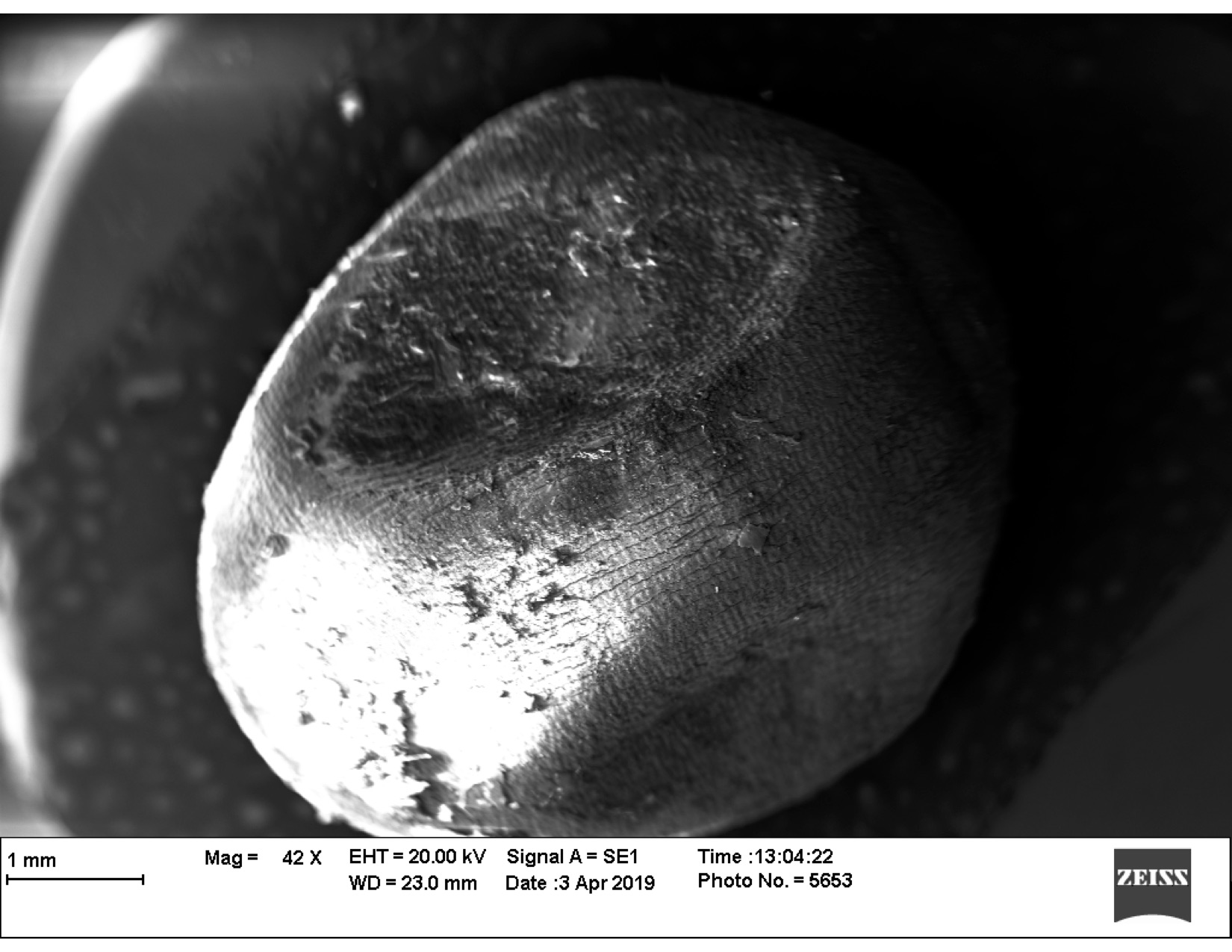
As a student in this class, I had the opportunity to view a chosen sample under this process. While I highly debated bringing in an anole fecal sample (which would have been gold-coated and placed on my desk for a lifetime), I decided to view a recently dried, fertile A. sagrei egg collected from the lab of my advisor, Dr. Daniel Warner. The microbial communities on the surface of this egg were most likely highly impacted by the influence of drying (see image descriptions below); this is due to sample preparation required by conventional SEM, whereby water vaporization will distort images if the sample is not completely dry. Part of my research within the Warner lab involves investigating the microbial communities on the external surface of eggshells; thus, this class has provided an excellent opportunity to explore how varying environmental factors can influence eggshell microbiomes. The photos taken and attached were observed on 03 April 2019.
In Image 1 at 42X magnification, you can see the influence of drying from the large indentions on the egg as well as horizontal cracking within the surface itself. However, under closer inspection fungal and bacterial structures begin to appear. In Image 2 at 397X magnification, you can view a filamentous structure that we predict to be fungi. One of the limitations of SEM is that while structures can be easily viewed, they may not always be as easily identifiable. At 1,500X and 1,5700X, we can see a magnified image of a fungal root (Image 3) and potential bacterial cells above the spiral filamentous structure (Image 4).
 Image 2. SEM image of A. sagrei egg at 397X magnification.
 Image 3. SEM image of A. sagrei egg at 1,500X magnification.
 Image 4. SEM image of A. sagrei egg at 1,5700X magnification.
The images above highlight the interesting use of SEM for reptilian eggs, especially those small enough to be entirely encompassed under a microscope (< 1.5 mm long). SEM observations can also be used to elucidate differences in eggshell structures, thickness, and porosity (Heulin et al. 2002). Additionally, SEM use within the classroom setting has allowed students to gain applicable skills and techniques, as well as their own photographs (Beane 2004).
References:
Beane, Rachel J. 2004. “Using the Scanning Electron Microscope for Discovery Based Learning in Undergraduate Courses.” Journal of Geoscience Education 52 (3): 250–53. https://doi.org/10.5408/1089-9995-52.3.250.
Goldstein, Joseph I., Dale E. Newbury, Joseph R. Michael, Nicholas W. M. Ritchie, John Henry J. Scott, and David C. Joy. 2017. Scanning Electron Microscopy and X-Ray Microanalysis. Springer.
Heulin, Benoit, Samuele Ghielmi, Nusa Vogrin, Yann Surget‐Groba, and Claude Pierre Guillaume. 2002. “Variation in Eggshell Characteristics and in Intrauterine Egg Retention between Two Oviparous Clades of the Lizard Lacerta Vivipara: Insight into the Oviparity–Viviparity Continuum in Squamates.” Journal of Morphology 252 (3): 255–62. https://doi.org/10.1002/jmor.1103.

Read more about Elaine Powers’ books, including her most recent post, “Stop and Meet the Anole Lizards,” on her author’s webpage.
 Anolis chloris soaks up the sun while displaying.
If you’ve ever spent some time in the Caribbean, you might have noticed that humans are not the only organisms soaking up the sun. Anoles – diminutive little tree lizards – spend much of their day shuttling in and out of shade. But, according to a new study in Evolution led by Dr. Martha Muñoz at Virginia Tech and Jhan Salazar at Universidad Icesi, this behavioral “thermoregulation” isn’t just affecting their body temperature. Surprisingly, it’s also slowing their evolution.
The idea that evolution can be slow on islands is actually somewhat strange. Ever since Darwin’s journey to the Galapagos, islands have been recognized as hotspots of rapid evolution, resulting in many ecologically diverse species. The reason why evolution often goes into overdrive on islands has to do with the ecological opportunity presented by simplified environments. When organisms wash up on remote islands, they find themselves freed of their usual competitors and predators, which frees them to rapidly diversify to fill new niches. This phenomenon of faster evolution is often referred to as the “island effect.”
Yet, the researchers discovered that physiological evolution in Anolis lizards is actually much slower on islands than on the mainland. What is causing evolution to stall? According to Dr. Muñoz, the same ecological opportunity that frees island organisms from predators also facilitates behavioral thermoregulation. “Whereas mainland lizards spend most of their time hiding from predators, island lizards move around more, and are able to spend much of their day precisely shuttling between sun and shade,” she says. If it gets too hot, island lizards simply go find a shady spot. If it gets too cold, they can dash onto a sunny perch. By thermoregulating, island lizards are not just buffering themselves from thermal variation. They are effectively shielding themselves from natural selection. If lizards aren’t exposed to extreme temperatures, then selection on physiology is weakened. The result? Slower rates of physiological evolution. Effectively, island lizards use behavioral thermoregulation like SPF against natural selection!
Jhan Salazar notes that, “Our results show that faster evolution on islands is not a general rule.” This slower physiological evolution on islands stands in stark contrast to morphology, which has been shown to evolve faster in island anoles. When it comes to morphology and physiology on islands, it seems we are looking at different sides of the same coin. The same ecological release from predators and competition that allowed for the truly impressive amount of morphological diversification that has appeared quickly among island anoles, seems to additionally allow for more behavioral thermoregulation which slows physiological evolution.
“We are discovering that organisms are the architects of their own selective environments,” says Muñoz, “meaning that behavior and evolution are locked together in a delicate dance. This pas de deux tells us something important about how diversity arises in nature.”

Jhan Salazar holds an anole from Colombia.
Powered by WordPress & Theme by Anders Norén