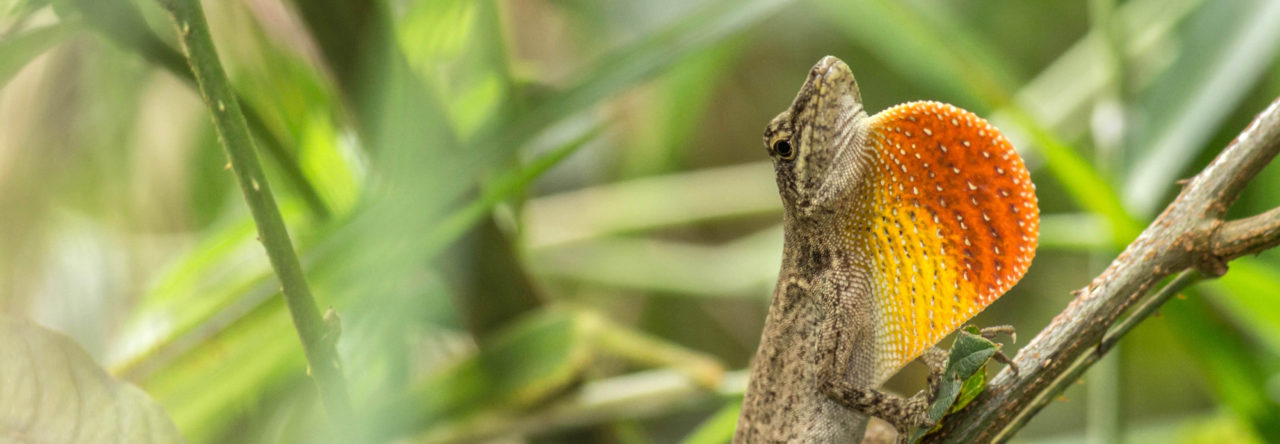
Professor of Biology and Director of the Living Earth Collaborative at Washington University in Saint Louis. I've spent my entire professional career studying anoles and have discovered that the more I learn about anoles, the more I realize I don't know.
Abstract: Courtship and mating events in Mexican Anolis species have been reported mainly in captive conditions. Herein, we report a field observation of the mating behaviour of A. quercorum on a coffee plant, in the Sierra Madre del Sur, Oaxaca. Neck biting by the male, positioning on the female, head waving, copulation/intromission, as well as dislodging and retreat behaviours were observed in the wild. The mating duration was 25 minutes, which is within the reported period in the related A. punctatus. Future studies should improve and build on courting and mating observations to clarify if the observation duration reported here is part of the typical behavioural repertoire of A. quercorum.
Photo from https://www.pinterest.com/pin/female-green-anole-mating-behavior–73183562679637586/
Long time AA stalwart Pat Shipman writes:
Just a random observation of anoles in my North Carolina. I believe all to be A. carolinensis as might be expected. For the first time since I moved here, I came upon two individuals mating. They had turned chocolate brown instead of their usual leaf green. I didn’t disturb them & couldn’t get to my camera fast enough to take a photo. If this color change unusual? It is tempting to think they were so pleased at having sex that they changed color.
Reader Gary Owen Dick (see also this post on a yellow anole he found) writes from near Dallas: Took some pics the other day of a female green anole shedding. What intrigues me is the blue coloration on the inner side of the backlit pieces of the loose stratum corneum seen at these angles. Is this a structural thing, or a camera illusion?
You’ve likely seen this common lizard. Why it changes color | ECOVIEWS
Whit Gibbons
Contributor
May 1, 2026, 3:45 a.m. CT
One of the most commonly seen lizards in the Southern states is the green anole, also known as the North American green anole or Carolina anole. (Its scientific name is Anolis carolinensis.) Although more than 400 species of anoles are known to science, the green anole is the only one native to the United States. Most people appreciate seeing them in their yards.
Q. A type of lizard we have in Birmingham, Alabama, is sometimes green and sometimes brown. I know it is not two different lizards because I have watched one change from brown to green. Are these a type of chameleon that can change skin color to match their surroundings?
A. No. Anoles are in a different family of lizards from Old World chameleons. Those are the ones famous for being able to change skin color based on the background, thus creating a true camouflage. In green anoles color change is a response to external factors, such as temperature and humidity. It may also be influenced by hormonal changes.
Whether lizards experience emotions comparable to humans remains a mystery. Researchers continue to investigate why anoles change color, as well as what purpose that change serves for the individual lizard. Most anoles found hidden under bark or leaves on cool days will be brown. If you pick up a brown one and hold it, it will usually turn green.
To learn more, I contacted Tom Jenssen, an expert on the subject of color-changing behavior in green anoles.
During his career as a professor at Virginia Tech, Tom observed thousands of green anoles while conducting research on the species. His observations confirmed categorically that the color of a green anole has nothing to do with what the lizard is standing on. One on a green leaf can be brown; one on dark soil can be green.
He indicated that factors causing a green anole to exhibit the brown color phase are not completely understood but he explained the biological mechanism.
“Color-shifting comes from melanophore activity over a subdermal layer whose structure reflects green wave lengths.” In other words, the concentration of black or brown pigment cells determines the color exhibited. If the pigment cells are large, they obscure a lower level in the skin that reflects green light. When the cells are concentrated, the lizard looks dark brown, mottled brown or even like a bad bruise of blotchy brown and olive-green. If the pigment cells contract in size, the lower level is exposed, and the lizard appears green.
He further noted that the activity of pigment cells and their concentration are controlled by the endocrine system, the glands that affect hormones and mood changes for many animals. The remaining biological mystery: What triggers the endocrine system to cause the pigment cells to contract or expand? Body color in anoles is highly complex, with no simple answer for why an individual is a particular color at any given time.
Social interactions with other lizards may be responsible in some cases. Brown coloration could possibly result in faster warming of the body on a cool sunny day.
Q. Why do these lizards that can change from brown to green sometimes have a bright red throat?
A. Male green anoles use the vivid red throat fan, or dewlap, to challenge other male anoles and sometimes even other animals. The dewlap display is often accompanied by push-ups and head-bobbing. An invasive species from Cuba, the brown anole, now found in Florida, Georgia and Alabama, has an orange dewlap.
Next time you see a green anole displaying a red throat, take a moment to watch its performance. Who is its audience? Is it another anole in the vicinity — or is it you?
Native green anoles are completely harmless and offer fun outdoor entertainment. Enjoy watching them stalk bugs and interact with each other. They are indicative of a healthy environment and deserve our appreciation wherever we find them.
Whit Gibbons is professor of zoology and senior biologist at the University of Georgia’s Savannah River Ecology Laboratory. If you have an environmental question or comment, email ecoviews@gmail.com.
Despite being misunderstood, Green Anoles remain adaptable and present in North Georgia. Photo by Riley Hansen.
With spring weather on the rise, green anoles, a small lizard species native to the southern portion of the United States, are returning to Georgia in large numbers. Anolis Carolinensis is known as a “trunk-crown ecomorph,” meaning they can change colors from shades of brown and green depending on their temperature and stress level.
Lily Grace Smith, a UNG freshman with a concentration in sustainability, said, “I have experience with green anoles because they like to hide in my house a lot. I live near a creek in a forested area, so I come into contact with them frequently. They are seen as scary because they like to jump around a lot to try to escape, but if you hold them by softly holding right under their head, you can release them.
Lily Grace Smith, a holding a green anole she caught. Photo by Lily Grace Smith.
The Green Anole also faces many challenges through deforestation and predation. Green anoles originally inhabited the low-level brush of forests and gardens but were pushed into the higher topiary region by their invasive neighboring species, the brown anole, a non-native species native to the Caribbean that was introduced in the late 1800s.
“I’m glad I’m seeing them around because they regulate the insect population and also keep their predators around,” Smith said. “I wish people would save them and, if possible, make tiny habitats for them (keeping leaf litter, brushes, vertical spaces for them to bask on).” – Lily Grace Smith, UNG Freshmen Environmental Spatial Analysis Major
With limited research on the specific predators impacting the green anole populations, researchers are studying specific instances of predation that have appeared due to the introduction of other non-native species such as carnivorous plants.
In a publication from Herpetological Review, authors Daniel A. Warner and Patrick Thompson of Auburn University said, “Although Interactions between these two species are probably rare, the native ranges of ‘A. carolinensis and D. muscipula overlap in areas of North Carolina and South Carolina, USA, suggesting that A. carolinensis is a potential source of nutrients for this carnivorous plant. In addition, the small size of the D. muscipula restricts prey to relatively small individuals, and its small native range restricts the impact of this predator to a limited area.”
Gallery • 6 Photos (you’ll have to go to the online article to see them all!). Green Anoles are often kept as pets in the South, and proper equipment and handling are vital for their survival. Photo by Riley Hansen.
“The characteristics of invasive species alone cannot explain the establishment of invasive populations,” Maya A. Jackson of Xavier University of Louisiana and Sonny S. Bleicher of Xavier University of Louisiana and Loyola University of New Orleans, in a study covering Behavioral Plasticity said, “Anoles, irrespective of species, appear to act more agonistically in urban zones. However, the two species of anoles vary greatly in their behaviors and reveal a more complex balancing act of ritualistic signaling.”
Despite these challenges, the green anoles’ adaptability and rapid evolution have assured their return to houses, schools and communities of the south this spring.
Mashpi Chocolate sustainability farms chocolate to help preserve nature in Ecuador. And anoles are doing their part. As they say on their website: “All the ingredients we use in Mashpi Chocolate are grown in an agroecological and regenerative way, next to cocoa trees and within edible forests….We created this chocolate to preserve a native forest reserve, restore degraded areas and generate opportunities in the magical territory of the Andean Chocó….The beauty of coffee is that it is planted under the shade of other trees, providing a habitat for many other species. We use high-altitude coffee as it has a special set of aromas and a characteristic taste that makes me want more!”
As for anoles, decide for yourself which species! Perhaps the fabulous Reptiles of Ecuador‘s Anolis webpage can help!
And many thanks to the Missouri Botanical Garden’s Carmen Ulloa Ulloa for not only tipping AA off to this, but providing a delicious sample!
The very first Anole Annals post in November 2009, a poem by AA stalwart Yoel Stuart.
This all started with an innocent query: how long has Anole Annals been around? This led to a series of questions answered–for the most part accurately–by chapgpt. Unfortunately, the links didn’t copy, but if you want to go to the posts mentioned below, look at Chatgpt’s transcript of our conversation.
So with that, here goes:
when did Anole Annals debut?
The blog Anole Annals effectively debuted on November 21, 2009. The first post—written by Jonathan Losos—contained several anole-themed haikus by Yoel Stuart.
A few additional details about the early history:
Nov 21, 2009: First post published (the haiku post).
2009–2010: Only a couple of posts appeared initially.
Late October 2010: The blog began posting regularly and “really got rolling.”
The site was created collaboratively by Losos and Richard Glor, with the goal of serving as a clearinghouse for research, news, and observations about Anolis lizards.
So the short answer:
Launch / first post:21 November 2009
Regular activity: mostly from late 2010 onward
If you’d like, I can also reconstruct the very earliest posts and contributors from 2009–2011—they give a pretty fun picture of how the blog community got started.
Giant Cuban anoles have found footholds in habitats across Florida thanks to expanding human development over the past decades.
But it’s unclear whether the reptiles can push into Georgia or if the introduced reptiles may be near the edge of their potential range.
“Jacksonville might be suitable, even though one might be surprised that they can get so far north,” said Alexander Romer, a quantitative ecologist at the University of Florida’s Fort Lauderdale Research and Education Center who works with the interagency Everglades Invasive Reptile and Amphibian Monitoring Program (EIRAMP).
A biology student was the culprit behind the first introduction of Cuban knight anoles in 1952 to the campus of the University of Miami’s north campus in Coral Gables. They have since spread throughout much of the state—especially in urban areas. These lizards are much larger than most anoles, stretching up to 20 inches long, including their tails. They are striking, with vibrant green bodies, yellow stripes with black speckles and baby-blue mascara-like eye shadowing.
Knight anoles gravitate toward human settlements. Credit: Joshua Rapp Learn
Their ecological impact isn’t completely certain yet, but scientists have observed them eating some imperiled vertebrates, such as Florida tree snails (Liguus fasciatus). They also likely eat federally endangered Florida tiger beetles (Cicindelidia floridana) and Schaus’ swallowtail butterflies (Papilio aristodemus). “We know that they do eat butterflies,” Romer said. “They do eat beetles.”
In a study published recently in Ecology and Evolution, Romer and his colleagues examined the factors that characterized suitable habitat for knight anoles in Florida and compared them to the factors that predicted occupancy in their home range of Cuba.
Citizen scientists track anoles
To conduct the study, the team relied on citizen science reports gathered from the Global Biodiversity Information Facility, a database that corrals information from platforms like iNaturalist together with museum specimen data.
They also used data that EIRAMP collected during reptile surveys in southern Florida in the Everglades Cooperative Invasive Species Management Area.
The models that they developed predicted knight anoles gravitated toward different ecological factors in Florida as opposed to Cuba. In Florida, for example, urbanization was the strongest predictor of knight anole presence, which wasn’t the case in Cuba.
Knight anoles prey on native invertebrate, some of which are imperiled. Credit: Alexander Romer
While their study didn’t examine why Florida knight anoles gravitate more toward human settlement, Romer said it might have to do with the novelty of the environments and the level of disturbance there compared to Cuba. “Disturbed habitats likely have more open niches,” he said. “There are [fewer] predators, less competition.” In Cuba, meanwhile, the ecosystems might function better, with more predators that control the expansion of knight anoles.
So far, knight anoles have been seen in most eastern coastal cities in Florida and some western coastal cities. They are found all the way north to St. Augustine, but the models predicted the heat island impact in Jacksonville has likely made that city warm enough for the lizards, though they haven’t yet spread there, according to records.
Romer still hesitates to call knight anoles invasive rather than just introduced at this point, despite their potentially negative impact on several imperiled invertebrates. But this research shows that developing or disturbing habitat only helps them spread.
“Conserved habitat is precious,” he said. “When you disturb habitat, you’re facilitating invasive species. When you protect it, you’re protecting native species.”