
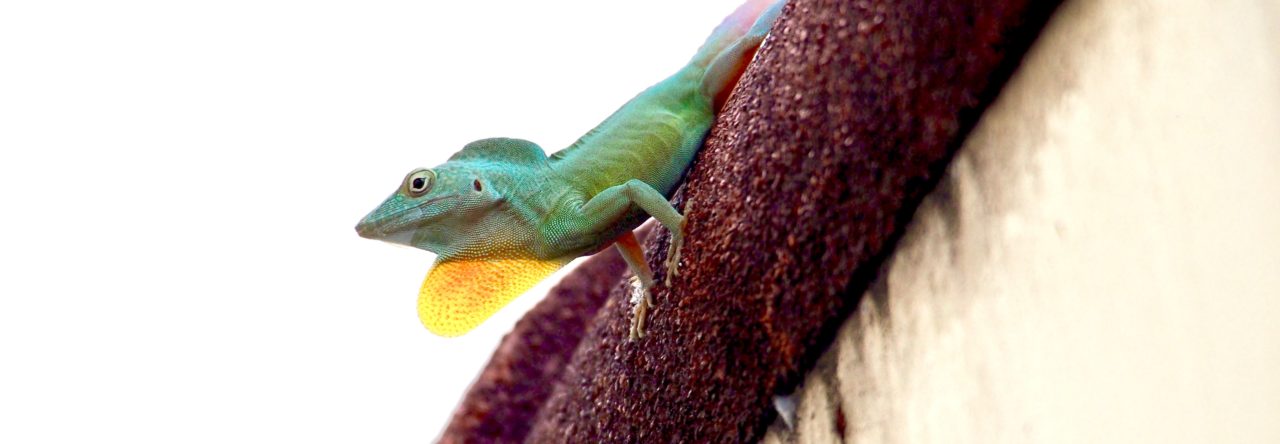
Knight Anoles Spreading through Florida–Will They Get to Georgia?

Cuban knight anoles were introduced to Florida in the 1970s. Credit: Alexander Romer

from the Wildlife Society:

Florida towns facilitate spread of knight anoles

Giant Cuban anoles have found footholds in habitats across Florida thanks to expanding human development over the past decades.

But it’s unclear whether the reptiles can push into Georgia or if the introduced reptiles may be near the edge of their potential range.

“Jacksonville might be suitable, even though one might be surprised that they can get so far north,” said Alexander Romer, a quantitative ecologist at the University of Florida’s Fort Lauderdale Research and Education Center who works with the interagency Everglades Invasive Reptile and Amphibian Monitoring Program (EIRAMP).

A biology student was the culprit behind the first introduction of Cuban knight anoles in 1952 to the campus of the University of Miami’s north campus in Coral Gables. They have since spread throughout much of the state—especially in urban areas. These lizards are much larger than most anoles, stretching up to 20 inches long, including their tails. They are striking, with vibrant green bodies, yellow stripes with black speckles and baby-blue mascara-like eye shadowing.

Knight anoles gravitate toward human settlements. Credit: Joshua Rapp Learn

Their ecological impact isn’t completely certain yet, but scientists have observed them eating some imperiled vertebrates, such as Florida tree snails (Liguus fasciatus). They also likely eat federally endangered Florida tiger beetles (Cicindelidia floridana) and Schaus’ swallowtail butterflies (Papilio aristodemus). “We know that they do eat butterflies,” Romer said. “They do eat beetles.”

In a study published recently in Ecology and Evolution, Romer and his colleagues examined the factors that characterized suitable habitat for knight anoles in Florida and compared them to the factors that predicted occupancy in their home range of Cuba.

Citizen scientists track anoles

To conduct the study, the team relied on citizen science reports gathered from the Global Biodiversity Information Facility, a database that corrals information from platforms like iNaturalist together with museum specimen data.

They also used data that EIRAMP collected during reptile surveys in southern Florida in the Everglades Cooperative Invasive Species Management Area.

The models that they developed predicted knight anoles gravitated toward different ecological factors in Florida as opposed to Cuba. In Florida, for example, urbanization was the strongest predictor of knight anole presence, which wasn’t the case in Cuba.

Knight anoles prey on native invertebrate, some of which are imperiled. Credit: Alexander Romer

While their study didn’t examine why Florida knight anoles gravitate more toward human settlement, Romer said it might have to do with the novelty of the environments and the level of disturbance there compared to Cuba. “Disturbed habitats likely have more open niches,” he said. “There are [fewer] predators, less competition.” In Cuba, meanwhile, the ecosystems might function better, with more predators that control the expansion of knight anoles.

So far, knight anoles have been seen in most eastern coastal cities in Florida and some western coastal cities. They are found all the way north to St. Augustine, but the models predicted the heat island impact in Jacksonville has likely made that city warm enough for the lizards, though they haven’t yet spread there, according to records.

Romer still hesitates to call knight anoles invasive rather than just introduced at this point, despite their potentially negative impact on several imperiled invertebrates. But this research shows that developing or disturbing habitat only helps them spread.

“Conserved habitat is precious,” he said. “When you disturb habitat, you’re facilitating invasive species. When you protect it, you’re protecting native species.”

It’s Not What You Eat, It’s Where You Deplete: Resource Competition between Introduced Lizards in Hawaii

Left: gold dust day gecko handling a spider in the vegetation. Center: green anole handling a moth. Right: brown anole surveying the ground.

Or, “Prey depletion by a predator guild suggests spatial differences in competitive ability, but not prey partitioning, consistent with functional trade‐offs.”

Anole biologists may take for granted that anoles compete. We have plenty of evidence, after all, for the phenomenon of interspecific competition — when comparing populations in sympatry vs. allopatry, we often see reductions in fitness, shifts in resource use, or trait evolution to minimize resource use overlap. It may surprise you, then, that we actually have relatively little insight into the mechanisms of competition in Anolis: what resources do anoles actually compete for (e.g. food or space), and how (e.g. exploitation or interference)? If you don’t believe me, pull out your copy of Lizards in an Evolutionary Tree and read page 2291.

Understanding mechanisms is important because it allows us to make predictions for the outcomes of species interactions in different contexts. I have long wanted to know whether green anoles (Anolis carolinensis) are likely to persist in Hawaii following the introduction of brown anoles (Anolis sagrei) and gold dust day geckos (Phelsuma laticauda). My initial work in this system was directly out of the classic Anolis playbook: enclosure experiments looking at traits, resource use, and fitness under controlled resource availability in allopatry vs. sympatry2,3. In other words, I was focused mainly on documenting the phenomenon of competition. At some point it clicked that in order to answer the question I cared about the most — the potential for long-term coexistence — I needed to identify the mechanisms of competition, and how species differences in competitive ability may translate into coexistence in this system.

Our latest experiment was grounded in mechanistic theory for consumer-resource interactions developed by Tilman4, R* theory. The key insights from this body of theory are that exploitation competition comes down to who can suppress shared limiting resources to the lowest levels under different conditions, and that the ability to suppress resources should be predictable from consumer traits. Designing experiments from this perspective caused me to shift from measuring resource use overlap (i.e. diet, perch height, body temperature), to measuring prey populations, lizard demographics, and lizard foraging rates.

While R* theory is foundational, general, and from the golden age of ecology — when there was great optimism about the potential for simple theory to explain community dynamics — empirical tests of R* predictions have previously been limited to microbes, microfauna, and grassland plants. This is probably because it is a ton of work to collect the necessary data, and we only had a chance at success in a system of vertebrate, mobile predators because of the many decades of work on anoles. Our core field team (myself, Spencer Alascio, and Jose Carranza), aided by a large cast of volunteers, spent multiple days in the field every single week for over a year. 29,000 arthropods measured5, 3,000+ mark-recaptures of lizards6, and over a 100 hours of focal lizard observations later7, we got our answer.

We previously found that the species differ in their clinging ability on rough vs. smooth substrates, and here we found that this results in different species being better at catching prey in different microhabitats (ground vs. vegetation). We all like to do what we’re good at, and indeed brown anoles and day geckos each had the highest prey capture rates in the microhabitat where they cling the best. These differences in microhabitat-specific performance led to spatial differences in competitive ability: brown anoles drove prey densities on the ground down to lower levels than any other species, and day geckos drove prey densities in the vegetation down to lower levels than any other species. Even though green anoles had similarly high capture rates to brown anoles on the ground, and to day geckos in the vegetation, they did not suppress prey the most in either microhabitat because they are the worst at converting prey into new offspring. As a result, green anoles achieve densities only half as high as the other two species under the same environmental conditions and in the absence of interspecific competition. This insight underscores the value of rooting empirical work in theory—we would have never measured conversion rates without the guidance of a theoretical framework.

In addition to helping us design an effective experiment, the models allow us to achieve my ultimate goal: predicting whether green anoles can persist long-term. By using our empirical data to parameterize consumer resource models for mobile predators a la Vincent et al.8, co-author Kyle Edwards was able to generate testable predictions for species coexistence under different ratios of ground and vegetation habitat. What we found, by graphical analysis of zero net growth isoclines, is that while any two of the species can coexist under some conditions, green anoles cannot persist on the landscape in the presence of both of the other species under any habitat ratios. As all three species are now distributed island-wide9, our models predict that green anoles will go extinct. This prediction is of course specific to the context in which we collected the empirical data to parameterize these models. I look forward to testing these predictions in the next enclosure experiment, and in the natural experiment playing out in real time on the landscape.

Overall, our results support the idea that trade-offs in the ability to suppress prey across different microhabitats, which we refer to as spatial heterogeneity in competitive ability, is a likely coexistence mechanism in this system.

Ecuador’s Eccentric Anoles

Male Anolis proboscis. Photo by Sam Schenker.

Ecuador is one of the most biodiversity-rich and unique locations in the world – especially for herps. Currently, there are 207 species of lizards there, 41 of which are some of the most spectacular anole species around (Arteaga 2025). As a herp wildlife photographer and an employee of the Khamai Foundation, I have had many chances to encounter and document some of these incredible animals. In this post I will offer some photos, stories, and natural history information about the anole species I witnessed on a ~10 day trip to Ecuador in 2022. The locations we visited included Mindo, at the Septimo Paraiso Lodge; the Choco, at Parque Bosque La Perla; and the Amazon lowlands, at the Yasuni Scientific Station and Yarina Lodge.

Mindo

Observed species: Anolis poei, Anolis fraseri, Anolis proboscis, Anolis aequatorialis

The Mindo Cloud Forest is a very unique ecosystem in the Ecuadorian Andes. While it is famous in the birding community, it also supports a variety of colorful and strange anoles. Mindo’s hallmark anole species is, of course, the Pinocchio anole (Peters and Orces, 1956), famously discussed on AA numerous times. The Pinocchio anole’s trademark nose is actually just flesh and scales – it bends when touched, and would clearly be useless in a jousting battle. Some observations of these lizards show that they can actually raise/lower their horn at will – to move it out of the way to eat, for example – despite the seeming lack of muscle. This species is extremely cryptic, as most herpetologists have found after returning disappointed from Mindo, and very little is known about their life cycle and behavior. This can be attributed to the fact that these lizards tend to prefer the canopy of the cloud forest (the individual we found was knocked down from a two-story tree!) and they move at a snail’s pace during the day. Like many other anole species, A. proboscis can turn from bright greens and black to muddy brown colors when stressed. After a stunning photo shoot, the male individual we found was returned to a safe location away from the owls near the lodge

Male Hippie Anoles (Anolis fraseri) have some of the most stunning colors in the nighttime cloud forest. Most males have bright red heads, as this old individual did, with some also having blue and purple colors down their backs – very 70’s indeed! These diurnal lizards are actually uncommon to see, since they perch higher in the forest than most common lizards. We were lucky to see two individuals, a male and a juvenile, who both offered their best poses.

Juvenile Anolis fraseri. Photo by Sam Schenker.

Adult male Anolis fraseri. Photo by Sam Schenker.


Chocó

Observed species: Anolis granuliceps, Anolis gracilipes, Anolis fasciatus

Mythic Peruvian Anoles Rediscovered

Color in life of Anolis laevis. Dewlap of adult male (A), lateral head of adult male (B), lateral body of adult male (C), ventral body of adult male (D), lateral head of adult male stressed (E), lateral body of adult male stressed (F), mouth of adult male (G), dewlap of adult female (H), lateral body of adult female (I), ventral body of adult female (J), lateral head of adult female stressed (K), lateral body of adult female stressed (L).

The rediscovery of Anolis laevis is one of those stories that seem written to remind us why biological exploration remains indispensable. Described in 1876 from a single specimen, holotype ANSP 11368, and then lost to science for a century and a half, this small anole with a strange proboscis on its snout became a myth of the montane forests of northeastern Peru. For more than a decade, herpetologist Pablo Venegas conducted repeated and systematic surveys throughout the region, from 2003 to 2018, intensively searching the same montane forests without finding a single trace of the elusive Swordsman anole, reinforcing its reputation as a species that might have vanished forever.

Holotype of Anolis laevis ANSP 11368 (SVL = 60.0 mm). Head in dorsal (A), lateral (B), and ventral (C) views. Body in dorsal (D), and ventral (E) views. Tail in ventral (F) view.

The work reported in our recent paper began quietly in 2008, when two adult females were collected in Laguna Negra, in the department of San Martín, Peru, without anyone knowing at the time that they held the key to solving a historical enigma. Ten years later, in 2018, two adult males appeared in Posic and Nuevo Chirimoto, confirming that the “swordsman anole” was still alive. It was at that moment that a systematic investigation began which, after years of comparing morphology, reviewing historical collections, and documenting living individuals, succeeded in bringing to light a species that had remained in the shadows for generations.

The process was as captivating as it was rigorous. Researchers compared every detail of the new specimens with the 19th-century holotype, a specimen that is deteriorated but still retains the diagnostic characteristics that define the species. The male’s small rostral proboscis and dorsal crest formed by triangular scales are still visible, features that match precisely with the rediscovered animals, dispelling fears that this was a different cryptic species. The study also revealed a surprising sexual dimorphism: the females, unknown until now, completely lack a proboscis but have a black gular fold with white scales, while the males have a pink gular fold with a bluish border. This revelation not only completed the portrait of A. laevis, but also provided an essential piece of the puzzle for understanding how sexual selection and visual signaling operate in these Andean anoles.

Sexual dimorphism in Anolis laevis.

The work condenses decades of uncertainty into a powerful visual sequence. The holotype allows us to observe, from dorsal, lateral, and ventral views, that even after 150 years of preservation, the key features are still there, anchoring the species’ identity to the present. The photographs reveal a lichen-colored lizard, almost camouflaged among moss and damp leaves, and show the female with her dark dewlap deployed for the first time. Comparison with other proboscis anoles, such as A. phyllorhinus from Brazil and A. proboscis from Ecuador, highlights a fascinating evolutionary truth: although these “big-nosed” lizards look alike, they belong to different lineages.

Peruvian Islands Foster Rapid Morphological Evolution in Introduced Lizards

As well exemplified by a significant fraction of anole research, islands can act as natural laboratories of evolution. With limited space, fewer predators, simplified communities, and isolation from the mainland, islands often impose strong and distinctive selective pressures relative to continental habitats. However, although anoles provide some of the most famous examples of evolution on islands, insularity can exert its effects on different types of organisms.

In our recent paper in Reptiles & Amphibians (Zamalloa-Bustinza et al. 2025), we focused on the Peruvian Lava Lizard (Microlophus peruvianus), a conspicuous and widespread species found along the South America’s western coast that was deliberately introduced to several offshore islands in the 1940s. These introductions were intended as a potential biological control for guano-bird ectoparasites. Despite the abundance and broad distribution of Microlophus, this island–mainland system has received surprisingly little attention. Taking advantage of this relatively recent introduction, we explored whether island populations show evidence of rapid morphological divergence from their continental counterparts.

To explore this, we compared adult lizards from a mainland population in northern Peru (San Pedro de Vice) with individuals from an insular population on Lobos de Tierra Island. Rather than focusing on a single trait, we examined a suite of ecologically relevant morphological characters, including body size, head dimensions, and limb proportions, traits known to be tightly linked to feeding and locomotion in lizards.

After less than a century of isolation, island and mainland populations showed clear and consistent morphological differences. Island lizards were larger overall and had relatively longer limb elements and interlimb distances. In contrast, mainland individuals tended to have proportionally larger and taller heads, as well as longer fingers, toes, and femora.

These differences might be pointing to subtle but meaningful shifts in ecomorphology. The evolution of relatively larger heads and longer digits in mainland lizards may reflect the demands of exploiting a more diverse prey base and moving through open habitats where predators and competitors are present. On islands, larger body size may be favored under conditions of reduced predation, while longer forelimbs may be associated with the use of different microhabitats when compared to mainland populations.

Together, our results suggest that morphological differences between island and mainland populations can emerge rapidly following introduction. However, further research is needed to link morphological divergence to ecological causes, if any. Ongoing work is expanding this approach to additional islands along the Peruvian coast and to other aspects of the phenotype, including behavior. These efforts will help determine whether the morphological patterns observed here are consistent across the species’ broad geographic range and how closely they align with ecological differences among localities.

Zamalloa-Bustinza, D., Burga-Castillo, M., Perez, J., Quispitúpac, E., & Toyama, K. S. (2025). Rapid ecomorphological divergence between island and mainland populations of the Peruvian Lava Lizard (Microlophus peruvianus) in Northern Peru. Reptiles & Amphibians, 32(1), e22961-e22961.

From Tiny Spines to Sticky Toes: What Cyrtodactylus Geckos Can Tell Us about the Evolution of Stickiness in Lizards

Figure 1: A) Trunk-dwelling Cyrtodactylus consobrinus © L. Grismer. Its subdigital scales (the scales below the digits, where toepads might evolve) are covered with spines (inserted). B) Crown-dwelling C. elok © L. Grismer. Its subdigital scales are covered with setae (inserted). Both of these species have incipiently expressed toepads (lamella-like scales), although these are more strongly expressed in C. elok than in C. consobrinus (Riedel et al. 2024). Microstructure images from Ginal et al. 2026.

Like anoles, geckos are famous for their adhesive toepads, enabling astonishing climbing abilities. Since adhesive toepads evolved independently in geckos and anoles, these two rather distantly related lizard clades have become the poster-children of convergent evolution in climbing. But, astonishingly, how such a complex system actually evolves has until recently garnered little attention. And while anoles have long been celebrated for their sticky pads, the literature tends to treat the spectacular adhesive system in a binary fashion as either being present (full pads) or absent (pad‑less) in geckos– despite the fact that earlier research already indicated that this might not be the case.

The genus Cyrtodactylus (~ 400 species) is an excellent vehicle for studying the transition from a pad‑less ancestor to a fully adhesive foot because its members occupy a dizzying array of habitats — from ground‑dwelling leaf‑litter specialists to tree‑crown acrobats — quite comparable to Anolis lizards in this regard. And not only that, but our previous work has revealed that Cyrtodactylus displays a continuum of sub‑digital scale shapes ranging from tiny round scales to broadened, lamella‑like “incipient toepads” (Riedel et al. 2024).

So, building on these previous studies, we embarked on a project to look at the sub-digital microstructures of Cyrtodactylus geckos as the logical next step. The dry‑adhesive systems of geckos and anoles rely on arrays of microscopic filaments called setae (Fig. 2). In geckos four filament types have been described (Garner & Russell 2021): spinules, spines, prongs, and setae (Fig. 2). While spines ancestrally cover most parts of the skin of geckos and anoles alike, and likely evolved for self-cleaning purposes (lotus effect), spines and prongs have been hypothesized to be “pre‑adhesive” adaptations that improve traction on rough surfaces. Only setae have been proven to generate sufficient van‑der‑Waals forces capable of generating adhesive forces of sufficient magnitude to support the entire animal.

Figure 2: Microstructures found in geckos and anoles. Spinules are short, tapered filaments covering the majority of the skin of geckos and anoles alike. Spines are somewhat longer with pointier tips, while prongs have blunt, flattened tips. Setae are long filaments possessing triangular tips, called spatulae. Illustration from Ginal et al. 2026 (redrawn and modified from Garner & Russell 2021).

The actual study, building upon a hypothesis formulated 50 years ago (Russell, 1976), began with checking museum specimens for the presence of subdigital microstructures using light microscopy, since the outer skin layer is often lost in specimens stored in ethanol for long time periods. Of the 86 specimens examined, spanning 30 species from four museum collections, 53 specimens belonging to 27 species were suitable for examination with the scanning electron microscope (SEM), which is the standard tool for studying integumentary microstructures in reptiles. Although representing only a small fraction of the 400 species of Cyrtodactylus, this sample constituted a sufficiently broad phylogenetic coverage across the genus. It also incorporated representative stages in the sub-digital scale shape continuum and species representing multiple habitat preferences (ecotypes). SEM imaging was used to first categorize microstructures into the four known types (Fig. 2) and then to quantify various parameters, such as filament length, diameter, and density, which are known to vary across species and microstructure types, all of which are related to the function of these structures. From these measurements, effective bending stiffness – a measurement of flexibility, which is particularly important for setal function – could be calculated. We then applied different modelling approaches to test for correlations of both microstructure types and measurements with ecotypes and reconstructed their evolutionary history to compare their evolution with the evolution of scale shapes as reconstructed in our previous study.

We found that spines are likely the ancestral condition for the genus at large and that prongs evolved three times independently from spines, while setae evolved two times – once in the intertidal species C. seribuatensis and once in a large crown group including many but not all arboreal or saxicoline (rock-dwelling) lineages (Fig. 3). This indicates that microstructure types are phylogenetically constrained. Interestingly, the two arboreal clades with strongly expressed incipient toepads (lamella-like subdigital scales) are nested within the setae-bearing crown group, indicating that the evolution of setae preceded the evolution of lamella-like scales in these lineages. Thus, our results suggest that adhesive competence may arise before the classic “lamella” morphology. However, C. consobrinus (a trunk species) shows the incipient toe pad gross morphology of its subdigital scales but lacks setae—its microstructures are spines, indicating the converse may also be the case.

Figure 3: Ancestral state reconstruction of the microstructure types of our sample of Cyrtodactylus geckos. * & ** indicate weak and strong transitions towards incipient toepads (lamella-like scales) reconstructed by Riedel et al. (2024). SEM images of microstructures and subdigital scale shapes are illustrated for some species. (Ginal et al. 2026)

The ecotype (e.g., cave, crown, granite, karst) of a species does not predict whether a species has spines, prongs, or setae. However, specific filament traits (e.g., apical diameter, effective bending stiffness) differ significantly among ecotypes—crown‑dwelling species have the smallest apical diameters and the most flexible filaments (lowest effective bending stiffness). Thus, it appears that phylogeny determines what filament type a species has, while micro‑habitat fine‑tunes how those filaments are built.

Overall, our study provides important insight into the evolution of toepads, in that we show that setae (indicative of adhesive competency) can evolve without the expression of obvious macro‑scale pads, and that multiple independent origins of setae have occurred within a single genus. These findings highlight the evolvability of the adhesive system and establishes that the genus Cyrtodactylus offers a living laboratory for the study of the stepwise evolution of complex adhesive systems (thus providing an excellent platform for comparative studies with anoles and other climbing squamates).

If you want to read more, check out our open-access paper:

Ginal, P., Y. Ecker, T. Higham, L. L. Grismer, B. Wipfler, D. Rödder, A. P. Russell, & J. Riedel (2026): Subdigital integumentary microstructure in Cyrtodactylus (Squamata: Gekkota): do those lineages with incipiently expressed toepads exclusively exhibit adhesive setae? Beilstein Journal of Nanotechnology 17: 38–56. https://doi.org/10.3762/bjnano.17.4


Further references:

Riedel, J., K. Eisle, M. Gabelaia, T. Higham, J. Wu, Q. H. Do, T. Q. Nguyen, C. G. Meneses, R. Brown, T. Ziegler, L. L. Grismer, A. P. Russell, & D. Rödder. 2024: Ecologically-related variation of digit morphology in Cyrtodactylus (Gekkota, Squamata) reveals repeated origins of incipient adhesive toepads. Functional Ecology 38: 1630–1648. https://doi.org/10.1111/1365-2435.14597

Garner, A.M. & A.P. Russell, 2021: Revisiting the classification of squamate adhesive setae: historical, morphological and functional perspectives. Royal Society Open Science 8, 202039. https://doi.org/10.1098/rsos.202039

Russel, A. P. (1976): Some comments concerning interrelationships amongst gekkonine geckos. In: D’Bellairs, A., Cox, C. (Eds.), Morphology and Biology of Reptiles. Academic Press, London, pp. 217–244.

Knight Anole Meets Cat

Photo by Miriam Lipsky

Happy ending: they both lived to see another day thanks to the screen between them! Thanks to Miriam Lipsky for the photo from Miami.

Want to Know More about Anole Behaviour?

JUST PUBLISHED: Understanding Animal Behaviour is a non-fiction graphic novel featuring anoles and other lizards. This isn’t a kid’s book or comic. It is written for adult readers interested in understanding why animals do what they do and how researchers go about studying behaviour.

And its FREE.

Here’s a taster from Chapter 4 on the challenges anoles face when trying to advertise territory ownership in natural environments.

Breaking News: Green Anole Savagely Bites Stephen Colbert

Ok, not actually breaking news–occurred almost eight years ago, but somehow word never reached Anole AnnalsPeople magazine tells the story:


Nearly three years after taking over The Late Show from David LettermanStephen Colbert finally welcomed the first animal expert back on the CBS program, Friday. But… he might regret that decision.

The 53-year-old talk show host sat down with Nathaniel “Coyote” Peterson, the animal expert and adventurer known for his popular YouTube show Brave Wilderness — for which he travels the globe letting animals and insects bite and sting him.

It was only fitting, then, that Peterson brought an animal along to bite Colbert. “I was told you wanted to enter the bite zone,” Peterson said, before pulling out the green anole lizard. “What we have here is…arguably one of the most painful lizards in the world. They can be found all throughout Florida and maybe even here in New York because they often times escape as people’s pets.”

He then asked Colbert, “If you’re brave enough, and I know you are, you’re actually going to be bitten by one of these anoles.”

StephenColbertLizard

Colbert was game, though he was nervous. “I wanted to do something that wasn’t very painful,” he said. “Lizards don’t really bother me but is it going to hurt?”

“That’s yet to be determined,” Peterson said. “How are you going to endure the pain. It’s all on you. You have to mentally prepare yourself. When I do this and I’m bit and stung by things, I kind of walk and pace behind the cameras before I actually go through with it.”

The former Colbert Report host didn’t do that. Instead, he stayed seated — looking directly into the camera before saying, “I’m Stephen Colbert and I’m about to enter the bite zone with the green anole.”

That’s when Peterson put the lizard up to Colbert’s ear — because “the ear is the best place to be bit by this thing, then it just kind of hangs there like an earring,” according to Peterson.

As for the bite, Colbert handled it well. “Well done. Well done,” Peterson said.

Invasive Brown Anoles More Aggressive to Native Greens at Higher Temperatures

Tulane University reports:

Study: Invasive lizards’ tempers flare with the heat

Turns out those New Orleans lizards with record levels of lead in their blood are also picking more fights — but heat, not heavy metal, may be driving their aggression.A new Tulane University study published in the Journal of Thermal Biology finds that invasive brown anoles become more aggressive toward native green anoles as temperatures rise, suggesting that warming conditions could tip the competitive balance between the two species.

Earlier Tulane research revealed record-high levels of lead in brown anoles collected in New Orleans, prompting questions about whether lead exposure could explain their feisty tendencies. While the team can’t rule out a connection, the evidence so far points elsewhere, said senior study author Alex Gunderson, assistant professor of ecology and evolutionary biology in Tulane’s School of Science and Engineering 

“We don’t yet know whether lead contributes to the brown anoles’ aggressive behavior,” Gunderson said. “But since we haven’t seen lead affecting them in other ways, my guess is that it’s probably not the cause. What we can say for certain is that their aggression increases with warmer temperatures.”

The research, led by Gunderson and PhD student Julie Rej, examined how temperature influences aggression between the two species, which compete for the same habitat in the southeastern United States. The invasive brown anoles displace the native green anoles from their preferred habitats in the wild, and behavioral aggression is one potential reason.

“Invasive species cause a lot of ecological and economic damage, so biologists are really interested in understanding what makes these species so successful,” Rej said.

The team found that brown anoles are consistently more aggressive than green anoles, and that their aggression increases as temperatures rise.

To measure aggression, Rej placed pairs of brown and green anoles together in controlled enclosures set to simulate different seasonal temperature ranges – from cool spring days to hotter summer conditions expected in the future. Across all tests, brown anoles displayed higher levels of aggression, and while rising temperature increased the aggression of green anoles somewhat, the gap between the two species’ aggression widened as the temperature increased.

The findings suggest that as the climate continues to warm, invasive brown anoles may become even more dominant competitors, further displacing native green anoles from their preferred habitats.

“Climate change can make invasive species more potent, and this study shows that heat-driven aggression could help explain why in some cases,” Gunderson said.

The study contributes to growing evidence that behavioral responses to temperature are an important, and often overlooked, factor in how species will interact and compete as global temperatures rise.

The research was supported by Tulane University and conducted at the Gunderson Lab, which studies how animals respond and adapt to environmental stressors such as temperature changes.

Page 1 of 304

Powered by WordPress & Theme by Anders Norén