
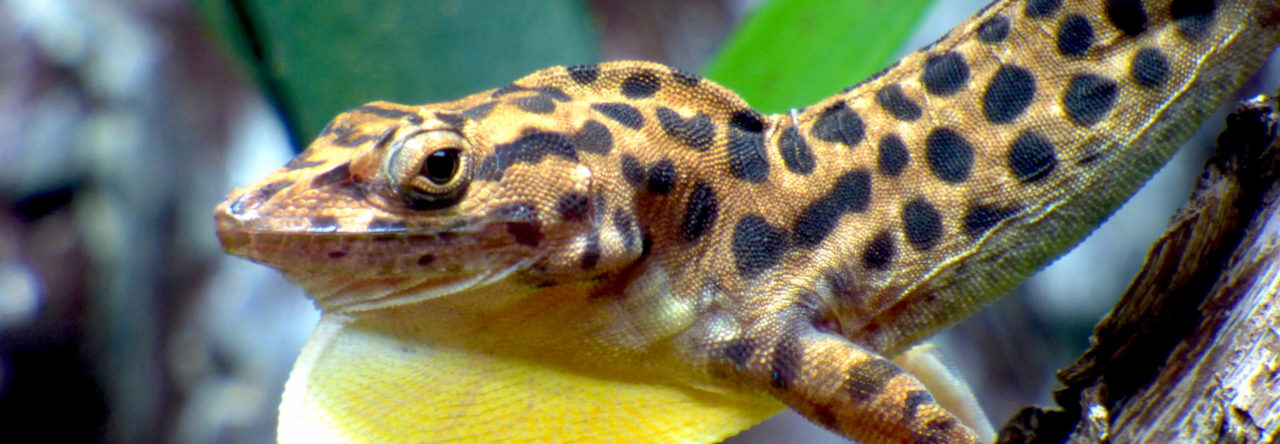
 My parents have Anolis carolinensis living in their mums. This picture was taken in the spring, but they’re still in her potted plants in November, just cold and hunkered down.

I thought it might be fun to do a bit of anole annals trivia. Your first question: which species dewlap is pictured above? First correct answer wins a hearty pat on the back!
My name is Frederik Sachser and I am studying Biology at the Heinrich-Heine-University of Düsseldorf, Germany and at the moment I am about to start writing my Bachelor thesis. I want to study the influences of the eyespots of Caligo on Anoles at “Un poco del Choco” in Ecuador next March. I heard that there is a wet season at this time and I am wondering if the anoles are showing less activity because of this. Can anyone advise me? My email is Frederik.Sachser@uni-duesseldorf.de.

The green thing on the left doesn’t look like a real anole to me. But apparently it’s convincing enough to both predators and other anoles, because both attack them, as evident by the bite marks they leave on these clay doppellizards. McMillan and Irschick deployed these faux lizards in trees in two areas in New Orleans, on the Tulane campus and in a wilder area outside of town. In the wild area, the models had bites marks clearly identifiable as belonging to lizard jaws (photo on right), and others that were from birds or other presumed predators. By contrast, perhaps not surprisingly, on the lovely grounds of Tulane, models were bitten by anoles, but not by predators. Also not surprisingly, there were no bites of any kind in either locality in the winter, and many more in the spring and fall. You might say to yourself: maybe lizards and predators just like to bite clay or anything new that shows up in their environment. How do we know that they actually thought they were attacking a lizard? Well, we don’t, of course, but the researchers did put out cubes made of the same material, and none of these were attacked, which lends some credence to the possibility that these models, cartoonish as they seem, may have passed for the real thing. McMillan and Irschick, following others, suggest that these models may serve as a proxy for levels of predation and intraspecific aggression.

A bunch of our young captive born anoles are coming down with an illness that results in swollen eyes, blindness, inability to feed, and, ultimately, death. The material that is causing the eyes to swell does not appear to be retained shed, but rather a membranous mass that gradually expands to cover the entire eye. We sent some animals off for necropsy and the preliminary results indicate hypovitaminosis A. At least one published study identifies this condition in captive green anoles, although the symptoms reported in that case were more widespread [pdf link]. We feed our anoles two types of crickets: Acheta and Gryllodes. The crickets, in turn, are fed chicken mash and limited quantities of fresh vegetables. We also dust our crickets with a calcium + D3 supplement during 2/3 of their weekly feedings. We’ve been housing hundreds of adult anoles on this feeding regimen for the last few years without trouble (the putative hypoviaminosis A is cropping up only in our 6-8 month old juveniles). We’re going to add a multivitamin to our dusting routine and will begin supplementing crickets with more fresh vegetables (including things high in vitamin A like sweet potatoes), but we’re also wondering if anyone else has had experience with hypovitaminosis A in anoles. We’re particularly interested to know how treatable the condition is once diagnosed and whether it results strictly from a dietary deficiency or if other aspects of the animals environment may be contributing.
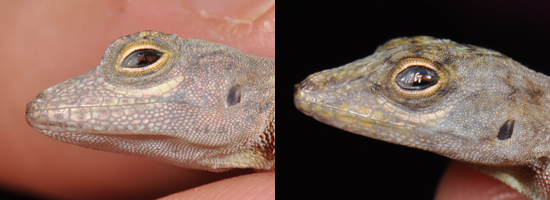

Photo by Casey Gilman, U. Mass. Amherst
In addition to performing dewlap extensions, head bobs, and pushups, many anoles raise a dorsal crest during territorial disputes. Here, two Anolis sagrei males square off. The static dorsal crest serves to modify the appearance of active pushups and dewlap extensions, perhaps making the male appear larger and more imposing. It is unclear how the crest is controlled. Jenssen notes the lag period before the crest is raised and the persistence of the crest after a territorial bout is concluded; thus, the crest may be a response to adrenaline and under the control of the sympathetic nervous system. Note the tongue extension by the top lizard.
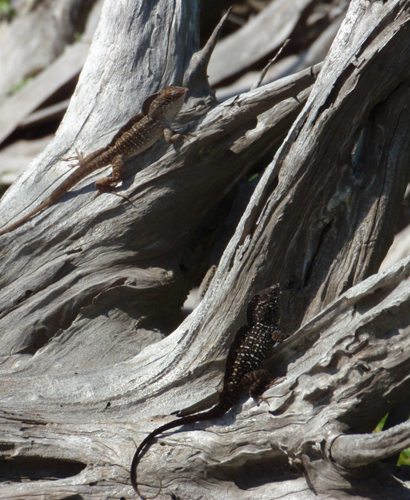

I took the photo above while out on nocturnal hunt for twig anoles in the Sierra de Bahoruco (a mountain range in the southwest Dominican Republic). Searching for twig anoles generally involves lots of hours spent scanning vines and twigs for narrow lizard profiles. Can you find the twig anole in this image (click on the image for a larger version)?
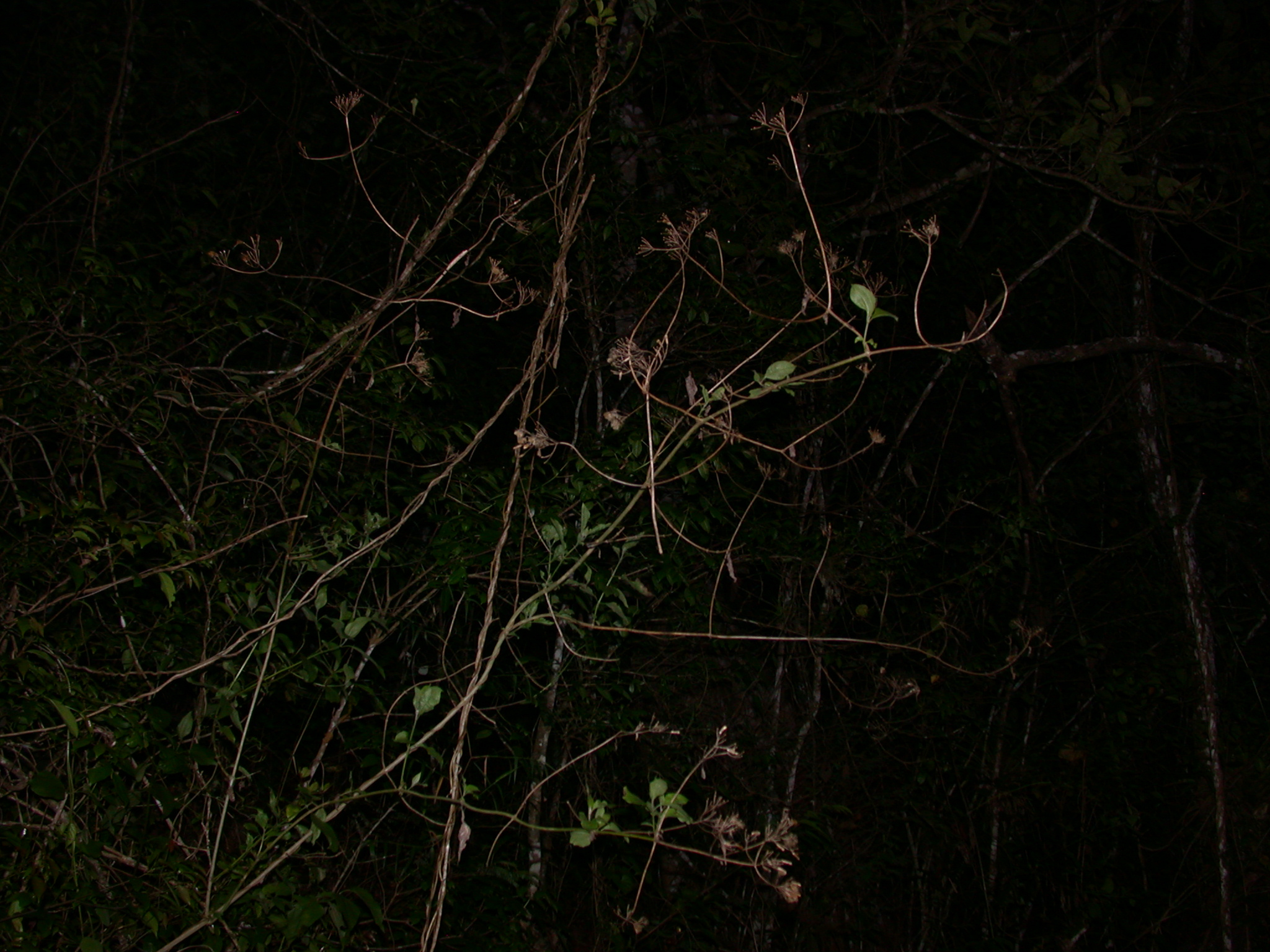
Anoles fall prey to a variety of animals. Here, a male brown anole, A. sagrei, is being subdued and swallowed by a black racer (Coluber constrictor). Casey Gilman and I heard the two animals struggling while working on spoils islands in Mosquito Lagoon.

Photo by C. Gilman, U. Mass. Amherst
All of these islands have Florida-native green anoles (Anolis carolinensis) on them. Most islands also have the brown anole, an invasive species. In his Anolis Newsletter VI contribution, Nathan Turnbough found a non-random association between brown anole presence and racer presence on Mosquito Lagoon islands. He concluded that high densities of brown anoles support more racers.
Green anoles tend to become more arboreal in the presence of brown anoles. It is generally thought that direct interactions between the species, like resource competition or intraguild predation, cause this habitat shift. However, by increasing the density of predators, brown anoles may also indirectly affect green anole habitat use. The habitat shift may result from green anoles getting out of the way of ground-foraging racers – an escape to enemy free space.
Anoles only lay one egg at a time. This penurious habit has been speculated to result from their arboreal lifestyle—because they spend so much time running around on vertical surfaces, they can’t afford to be weighed down by a big clutch of eggs. Reasonable enough, but is there any evidence that carrying eggs has any cost to female anoles? In a recent study in Ethology, Johnson et al. find that in A. carolinensis, as the mass of the egg increased, display behavior and movement rates decreased, suggesting that females are less active as they become more gravid. Whether this is inactivity results because females are more vulnerable to predators or for other reasons is not known.
This video was filmed near Bayahibe in the Dominican Republic in the summer of 2010. You’ll probably enjoy this video more with the sound turned off, I get pretty excited providing color commentary and use at least one naughty word.