
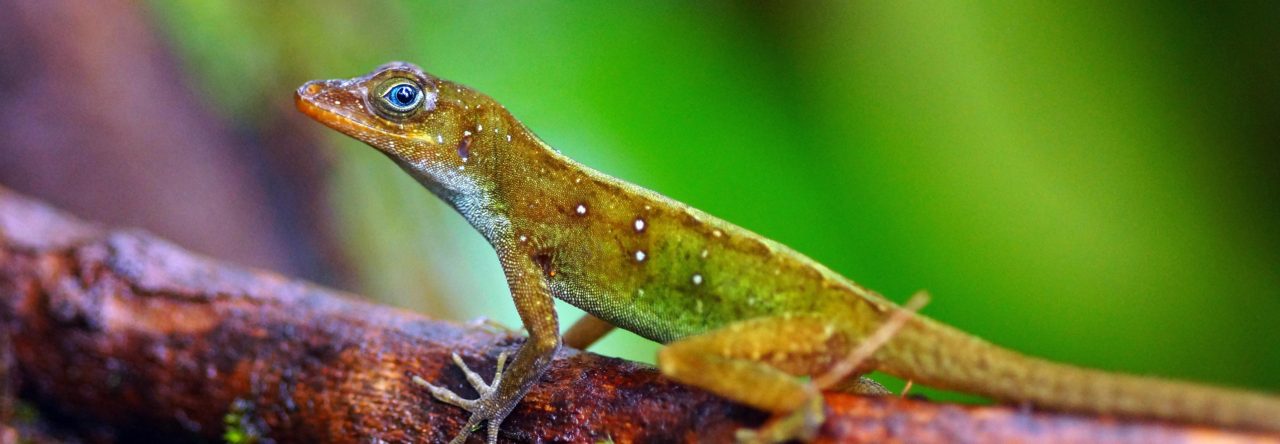


Can someone explain this to me? Have anoles gotten commercially big when I wasn’t looking?
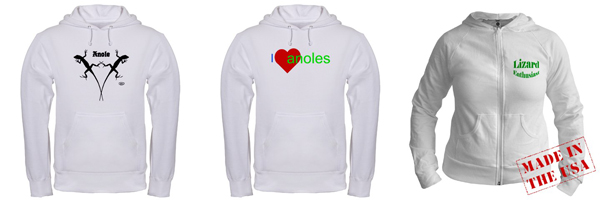

Photo of A. schwartzi copyright J. Losos.
This post is for those of you who might not be regular readers of Amphibia-Reptilia. Last summer, Joyce et al. reported on habitat mediated variation in size, population density and mating system in the St. Eustatius (Lesser Antilles) anole A. schwartzi. Joyce et al. quantified body size, density, and frequency of display behaviors in populations of A. schwartzi occupying habitats with and without available rocky substrates. They found denser populations of larger individuals that tend to display more frequently occupying rocky substrates. Their results suggest that the mating system and intensity of competition for mates varies among habitats in a predictable manner. This article is another in a long string of valuable contributions from Bob Powell’s REU courses.

Just following through on my promise to post more tongue extension photos. This one is of two male A. stratulus in Puerto Rico engaging in a vigorous back and forth display. Similar to the results reported by Schwenk and Meyer, this exchange occurred in the later stages of an encounter and was followed by direct physical aggression between the two males pictured.

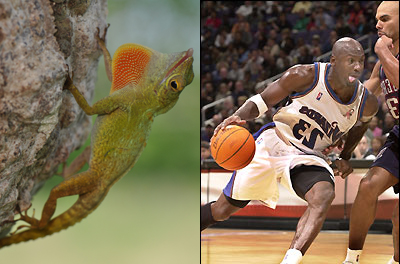
Anole displays can get pretty intense. My favorite feature of a really vigorous display is the lingual extension, a move that reminds me of Michael Jordan driving the lane for a dunk. Although I’ve illustrated this phenomenon with a photo of Anolis distichus, I’ve seen many species of anoles using this move during really intense displays. I’ll try to post more photos in the coming weeks.
The editors of Anole Annals were saddened to learn that an Islamist insurgent group in Somalia has taken the name of our favorite lizard. According to Voice of America News, the Anole fighters and their ally, the Ras Kamboni Brigade, are among the “clan-based factions of Hizbul Islam, a fundamentalist nationalist opposition group that formed an alliance with al-Shabab earlier this year to oppose the U.N.-backed government in Mogadishu.” Other news outlets confirm the existence of the anole group, but offer up few additional details [1, 2]. The anole fighters do not appear to have taken their name due to any perceived affiliation between Anolis lizards and the fundamentalist Islamic insurgency in Somalia (it seems more likely that group’s name is derived from an affiliation with the town of Anole in coastal Somalia). Nevertheless, we at Anole Annals are speaking out today to denounce exploitation of the anole name for violent purposes and to express our support for a non-violent resolution to the ongoing conflict in Somalia.

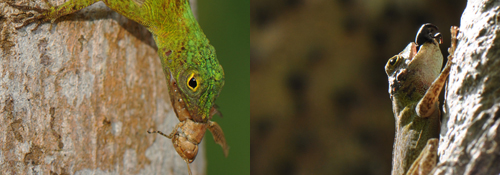
Yesterday I posted a short video of the Hispaniolan trunk anole (Anolis distichus) feeding on ants and noted that this species eats lots of social insects. Like most anoles, however, A. distichus is also a fairly opportunistic feeder that will eat more or less whatever it can fit in its mouth. I illustrate the diversity of this species’ diet with today’s photos of predation on an orthopteran and a curculionid beetle (both photographs were taken in situ in the Dominican Republic).

Köhler & Vesely begin their recent Herpetologica paper [doi link] on the Central American anole Anolis sericeus with a quote from the famous West Indian herpetologist Thomas Barbour (1932), who suggested that it was ‘‘a wicked and sinful affection to describe more anoles.’’ Undaunted, Köhler & Vesely go on to elevate two species from within the widespread Anolis sericeus based on differences in scalation, dewlap size and hemipenal morphology. It’s a shame their photos are published in black and white because A. sericeus and its relatives have one of the prettiest dewlaps you’re ever going to see (this crappy photo I took in Belize a few years back really does them little justice). The diagnostic features that Köhler & Vesel report are compelling, and provide another exciting example of morphologically cryptic species in a widespread anole species.
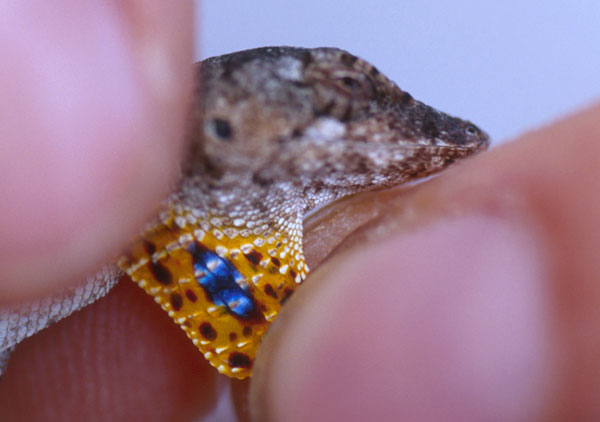
Hispaniola trunk anoles (a.k.a. the distichus series) tend to specialize on social insects. The little bugger in this video was chowing down on ants when we filmed him last summer in the Dominican Republic. You’ll see him flash his dewlap after picking off a few ants; such post-feeding displays are common in A. distichus.
check out the lizard comic book super hero, Anole here
