E-Book Readers Beware

Not in a Digital World! (photo from http://www.livingwisdomschoolseattle.org/pages/kindergarten.html)

Lizards in an Evolutionary Tree can be bought as an e-book from its publisher, the University of California Press.  Naively, I would have thought that a virtual book would be substantially cheaper than its ink and paper counterpart, but not so; UCP charges nearly as much for the e-book as for the hardback.  The e-book does have some advantages, though: it weighs less and can be easily searched for keywords, for example.  There are disadvantages, too: you’re not supposed to make copies, or even lend it to someone else.  Further, according to infibeam.com, which sells the e-book, you’re not even allowed to read it out loud!  So, if you’re planning to host a LIAET party for Christmas, or would like to use it for nighttime stories for the kids, or even were hoping to quote from it for dramatic moments in your classroom lectures, you’d better not go digital.  Incidentally, the paperback version is due out in February, and Amazon is currently selling it for 1/3 off.

Google Announces New Initiative to Track Study of Anoles

Well, more or less.  The New York Times, and many other newspapers, reported today (link 1) on a new project involving Google’s database of 5.2 million digitized books.  From this massive compendium of 500 billion words, it is possible to chart the use of words, and even combinations of words, through time.  Naturally, that immediately leads to the question of how usage of “anole” and “Anolis” has changed through time.  The results are presented in the graphs above.  The most obvious surprise is the peak in the mid-1950’s.  Why this should be, I don’t know, but my guess is that it has something to do with the actual books that have been digitized.   You can check this out for yourself by going to the Google Books website and rummaging around.  For example, here’s my search for “Anolis” in the 1950’s (link 2).  My guess based on this is that Google was only able to digitize many old journals, and perhaps those journals willing to be involved in projects like the Biodiversity Heritage Library, but that they do not have much of the recent scientific literature in their data base.   Compare, for example, the hits that come up for the 50’s versus those for the same search for the 1990’s (link 3).  Just a hunch, though—might make an interesting interdisciplinary undergraduate project.

The y-axis reveals that, shockingly, “anole” and “Anolis” are used in only a small minority of all books, surely something that will change in the future as knowledge of and interest in anoles continues to expand.  Note, too, that “anole” is used an order of magnitude more often than “Anolis,” not surprisingly given that most of these books are not scientific.  It is also possible to search for combinations of words, such as “anole” and “fabulous,” but we have not yet undertaken this exercise.

New Data on the Reproductive Cycle of Anoles

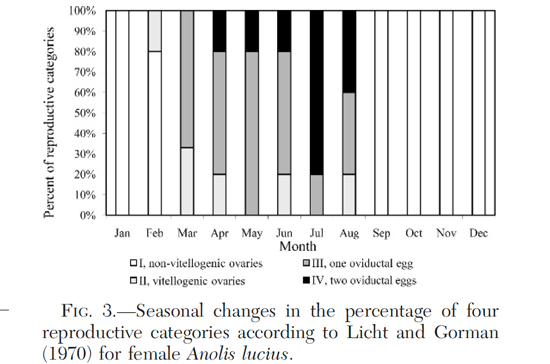
Many lizard species lay one or two multi-egg clutches each year; anoles, however, distribute their egg laying over the course of several months by producing a single egg every week or two.  Although this unusual aspect of anole reproduction is conserved across the entire genus, other aspects of anole reproduction exhibit considerable variation.  The annual reproductive cycle of anoles, for example, is known to vary from nearly continuous year-round egg production to highly seasonal reproduction limited to the warmest or wettest months.  This variation appears to result from a combination of regional environmental variation, reproductive cycle plasticity, and historical contingency.  In the latest issue of Herpetologica, Domínguez et al. (2010) provide new details on the reproductive cycle of female A. lucius.  Although some previous reports have suggested continuous reproduction in Anolis lucius, Domínguez et al. find that female reproduction in populations near Havana, Cuba is highly seasonal; all specimens examined had non-vitellogenic ovaries between September and January before reaching peak egg production in July.  Although their quiescent period is shorter, the reproductive cycle of A. lucius is similar to that of the better-studied temperate species A. carolinensis in being driven by photoperiod and temperature.  Two other noteworthy facts seemed worth sharing.  First, like other anoles from the northern Neotropics, male and female A. lucius reach maturity in approximately eight months.  Second, communal egg-laying in A. lucius is noteworthy because, like other rock-dwelling species from Cuba (i.e., A. bartschi and A. argenteolus), females often lay in small cavities in cliffs, caves and rocks rather than in soil or trees.

Green Anole Escapes from Circus (ca. 1920)

If you spend much time at all in the collections of a natural history museum, you’re guaranteed to come across some weird and hilarious stuff (e.g., see this book).  Here’s a gem of a specimen label – this is a green anole skeleton from the Smithsonian (photo and “discovery” by Thom Sanger).

circus fugitive anole

The collecting remarks seem odd enough that I figured it might be an inside joke.  But Thom found the following question posted on the Circus History Message Board, which probably explains everything.…

“I have a somewhat of a bizarre question. My aunt, who is in her late 70’s, told my husband and I a story about when she went to the circus a child. My Aunt told us that when she was little girl her mother would buy her a little lizard that was attached a chain that was then attached to a pin. The pin would be worn and the lizard would walk around you until it died.”

The message board has replies from many old-time circus-goers confirming that Anolis carolinensis were indeed tied to strings and peddled to kids at the circus.  According to one poster, the lizards were called “bugs” and the peddlers “bug men.”  (!?!?)

“Jennifer, the lizards (which have been called chameleons) were known as “bugs” and the sellers on the midway were known as “bug men”. The pitchman would pin a “bug” on his lapel to be viewed as harmless and he carried the “bugs” for sale mounted on a board. Unfortunately the “bugs” didn’t last too long after leaving the circus grounds but kids loved them. John Goodall”

The Anoles of Mérida

“It must be the oldest part of Mérida…. In the afternoon when the sun lights the stucco buildings across the street, it’s possible to count a dozen different colors of paint, all fading together on the highest part of the wall…. Cats stalk lizards among the clay pots around the fountain, doves settle into the flowering vines and coo their prayers, thankful for the existence of lizards.” – The Lacuna, a novel by B. Kingsolver (2009; Harper Perennial; pp.393)


Mérida is the capital city of the Mexican state of Yúcatan. Of the lizards alluded to in the passage above, some were  undoubtedly anoles. Anoles are well known for their radiation in the Caribbean but are less appreciated for their radiations in mainland Central and South America, which rival their Caribbean counterpart in species diversity and morphological disparity.

(I say radiations because there were actually two radiations on the mainland. The first mainland radiation includes the basal clade of Anolis and is paraphyletic because the Caribbean radiation arose from within it. The second radiation, monophyletic, is actually a back-colonization of the mainland from the Caribbean.)

Which mainland anoles could be in Mérida? There are five anoles whose species distribution places them near or in Mérida: Anolis sagrei, A. lemurinus, A. tropidonotus, A. rogdriguezii, and A. sericeus. We’ll explore the natural history of these species to determine for which one(s) Mérida’s doves are thankful.

(1) Anolis sagrei, the brown anole, is not actually a mainland anole. This Cuban species is well known for its invasive abilities. For example, it has invaded the southeast U.S., Jamaica, Central America, Hawaii, and even Taiwan. Cats are known to feast on Anolis sagrei in other parts of its range, and there is a record of A. sagrei in Mérida; however, because The Lacuna is set in the early 1950s, we will assume that A. sagrei had not yet arrived in Mérida to fall prey to cats.

Anolis sagrei - photo by Neil Losin (http://www.daysedgeproductions.com/neil.blog/)

(2) Anolis lemurinus is a grey-colored anole, found in the understory of lowland forests. Individuals of this species are partial to shaded habitats and perch on the buttresses of trees while they watch and wait for their invertebrate prey. Often, they are heard scampering along the forest floor before they are seen. Perhaps this is why this species is called lemurinus, which means “belonging to the ghosts of the dead” in Latin. Anolis lemurinus is probably not food for Mérida’s cats for two reasons: (1) Mérida lies just beyond the edge of the species range for A. lemurinus, and (2) A. lemurinus is a forest, not city, dweller.

Anolis lemurinus - photo by Michael Benard http://calphotos.berkeley.edu/cgi/img_query?enlarge=0000+0000+0107+1742


(3) Anolis tropidonotus lives in primary and secondary forests. It too is a forest dwelling anole, preferring shady habitats. Individuals in this species are predominantly terrestrial and will burrow into the leaf litter to escape capture. Like A. lemurinus, A. tropidonotus is primarily a forest species and its range nears but does not include Mérida. Thus, it is an unlikely candidate.

Anolis tropidonotus - photo by Josiah Townsend http://www.flickr.com/photos/24831531@N07/2353154759/

(4) Anolis rodriguezii is a small anole that can be found most often in dry forests but in other forest types too. It usually perches several meters high but is known to descend out of the canopy to the ground. It also scrambles along the walls of ancient Mayan ruins. There is record of this species from Mérida, so it is probably common in the forests around Mérida, may venture into human establishments, and could be falling prey to cats in Mérida

<Please send me a photo if you have one>


(5) Anolis sericeus is a small anole too. This species prefers open savanna habitats, forest edges, and areas disturbed by human activity. Individuals in this species perch on shrubs, bushes, and grass tufts. Males of this lizard have a striking dewlap that is yellow with a blue or purple spot in the center. Given this species’s penchant for human-impacted environments and its near-ground perching habits, A. sericeus seems the mostly likely anole candidate to be cat food in Mérida.

A. sericeus - http://www.fororeptiles.org/galerias/images/88/large/1_anolis_sericeus.JPG

A haiku from the doves in homage to A. sericeus:

Coo-rageous anole,
Anolis sericeus.
Distracts pesky cats.

Many thanks to Julian C. Lee. I collected most of the information about the anoles of Mérida from his two books: The amphibians and reptiles of the Yucatan Peninsula (1996 – Comstock Publishing) and A field guide to the amphibians and reptiles of the Maya world (2000 – Cornell University Press).

Evolutionary Reinforcement in Anolis brevirostris

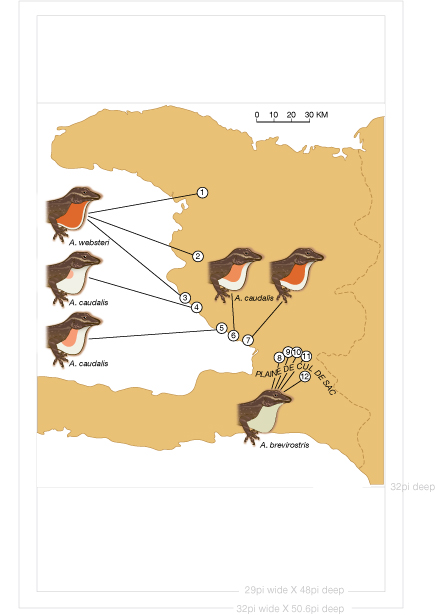
Figure from Lizards in an Evolutionary Tree, based on Webster and Burns (1973).

In a recent Anole Annals post, Luke Mahler mentioned the pioneering work of Webster and Burns on variation in the Hispaniolan trunk anole, A. brevirostris.  This paper presents one of the most compelling cases for the occurrence of reinforcement—the phenomenon in which natural selection leads to the evolution of increased reproductive isolation when two hybridizing species come into sympatry.  Surprisingly, however, this example is not well known; indeed, Google Scholar reports only 29 citations, only two of these post-1991.  This is too bad, because it is a wonderful example and deserves to be more widely known.  For this reason, I present a slightly modified description of variation in these lizards taken from Lizards in an Evolutionary Tree:

Three members of the A. brevirostris species complex, nearly indistinguishable in appearance, occur contiguously along the western coast of Haiti.  The southernmost of these species is A. brevirostris itself, which has a light-colored, pale dewlap.  By contrast, the northernmost species, A. websteri, has a vivid, orange dewlap.  Most interesting, however, is the species sandwiched in between the other two, A. caudalis, whose dewlap color varies geographically: at the southern border of its range, near A. brevirostris, its dewlap is bright orange, and at the northern edge of its range, where it comes into contact with A. websteri, its dewlap is white.  Interior populations exhibit variability in dewlap color with change occurring at least somewhat clinally from one end of the range to the other.  Display behavior also differs among all three species, with the behavior of A. caudalis being the most distinct from the other two species.  The most parsimonious explanation for these differences—particularly the geographic variation in dewlap color in A. caudalis—is that they evolved to prevent hybridization between closely related species.  Indeed, electrophoretic analyses by Webster and Burns confirm that levels of gene flow are high among populations within each species, but extremely low or non-existent between species, including adjacent heterospecific populations.

Lizards on a Plane: Transporting Anoles the Old-Fashioned Way

In the good old days, back when grad students weren’t afraid to push the boundaries and TSA didn’t exist, we used to transport lizards in the passenger cabin of airplanes.  We’d simply put them, one to a plastic bag, in a backpack or duffle bag and bring them onboard as carry-on luggage.  Rarely was this a problem.

Lizard guys weren’t the only ones to do this.  I remember a frog biologist telling me of the time he brought a bunch of coquis back to his lab from Puerto Rico.  They were snuggled into their individual little containers, dark and moist, and apparently quite content, because midflight they started calling as only a coqui can.  Of course, this attracted the attention of other passengers.  As they looked around, up and down and sideways, speculating about what was causing the ruckus, my colleague simply buried his nose in his book and kept quiet.

I only twice had trouble carrying anoles onboard.  The first time was in Gainesville, Florida, in 1987.  I was just starting out on my anole research and had flown to Miami to collect a sample of the superbly diverse, if non-native, anole fauna of that fine city.  I collected five species, including A. carolinensis (the only native species of the lot), A. sagrei, A. distichus, A. cristatellus, and several magnificent knight anoles, A. equestris, the largest anole species.  I then flew to Gainesville to meet with anole expert Alan Pounds, anoles in tow.  No problem.  However, on the way back, things did not go smoothly.  The Gainesville Airport, at that time, was a small, rinky-dink affair.  When I got to security, I put my duffle bag full of lizards onto the conveyor belt and through the x-ray machine it went (as an aside, as far as I could tell, no lizard suffered any harm from being x-rayed).  The inspector, a small, round, white-haired and cranky woman, took one look at her monitor and barked, “You’ve got an alligator in there.”  I pulled out a small A. carolinensis and tried to convince her otherwise, but to no avail.  It was the only time I had to check my bag o’ anoles.

The second problem trip was a year later in Jamaica.  In our travels, we would put the lizards in gallon-sized plastic bags, inflated with air (this was pre-Ziploc days—such bags are hard to find now).  Every two days, we would change the bags, and this worked fine.  Except on this particular trip, I failed to bring enough Baggies® with me, so we had to scour local shops for Jamaican made bags, which we eventually found.  However, unbeknownst to us, these bags were not well made.  On the day we were to fly out of Montego Bay en route back to California, we checked in and passed through security without incident.  I thought the coast was clear.  But then, as they called the flight, I realized that the security staff—all female, all dressed in elaborate red uniforms, including ornate hats—were hand-searching each piece of carry-on luggage.  My heart sank.  When I got to the front of the line, the woman unzipped my duffel bag, reached in, and started rummaging around with her hands, but without looking down.  Saved!  Or so I thought.  Unfortunately, several plastic bags had split open at the seams, freeing their captives, and a beautiful male Anolis grahami jumped out of the duffel and onto the table.  This the inspector did see.  She immediately let out a scream and—I kid not—stood on a chair.  I thought all was lost, but from her lofty perch, she yelled at me to catch the lizard and get on the plane, which I quickly did, returning to the lab without further trouble.

So, when talking to a fellow from Transport Executive’s Man and a Van Plymouth, I reminisced on how we used to do it in the old days.  No packaging lizards in coolers for transport in air cargo or checked luggage, no elaborate containers, no fuss, no muss.  It was a simpler, easier time, and usually it worked quite well.  I always suggest to travelers these days that they consider taking a duffel bag and try hand carrying their lizards, but then again, we can only guess how TSA would react (and the x-rays are probably now a lot stronger).

Note added June 2, 2013: Since this post was published in December 2010, a number of commenters have asked about the consequences of transporting lizards on airplanes. There are two issues for doing so. First, capturing a lizard and taking it somewhere else almost always requires a collecting and/or export permit from the state or country of origin. Failing to do so is breaking the law. Moreover, the United States’ Lacey Act makes it a felony to import into the United States any animal illegally (i.e., without permission) collected in or exported from another country. Let me reiterate: this is a felony. If you get caught doing this, you are in big trouble.

Second, can one bring lizards onto airplanes. As far as I am aware–though I may be wrong, so you should check yourself–there are no laws against doing so. However, airlines have regulations about what you can bring onto their airplanes and how you can do so, so you’ll need to check with the airline. In addition, there is the question about how to get the animals through security if you are transporting them with you. As always, the internet is a good place to start in trying to figure out what is allowed and how to proceed. Here’s one article I found in a quick Google.

Where’s Anoldo?

Imagine you’re walking down a busy city street, talking with your friend about the latest post you read on Anole Annals. You’re getting to the most exciting part of the discussion when a bus rumbles by and drowns out your sentences. Your friend can’t hear you and loses out on amazing anole knowledge.

Animals that live in complicated environments with noisy backgrounds face similar communication challenges. The signal can be auditory – imagine a frog trying to find a mate in a multispecies chorus in a Costa Rican swamp that just received its first rain of the year. The signal can be olfactory – imagine an ant trying to follow an hour-old trail laid down by one of its sisters. The noise can be visual too – imagine a transparent jellyfish trying to find a mate in the poor light environment of the ocean.

Or, Waldo trying to find Wenda.

Tough, right?

To ensure that communication is successful, animals should evolve signals that are highly conspicuous in the environment in which those signals are used.

Anoles are well known for their charismatic displays. They do push-ups, bob their heads, and extend a colorful flap of skin beneath their chin called a dewlap. Anoles display during territorial conflicts, courtship behavior, and predator avoidance. Anoles tend to live in very noisy environments. For example, how is a male anole displaying in the low-light forest understory to be seen against a background of shaking leaves?

One way for an anole to be seen is to create a dewlap whose color has great contrast in the light environment in which it is usually found. Another way is to use a display with jerky movements and rapid dewlap extensions that stands out even against low light and shaking leaves (Ord and Stamps 2008). A third way to be seen, discussed in a new paper by Ord et al. (2010), is to time displays to run during periods in which background noise is relatively low (i.e. the wind dies down and the leaves stop shaking). Imagine pausing your city-street conversation of anoles until after the bus had passed.

Ord et al. test whether anoles match their displays to calm backgrounds by comparing the display timing of Jamaican anoles, which use a rapid, jerky display, to Puerto Rican anoles, which use a slow, drawn out display. They hypothesize that the Puerto Rican species, with their slower head bobs and dewlap extensions, will time their displays to match a quiet background. In contrast, Jamaican species, whose display is thought to be suitable in noisy visual conditions, should show less background matching (Ord and Stamps 2008).

To answer this question, Ord et al. analyzed videos of lizard displays, comparing background noise during lizard displays to similar stretches of time when lizards were not displaying. They compared four species on Jamaica to four species on Puerto Rico. The species were similar in habitat use and dewlap color between islands, and there were no appreciable differences in the physical environment between islands.

Consistent with their hypothesis, Ord et al. found that Puerto Rican species actively avoided displaying during periods of high environmental noise; they waited until until the visual background calmed down. In contrast, Jamaican lizards did not time their displays as carefully. Thus, it appears that these two lineages of Anolis lizards have evolved different strategies to solve the problem of how to communicate in noisy visual environments.

Puerto Rican anoles avoid displaying during periods of high noise.


Anole Elevation! – A. distichus Subspecies Raised to Species Status

The distichus group on Hispaniola, including forms suggested for full species status by Glor and Laport. Image from their Figure 1.

In a recently accepted paper in Molecular Phylogenetic and Evolution, Rich Glor and Robert Laport suggest that the stalwart Hispaniolan anoles, A. distichus and A. brevirostris, actually represent complexes of species under the general lineage species concept. This idea is not new, but it’s surprising how long it’s been since it’s gotten serious attention. Before his tragic death in a car accident, Preston Webster made substantial progress working on the brevirostris-group species problem, using allozyme data to study the genetics of Haitian populations in the 1960s and 70s. Webster found evidence for genetic isolation among several brevirostris populations differing in dewlap color (Webster and Burns 1973), but never erected any species. He advocated the idea though, and under the guidance of legendary Caribbean systematist Albert Schwartz, Douglas Arnold erected three additional species from within Anolis brevirostris, naming one after the late Preston Webster (A caudalis, A. marron, and A. websteri; Arnold 1980). He also named erected two additional A. brevirostris subspecies.

In several later papers, Susan Case also used allozymes to study distichus and brevirostris subspecies, but she stopped short of naming any as species. She did, however, note evidence of stable genetic breaks among some distichus subspecies (e.g., Case and Williams 1984).

In the paper at hand, Glor and Laport turned their attentions mainly to the widespread Hispaniolan Anolis distichus, which has 16 subspecies (including some not on the main island of Hispaniola) that often differ remarkably in dewlap coloration. Focusing on the Dominican Republic side of Hispaniola, they found evidence for deep divergence in mtDNA among these subspecies, and argue that they represent distinct evolutionary lineages.  The picture isn’t completely clean of course – one of the forms (favillarum) renders another (dominicensis) paraphyletic for this particular marker – but the authors still make a case that these groups represent true evolutionarily distinct units. Certainly some will disagree with Glor and Laport’s decision to elevate these subspecies using the general lineage concept. But species concepts aside, it’s hard to argue with their conclusion that “studies that continue to treat A. distichus (sensu lato) as a single reproductively continuous unit will be problematic.”

Check out the paper!  I think this is the tip of the iceberg for distichoid anole systematics.  Glor and Laport refrained from tackling the Haitian distichus subspecies and also remained agnostic on the formal status of the three subspecies of A. brevirostris.  Rest assured this is just the beginning though…

Frugivory, Anolis sagrei

Video taken in June 2010, in the Bahamas. This anole is having a feast courtesy of one of his main predators. The fruit is from the wild dilly bush, not an easy fruit to crack for an anole, but it doesn’t present a challenge for a hungry curly-tail lizard, searching for his daily portion of sugars and fibers. After the curly-tail had his fill, the anole moved in to devour the pulp. Video taken by Dave Steinberg.

Page 303 of 306

Powered by WordPress & Theme by Anders Norén