

Photo probably by Manuel Leal probably at El Verde Field Station in Puerto Rico.
Read about it here
.
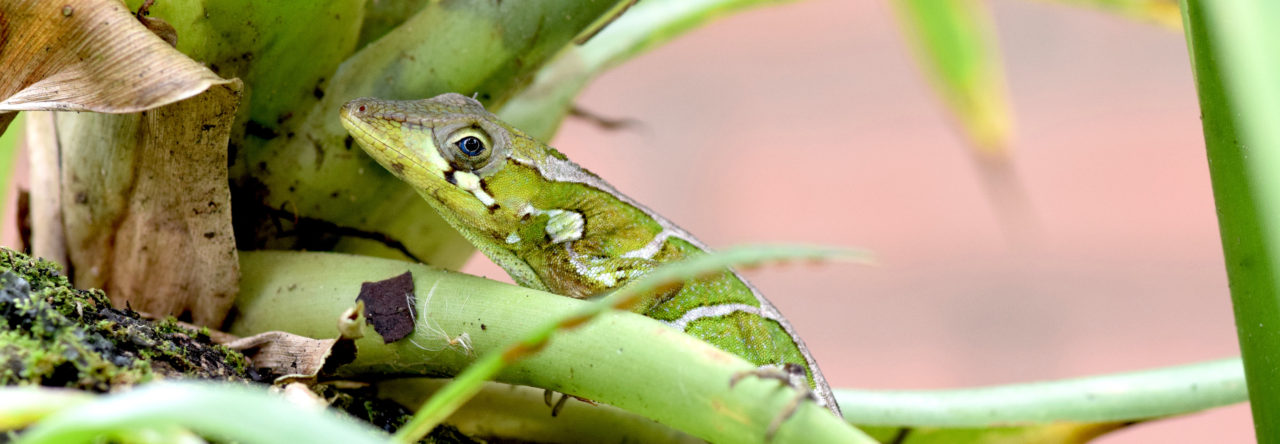
Photo probably by Manuel Leal probably at El Verde Field Station in Puerto Rico.
Read about it here
.
Anole Annals more or less turned one-half-year-old this month, making this a good time to look back and reflect. Readership continues to increase—we’re now getting an average of 202 readers and 351 page views a day. AA has published 208 posts by 30 authors from four continents and the Caribbean. For those new to the fold, here’s an annotated list of the 12 most popular posts, as judged by number of page views*:
1. Society for the Study of Evolution Announces Changes to the Name of its Journal
Far and away the most viewed, thanks to some Facebook re-posting in highly visible sites, this post documented the repeated appearance of anoles on the cover of the journal Evolution. Combined with the fact that an anole was the frontispiece for the program for the society’s annual meeting and that four of the six young scientists honored for their contributions at the meeting work on anoles (here, here, and here, plus Rob Pringle), the
suggestion that the society should reconsider it’s name seems quite reasonable.
2. Anole Annals Trivia: Find the Anoles
Always a crowd pleaser. ‘bout time for another one. Suggestions welcome.
Turns out that there are lizards out there besides anoles evolving on islands. Check out this award winning film from Nathan Dappen. The film took first place in the first annual NESCent Evolution Film contest. 11 films were screened and voted on by attendees at the Evolution 2011 meeting in Norman, OK.
Editor’s Note: all the entries in the film festival can be seen here. The runner-up, “Why Don’t You Teach Evolution,” is also great.
 “You’ve gotta see this!” my fiancé Mark called to me one morning. He was outside, which could mean only one thing: a wildlife encounter was underway. Living in a semi-rural neighborhood in Florida, you never knew what you would see, from a mated pair of Sandhill Cranes walking down the street with their young, to Gopher Tortoises excavating burrows in the front yard.
I walked downstairs to the concrete area under our elevated house where Mark was staring at something on the ground. I looked down to see a frog (Cuban Treefrog) with the tail of an A. carolinensis protruding from its gullet.
“I knew that lizard,” Mark said forlornly.
Anolis argenteolus is not the only (Cuban) species that has this “window” on the lower eyelid. Anolis lucius also has transparent scales, but if I recall there are 3 in this species. Interestingly, both of these species are to some extent saxicolous or cliff dwelling. So perhaps the sunglasses theory is correct. Protects the eyes from reflection off the white limestone rocks? Attached is an image of this species from the Matanzas Province.


The last post makes me recall this weird situation while in Cuba in 2007. Anolis argenteolus seems to have a “fake eye” right at its eyelid. This is mentioned in the species’ descriptions as 2 transparent palpebral scales “as windows”… Looking at some pictures I noticed the scale’s surface being quite reflective and with some iridescence, but it is hard to tell whether they really can see thru it or whether it is just a false eye so when they roost or they close their eyes during the day they are able to show that they still alert. According to Williams & Hecht (1955), these “windows” in the lower eyelids are presumed to act as “sunglasses” in order to reduce light intensity, though I saw the animal doing this even in shady situations. Or they may serve to detect movement while sleeping (Vergner and Polak, 1996).
 Anoles have served as great model organisms in studies of adaptive radiation and how form and function are molded by selection, but they have also been the center-piece for some of the most interesting (and classic) research on how the brain modulates aggression to determine dominance. For example, work by Cliff Summers and his laboratory (among others) over the years has provided great detail concerning how adrenal catecholamines and glucocorticoids, produced during “stressful” aggressive interactions, interact with serotonergic activity in the hippocampus to determine social rank. These neuroendocrine processes are outwardly expressed, in a sense, by the familiar eyespot seen prominently during male green anole (Anolis carolinensis) interactions. The formation of the eyespot is stimulated by catecholamines, and the latency of eyespot formation is dependent on serotonergic activity, which is influenced by glucocorticoid secretion. Males that develop the eyespot sooner tend to be dominant, and once eyespots have appeared in one combatant, aggression in the rival tends to be inhibited. At least that’s the way it seems to work in A. carolinensis.
 Joel McGlothlin received the 2011 Dobzhansky Prize, given to an outstanding young scientist in the field of evolutionary biology. Successfully fending off technical AV difficulties, Joel gave a fascinating talk in which he examined the idea that evolution should occur along lines of least genetic resistance, which are determined by the genetic correlations among traits. This hypothesis predicts that as traits diverge, they should diverge in ways that mirror the trait genetic correlations. Moreover, one would expect that this effect would attenuate over time, so that more distantly related species would show less evidence of diverging along these lines.
 Luke Mahler received this year’s Fisher Award, given by the Society for the Study of Evolution for the best paper emanating from a Ph.D. thesis published in Evolution in the preceding year. Mahler asked “what is the trigger for adaptive radiation?” and answered, “ecological opportunity”: a wealth of evolutionarily accessible resources (from Schluter). This leads to the prediction that the pace of adaptive radiation is regulated by competition, and is thus diversity-dependent. This hypothesis has been tested greatly in recent years by seeing if the rate of species diversification decreases through time as a clade radiates. But, Mahler argued, counting species is not enough—rather, we need to focus on patterns of diversification in adaptive traits.
Focusing on Greater Antillean anoles, Mahler asked whether rates of ecomorphological diversification decline as the number of species on an island increases. Testing this hypothesis requires estimating historical ecological opportunity (EO) by inferring ancestral species richness on an island and estimating rates of morphological evolution at ancestral nodes and how they changed as a function EO. To do this, Mahler and co-author Liam Revell developed at maximum likelihood approach to infer ancestral states incorporating uncertainty on the reconstruction of ancestral biogeographic locations.
The result is strong support for the ecological opportunity model. Rates of ecomorphological evolution are high early in anole radiation, but decline with increasing species richness.

Anolis sagrei from near one of Dan Warner's field sites. Photo by Aaron Reedy.
American Society of Naturalists’ Young Investigator Award winner Dan Warner presented a marvelous synthesis of studies of how external influences affect phenotype and survival in eggs and offspring of lizards and turtles. Among other things, he has demonstrated
that some types of plasticity are adaptive: in temperature sensitive sex determining lizards, males are produced at temperatures at which the fitness of male offspring is greater than that of females, and vice-versa.
Powered by WordPress & Theme by Anders Norén