
Rich Glor has thrown down the gauntlet. Who can name the five anoles pictured on the CaribHerp poster in the last post? I know what they are, but I had to get help on #5, which does not sport the typical look for that species (and the esteemed Dr. Glor’s guesses are incorrect).
Caribherp is a website devoted to all herpetologic matters West Indian. It describes itself as follows:
Caribherp contains information on amphibians and reptiles of the Caribbean Islands (West Indies). It serves as a checklist of what occurs in the region as well as a quick identification guide to the species. Approximately 2000 images and maps, and selected frog calls (sounds), are presented along with an integrated open-access journal, Caribbean Herpetology. The journal accepts color images and video and currently publishes brief communications on individual species—later volumes will include full research articles. The species accounts can be sorted in many ways. Maps of the Caribbean, both current and historical, can be found on a separate site, Caribmap. Multimedia essays related to conservation issues on Caribbean islands are on a third site, Caribnature.
The poster above and a similar one can be obtained here on the “Resources” page.
Do you ever stop and think about how long it must have taken Schwartz and Henderson to make all those amazing dot maps in their 1991 opus on West Indian amphibians and reptiles? They plotted known localities for every species of West Indian amphibian and reptile in the days before GPS and GIS! These days, making dot maps of species distributions is considerably less onerous, but often requires the use of cumbersome, expensive, and PC-only programs like ArcGIS. For the past couple of weeks, some folks in my lab – Daniel Scantlebury, Anthony Geneva, and Shea Lambert – have been attempting to make nice distribution maps for Caribbean anoles and other reptiles using the R statistical computing framework (R has a pretty steep learning curve for beginners, but it’s flexible, scriptable, free, and cross-platform). The results so far are pretty exciting. If you have a list of georeferenced localities, you can overlay these points on a very detailed political map in a matter of seconds. We’re just beginning to learn how to tap R’s map making potential and would love to hear from others doing the same! Technical details after the jump…
Taxonomist’s conundrum: What to do when a species needs a new name, but the moniker available is unpleasant? Case in point: this verdant beauty is surely the loveliest of the Bahamas’ lizards. Long known as A. carolinensis, recent work demonstrated that Bahamian green anoles and American green anoles are not closely related and thus represent independent colonizations from their Cuban, A. porcatus, ancestors. Hence, unless one wants to sink them all into a single species (which by the rules of zoological nomenclature, would be given the name A. carolinensis, thus sinking porcatus and representing another instance of U.S. hegemony over Cuba), the Bahamian lizards need a new name.
And, alas, that name already exists, and it’s a stinker: A. smaragdinus. Trying saying it yourself. There are a number of different ways to pronounce it—I have no idea which is correct, but they’re all unpleasant. And don’t bother trying to shorten it: “smarags” is cacophonous as well. It’s a shame, really, because the epithet is apt, meaning “emerald green” in Latin.
Anole Annals more or less turned one-half-year-old this month, making this a good time to look back and reflect. Readership continues to increase—we’re now getting an average of 202 readers and 351 page views a day. AA has published 208 posts by 30 authors from four continents and the Caribbean. For those new to the fold, here’s an annotated list of the 12 most popular posts, as judged by number of page views*:
1. Society for the Study of Evolution Announces Changes to the Name of its Journal
Far and away the most viewed, thanks to some Facebook re-posting in highly visible sites, this post documented the repeated appearance of anoles on the cover of the journal Evolution. Combined with the fact that an anole was the frontispiece for the program for the society’s annual meeting and that four of the six young scientists honored for their contributions at the meeting work on anoles (here, here, and here, plus Rob Pringle), the
suggestion that the society should reconsider it’s name seems quite reasonable.
2. Anole Annals Trivia: Find the Anoles
Always a crowd pleaser. ‘bout time for another one. Suggestions welcome.
Turns out that there are lizards out there besides anoles evolving on islands. Check out this award winning film from Nathan Dappen. The film took first place in the first annual NESCent Evolution Film contest. 11 films were screened and voted on by attendees at the Evolution 2011 meeting in Norman, OK.
Editor’s Note: all the entries in the film festival can be seen here. The runner-up, “Why Don’t You Teach Evolution,” is also great.
“You’ve gotta see this!” my fiancé Mark called to me one morning. He was outside, which could mean only one thing: a wildlife encounter was underway. Living in a semi-rural neighborhood in Florida, you never knew what you would see, from a mated pair of Sandhill Cranes walking down the street with their young, to Gopher Tortoises excavating burrows in the front yard.
I walked downstairs to the concrete area under our elevated house where Mark was staring at something on the ground. I looked down to see a frog (Cuban Treefrog) with the tail of an A. carolinensis protruding from its gullet.
“I knew that lizard,” Mark said forlornly.
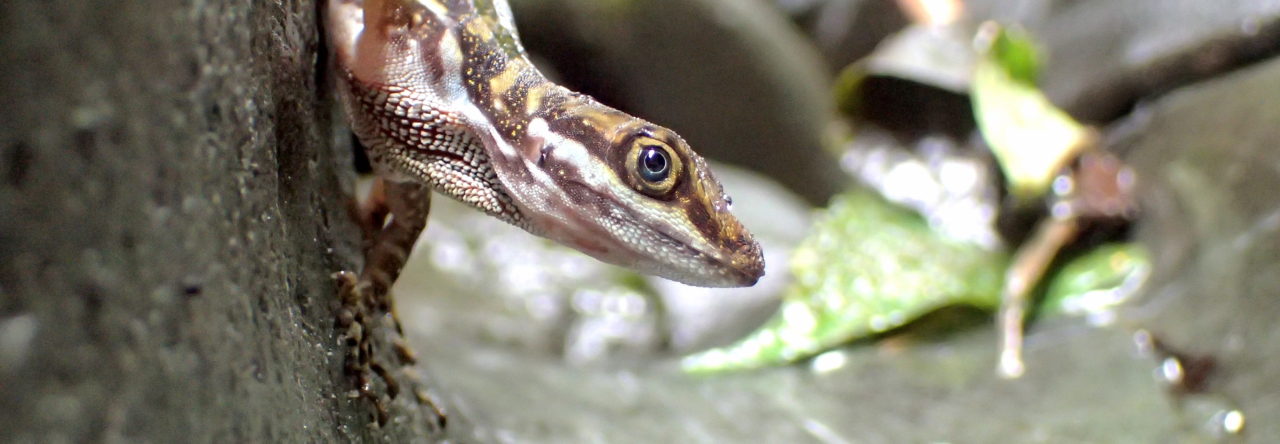
Anolis argenteolus is not the only (Cuban) species that has this “window” on the lower eyelid. Anolis lucius also has transparent scales, but if I recall there are 3 in this species. Interestingly, both of these species are to some extent saxicolous or cliff dwelling. So perhaps the sunglasses theory is correct. Protects the eyes from reflection off the white limestone rocks? Attached is an image of this species from the Matanzas Province.


