
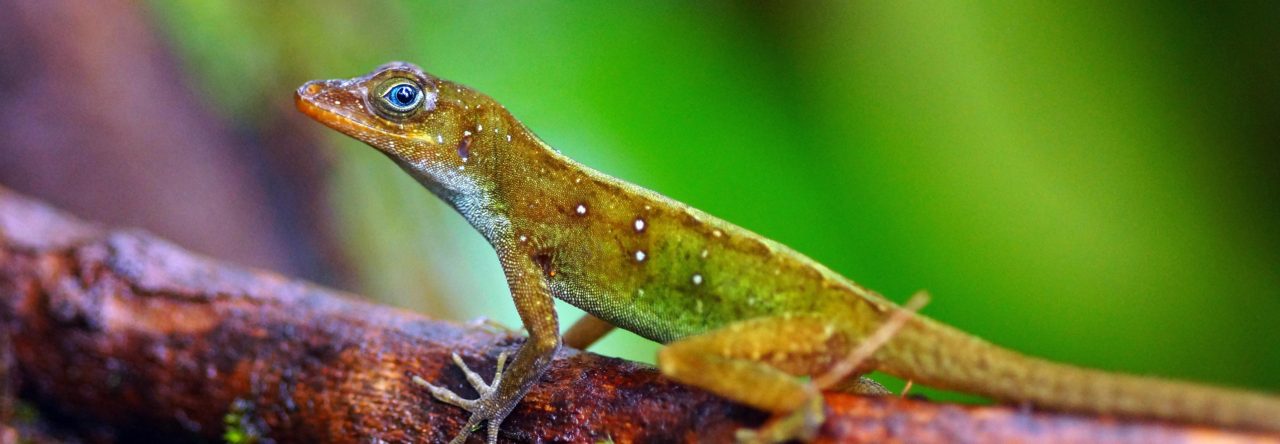
 In a fascinating talk, Chad Watkins reported the discovery of a surprising frequency of homeotic mutations along the anterior-posterior axis and implicated the high rate of transposons in the Hox D cluster as a possible cause. Watkins reported that 27% of DNA in the HoxD cluster is comprised of transposons, much higher than in other vertebrates. Moreover, Hox D gene expression is shifted posteriorly. For example, Hox D10 normally should express at anterior boundary of hip, but in A. carolinensis it is all the way down at the tip of the tail. Further, in later stage embryo, ectopic expression of D13 occurs in the hand and feet, which is novel in vertebrates. Could this be related to ecomorph differentiation in limb elements?
 Yoel Stuart reported on studies of sympatric anoles on small, man-made islands in Mosquito Lagoon in the Intra-Coastal Waterway in Florida. These dredge spoil islands were naturally colonized by A. carolinensis and more recently—sometimes by the hand of man—by A. sagrei. Surveying a dozen or so islands, Yoel asked whether the green anoles differ in the habitat use and morphology depending on whether they occur with brown anoles. Because we know that brown anoles are recent arrivals, any differences would be recent in origin.
Sure enough, in the presence of browns, green anoles perch higher and have larger toepads. Assuming that the change is genetic, the rate of change would be among the fastest ever recorded. But that’s a big assumption, and as Yoel notes, laboratory studies are needed to investigate whether differences truly are genetically based. Given that the number of lamellae is a trait thought to be fixed at birth, environmentally driven phenotypic plasticity seems unlikely, but this needs to be examined directly. In addition, Yoel plans to measure vegetation structure on the islands to investigate whether, by chance, differences exist between islands with and without brown anoles.
 Although the A. carolinensis genome is not yet published, it is already being widely used in comparative genomic studies. In a very interesting talk, Matt Fujita reported on the GC content of the anole genome in comparison to other taxa, with special focus on bird and mammal genomes. It turns out that the anole genome differs in many interesting respects. One particular focus was on isochores, which are long stretches of the genome with high GC content. It turns out that the anole genome contains a substantially lower proportion of isochores, and that the distribution of GC content is much more homogeneous across the genome.
 In an impressive synthesis of previous (Cox and Calsbeek, 2010; Cox et al., 2011)
and new work, Bob Cox reported on studies examining the adaptive significance
of sex ratio variation in brown anoles. Previous lab studies had indicated that
when a female brown anole mates with a large male, she tends to produce sons,
whereas when she mates with a smaller male, she disproportionately produces
daughters. Cox and colleagues set out to test why that might be so by producing
offspring with known parents in the lab, and then releasing them into the wild. The idea was to test whether sons fathered by larger males survived better than sons produced by small males and, conversely, whether daughters from small males fared better. They tested a number of other hypotheses, namely that females in good condition produced males which survived better (the Trivers-Willard hypothesis); that condition of males should affect survival of offspring; and that early hatching lizards survived better (a hypothesis suggested by early iterations of the experiment).
The hypotheses were evaluated in two stages: whether offspring production was a function of parent phenotype, and whether offspring survival was related to parent phenotype.
The most strongly supported hypothesis was the initial one: female ability to link offspring sex with paternal phenotype appears adaptive; male offspring fathered by large males and females sired by small males have highest fitness. Other hypotheses were less variably supported: either the sex of the offspring was not related to the condition of the parent, or no survival advantage was found.
The meetings kick off tonight in stinkin’ hot Norman, Ok. From the program guide, here are the anole-themed talks. Can’t attend? Fear not–AA will keep you abreast of events as they unfold.
Sunday, 2:45 P.M. University A, Cox, Robert, Urbach, Davnah, Duryea, M.C., Calsbeek, Ryan. Testing the adaptive significance of progeny sex-ratio bias in the brown anole lizard, Anolis sagrei.
Does anyone out there have good info or maybe a paper or two about the vitamin A requirement for Anolis lizards? We are having minor eye issues in our collection from time to time and when given vitamin A supplements, the problems seem to go away. They are always provided with the same vitamin/mineral/calcium suppliments as our other lizards, but I thought that maybe their requirement for the vitamin was greater than the other animals in our collection. Sometimes even the babies come out with “gunky” eyes, and we are not sure of the cause. Does anyone else ever have this problem?
Any help would be much appreciated. We are also looking for “normal” blood level values for these lizards, as our studies have shown that they have a much higher calcium level than we expected, especially in females.
Thanks for any help,
Will
Anoles in Florida really have to deal with some strange neighbors. You just never know who is going to move in next door. Giant day geckos are rapidly expanding their range in the Fla Keys and use a variety of perch sites and heights including manmade structures. This of course brings them in contact with all species of Anolis occurring there. I enjoyed watching this interaction… The A.carolinensis/porcatus was really troubled with the invader, using the entire repertoire of his display skills. The gecko (Phelsuma grandis) which was at least three times the mass of the anole, only seemed slightly hesitant to continue to the crown of the tree. Once there the anole displayed for several minutes trying to influence the gecko out of his small palm. Perhaps one day they will learn each others language.


Down the hatch. Anolis cybotes eats A. marron. Photo by Luke Mahler.
A few years back I was asked to give a talk to some undergraduate marine biology students studying at the Discovery Bay Marine Lab in Jamaica. I brought a live Jamaican giant anole (A. garmani) to this presentation, and told the students that this species eats just about any other animals it can fit in its mouth – including other anoles. One of the students seemed shocked by this revelation and suggested that “they only eat other anoles in emergencies, right?” This necessitated a little lecture on nature red in tooth and claw that seemed to leave some of the students on the verge of tears. (Presumably readers of this blog already know that whatever concerns organisms might have about inclusive fitness do not extend to the intra-generic level.)
Although anole on anole predation is a well-known phenomenon, most reports involve adults feeding on much smaller juveniles. In the latest issue of Herpetological Review, Luke Mahler and I report an exception to this generality involving predation by an adult male Anolis cybotes on an adult female Anolis marron. With a prey SVL ~60% as large as the predator’s (70mm for the predator v. 45mm for the prey) this observation ranks as the highest predator:prey ratio ever reported for anoles. Given that the A. cybotes failed to fully ingest its prey during the 8+ hours we held it captive, we speculate that this event was at, or perhaps even above, this individual’s prey size limit.

Lizard in an Evolutionary Tree's reworking of Williams' classic figure. Note that A. gundlachi is a trunk-ground anole, not, as indicated, a trunk-crown anole.
In this famous figure, Ernest Williams sketched out his view of how anole diversification occurred on the Greater Antilles, using Puerto Rico as an example. First, species diverge to use different structural habitat, producing the different ecomorphs. Subsequently, within-ecomorph divergence produces species that use the same structural habitat, but which occupy different climatic micro-climates, ranging from cool and moist rainforest to blazing hot and dry semi-desert. This two-stage pattern of evolution is displayed not only on Puerto Rico, but also on Cuba and Hispaniola (Jamaica, the most species deprived island, has little within ecomorph diversity).
In contrast to the plenitude of research in recent years on the adaptive basis of morphological differences among the ecomorphs, relatively little work has focused on the extent to which closely related species—members of the same ecomorph class—have adapted to occupying different microclimates.
Andrea Barragán Forero [andreabarragan10@hotmail.com] is working with A. concolor and A. pinchoti from the collection of the National University of Colombia. She is investigating whether the species are sexually dimorphic in size and shape, and if their morphology is similar to the Greater Antillean ecomorphs. Her work is entitled: Diversificación morfológica de Anolis solitarios: Anolis concolor y Anolis pinchoti de las islas de San Andrés, Providencia y Santa Catalina, Colombia.
Andrea could really use a photograph of a live A. pinchoti. If you can help her, please email her.