
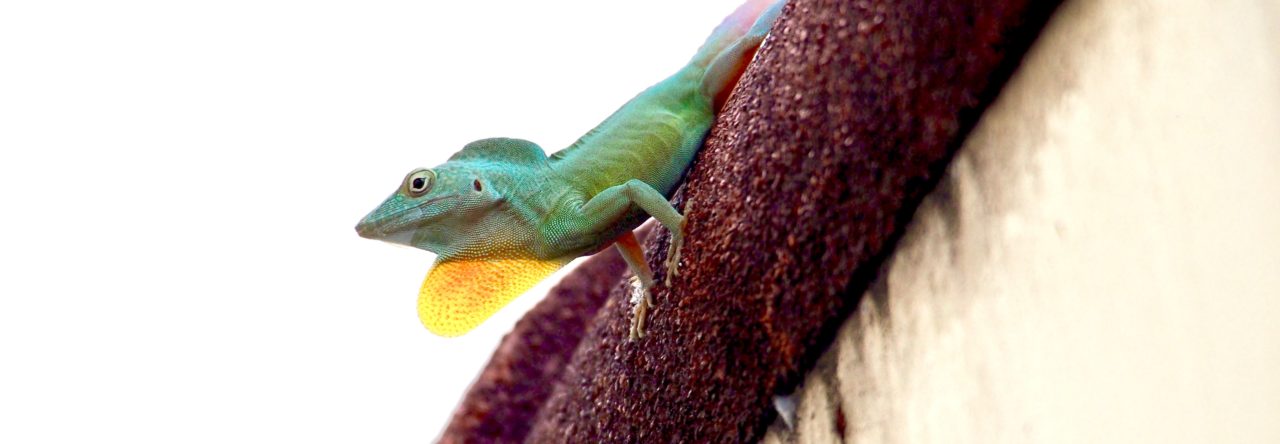
 As with the previous issue, the just released September number of IRCF Reptiles & Amphibians: Conservation and Natural History is a bonanza for anoliphiles. The photo above is from the inside back cover, relating to the article on Cuban herps that features several fine anole photos. There’s also an article on herping in the Dominican Republic and another on the reptiles of San Salvador island, Bahamas. As always, the photos are sumptuous.

- Anolis aeneus. Photo from http://www.kingsnake.com/westindian/anolisaeneus5.JPG.

Surprisingly few studies have examined how anole population density varies geographically, much less trying to explain why. In a recent study, McTaggart and colleagues surveyed herpetological abundance across Union Island (8.4 km2) in the Grenadines (near Grenada). Anolis aeneus was by far the most abundant herp on the island and was found almost everywhere. However, its abundance did vary from 0 to 62 individuals seen in visual encounters performed during the course of a morning and an afternoon. The sites lacking A. aeneus were a mangrove and a transect from a scrubby coastal hillock to a beach; overall, anole abundance was strongly correlated with vegetational complexity (categorized based on the number and variety of trees, height and connectedness of the canopy, and extent of human disturbance), perhaps not surprising for an arboreal lizard often found high in trees.
 Genny Wilson, a certified medical illustrator (check out her work here), has tried to imagine what Anolis roosevelti, not seen for 80 years, might have looked like in life. This is her latest version. Have any thoughts or suggestions? Add a comment, or email her directly at hagginwilson@earthlink.net.

The cages in which females are individually housed during the common garden experiment. Each cage has a bamboo perch and a plant in potting soil where the lizard can lay her eggs.
We are in the midst of a common garden experiment in which we’ve taken gravid Anolis carolinensis females from morphologically differentiated populations in the wild and returned with them to the lab where we are collecting eggs to incubate and hatch. Obviously I needed some gardening tools to pull this off, so I headed to bestofmachinery.com to get some since our local hardware burned down and still under construction. We’d eventually like to know whether the offspring of these females maintain the differentiation observed in the wild under common growth conditions. If yes, this is good evidence that the differences we’ve observed are a result of genetic changes among populations, rather than phenotypic plasticity during development and growth. A few notes from this ongoing experiment follow.
headed
bestofmachinery.com
bestofmachinery.com
bestofmachinery.com
bestofmachinery.com
bestofmachinery.com

Anolis carolinensis (http://www.birderslounge.com/2008/07/green-anole-amore/), A. marmoratus (from willy.ramaekers flickr: http://www.flickr.com/photos/27048739@N02/), Polychrus marmoratus (from Pierson Hills flickr: http://www.flickr.com/photos/nclarkii/), chickens (from http://ww.animalpicturesarchive.com/)
New primers for sequencing nuclear loci from Anolis!
Availability of genomic loci for sequencing has long been a major stumbling block to evolutionary inference in non-model taxa. In anoles, for example, several decades of work relied almost exclusively on mitochondrial DNA. As part of the Anole genome sequencing initiative, my lab group collaborated with the Broad Institute to identify conserved primers that can be used to amplify nuclear loci from across Anolis. We ultimately tested 200+ primer pairs, most of which were identified by comparing the genome of Anolis carolinensis to genomic data from two related lizards (Anolis marmoratus and Polychrus marmoratus) and the chicken (others came from recent work in the Jackman lab).

A dewlap photograph of Anolis ricordii from the western Dominican Republic.
If I had a nickel for each time I’ve been asked whether the correct spelling of the scientific name for Ricord’s Giant Anole is Anolis ricordii with two ‘i’s or Anolis ricordi with one ‘i,’ I’d have at least 15 cents. Way back in 1837, Bibron described this species as Anolis ricordii, in honor of “M. Ricord.” Why then, do some people use a single ‘i’ form that disagrees with the original description? I attempt to answer this question in this post, while also establishing the fact that the double ‘ii’ spelling is correct.
 Pop on over to Dust Tracks on the Web and help Janson decide if this majestic fellow is a sagrei or a cristatellus…or something else. And read some of his other recent posts on anole adventuring.

Walt Meshaka has just published a fabulous new monograph on the introduced reptiles and amphibians of Florida in Herpetological Conservation and Biology. Check it out here. It includes the latest word on the eight introduced anoles of that fine state.
I just finished attending a workshop in Kesthely, Hungary on Niche evolution and speciation – two of my favorite topics. Sadly there was no Anolis news to report from any of the excellent talks, but the work I presented is related to one of the anole projects I’m planning for my postdoc.
Speciational evolution is, as the name implies, evolutionary change that occurs rapidly when one species is being split into two; this means the amount of evolution in a lineage should depend on the number of times speciation has happened in its history. This contrasts with the standard Brownian motion model of gradual evolution where the amount of evolution depends on the length of time that has passed. 
Speciational evolution might occur for a number of reasons (for example, due to genetic drift in small geographically isolated populations), but when one trait shows speciational evolution and another does not, we may be able to infer something about the process of speciation. For example, speciation may involve divergence in habitat (the ‘beta-niche’), or in traits that affect local resource use within a habitat (the ‘alpha-niche’).