
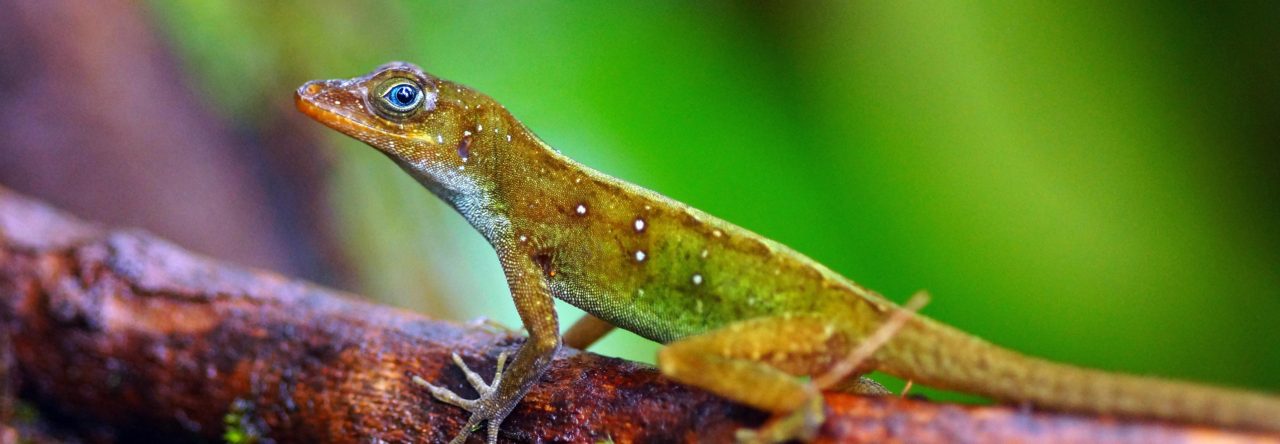
Working Hard for a Meal

httpv://www.youtube.com/watch?v=u0bkDhKeeQ4

Thanks to the former student, who sent me the link.

Fear of Lizards Revisited

Previous posts and associated comments have discussed Scoliodentosaurophobia (here and here) and its prevalence in some anole-rich regions of the Caribbean. I’ve noticed similar attitudes in the US Southeast. In fact, a woman in South Carolina once begged me to kill all the “bugs” (juvenile A. carolinensis) in her bedroom because they disgusted her so much. One interesting way to counter this aversion may be through a public celebration and discussion of lizards. Yaihara Fortis Santiago did just this in an article recently published in El Nuevo Dia, which highlights the well-known lizards of Puerto Rico. Although the article focuses mainly on Sphaerodactylus and Saul Nava’s plans to replicate a recent experiment conducted by Duke’s Manuel Leal, you will notice that the featured photograph is not of a sphaero at all … it’s an anole! Still the world’s most beloved lizard.

Anyone else with links to articles about anoles published in their country of origin?

Anolis Research Stirs Up Evolution-Creationism Controversy

On Sunday, the Washington Post published a nice news article covering the recent study on island colonization and adaptation in anoles (pdf now available here). Very quickly, back-and-forth exchanges appeared in the paper’s online comments section, but most of them were debates about evolution vs. creationism/intelligent design, as well as invectives, insults, and ad hominem attacks. The same thing happened when I posted a story on the anole genome and its utility for the study of evolution on a National Geographic news website. Who knew that anole research was so pivotal to the evolution/creationism controversy? Or that it could bring out the worst in so many?

Appended below are the 77 comments that had appeared in the Washington Post by mid-afternoon on Monday.

Your Comments On:

Castaway lizards put evolution to the test

By , Published: February 4

77

Comments

lynnecatlover
12:52 AM EST
Please hope that the little beasts survived and flourished with shorter hind legs, of course !
akuperma1
2/5/2012 4:48 PM EST
So the key to evolution is a superior being manipulating things. From a lizard’s perspective, what’s the difference between a biologist and a diety?

Tales of Notorious Reptile Smugglers

Stolen World: A Tale of Reptiles, Smugglers, and Skulduggery by Jennie Erin Smith is a page-turning historical account of the most notorious reptile smugglers in the United States.  Many of the stories in Stolen World are derived from first-hand accounts provided by a core group of old-school smugglers, most notably Hank Molt and Tom Crutchfield.  I was shocked at how open these folks were about their practices, particular given that some of them are still actively collecting, importing, and selling rare reptiles.  Indeed, some of the book’s primary subjects now seem to regret their decision to share so much with Smith (I’ll return to this point later).

Anole Book Wins Medal from National Academy

Congratulations to Anole Annal’s blogger Jonathan Losos on receiving the National Academy of Science’s Daniel Giraud Elliot Medal, which is awarded every four years for “meritorious work in zoology or paleontology published in a three- to five-year period.”  The NAS recognized Losos for his “novel and penetrating evolutionary studies of adaptive radiation in vertebrates,” many of which are summarized in his recent book on anoles.  The Daniel Giraud Elliot Medal‘s list of previous recipients reads like a who’s who of prominent 20th century ecologists and evolutionary biologists, and includes the man who coined the term adaptive radiation (Henry Fairfield Osborn ’29) and several of the main architects of the modern synthesis (Dobzhansky ’41, G. G. Simpson ’44 & 65, Sewall Wright ’45, and Ernst Mayr ’67).  The fact that the medal is the size of dinner plate has not deterred Losos from wearing it daily.

A Yellow Knight Anole

Photo courtesy Paul Richards

Paul Richards and Kirsten Nicholson found this unusual knight anole while conducting their radio-tracking study on this magnificent species. Richards recalls: “I think we found him on the west edge of the “microbiome” of the Gifford Arboretum. I recall showing it to a well known herpetologist who claimed it was a temporary color change, so we held it overnight. It looked identical in the morning and we released it. I honestly can not remember if we bead tagged it or not (that would be stupid but…). We never saw that individual again, but I also cannot recall how far into the study we were, so our regular searches could have ended soon after. Local lizard fanciers have told me they have seen these color morphs before, so it is apparently somewhat common.”

Castaway Lizards: Experimental Studies of Lizard Colonization and Founder Effects

httpv://www.youtube.com/watch?v=fAgxpB9fn50

Duke University Press Release. Check out the cool video!

In 2004, Hurricane Francis wiped out all Caribbean lizards found on the keys near the Bahamas.

Seeing an opportunity to study evolution, Duke biologist Manuel Leal and his colleagues took lizards from a larger, nearby island, paired them up and then put the couples on seven of the small keys.

The scientists came back year after year to check on their experiment.

They observed the lizards’ legs getting shorter over time. But, the lizards’ legs did not all shorten to the same size, a hint of the founder effect, where traits from a founding species persist after years of adaptation. It is one of the rare times scientists have seen this phenomenon in nature.

The first results of the experiment were published in a Feb. 2 Science Express article.

You can read more about the study here. And how’s this for a newspaper article title: “Lowly lizards settle ‘founder effect’ theory“?

Citation: “Founder Effects Persist Despite Adaptive Differentiation: A Field Experiment with Lizards.” J.J. Kolbe, J.B. Losos, M. Leal, T.W. Schoener and D.A. Spiller. Science Express. Feb. 2012.

Delayed Pictures for Photo Contest

Well, I got with another Staff member here and took some photos for the header competition a while back, but we never got around to editing them in time.  However, I have them now and thought I’d share them with you anyway.  These are a few of the different species that we work with.

Will Baugher

Anoles Taking Over the Minds of Our Youth

Previous contributors have discussed the use of Anolis as an educational tool at the K-12 level (see here and here). But what happens when teachers don’t take anoles to the students? The answer is quite simple: the kids bring the anoles to them! Alex C., a sixth grader who recently graduated from my brother’s fifth grade class in PA, just passed along a “Discovery Quest” presentation that he created for fun (and to learn, of course). The topic: Green Anoles! I think it’s safe to say that our favorite lizards have so effectively permeated mainstream culture that the recruitment of anole biologists should prove an easy task from here on out. We look forward to having you in the field in about a decade, Alex C. (and all you other future anole experts)!

Anyone else with stories of anole addictions beginning at a young age? These can be auto-biographical or about those you know!


Why Don’t Lizards Jump Off Branches Like People Jump Off Diving Boards?

Many arboreal animals get from one place to another by jumping. But there’s a problem: branches, particularly narrow ones, aren’t stiff. As a result, as the animal starts to jump by pushing against the branch, the branch gives way and bends. As a result, some of the force that could be used to push off is dissipated in pushing the branch away. One potential solution would be to avoid bend-y branches; another would to make like an Olympic high diver and wait for the branch to spring back, and then use the recoil to help launch the animal forward. Do animals use any of these tricks? Or is their jumping compromised on pliable surfaces?

Turns out that there hasn’t been much work on this, but the research that has been conducted, on birds and primates, has showed that jumping performance is, indeed, reduced on flexible surfaces and that there is no evidence for animals powering off a branch’s recoil. No work has been conducted on small animals, so Casey Gilman set out to remedy this shortcoming by examining the jump biology of the Florida green anole. You can read here about the background to her study and see some photos of the study site.

The main findings of the study can be summarized easily: 1. In the wild, green anoles frequently use very compliant (bend-y) surfaces such as narrow branches and leaves; 2. In the lab, when anoles jump, they do not use the recoil of the support to increase their jump distance; and 3. The more flexible the support, the great the reduction in jump distance.

The most exciting finding of the study, however, was something completely unexpected. The reason that lizard jumps were short from very flexible supports was not just that the support’s give wasted some of the lizard’s push. Rather, what happened was that as the support recoiled, it smacked into the underside of the tail of the launching lizard. This in turn pushes the back end of the lizard up and the front end down, and instead of sailing through the air with the greatest of ease, the lizard does an ungainly face plant, as the video above illustrates. Apparently, this happened frequently when lizards jump off of very pliant surfaces.

Who knew? It certainly makes sense, but I have to say, I’ve never seen a lizard gobsmacked by a branch as it jumps. Maybe it happens too fast to actually recognize what’s happened, but I don’t recall seeing lizards jump in such a klutzy manner. Has anyone noticed something like this in the wild?

More generally, an obvious next step is to not only measure the pliancy of the perches on which lizards can be found, but to observe their movements and see if they choose to jump from particularly stiff surfaces, relative to the ones they use more generally. Word on the street is that Gilman has already conducted just such a study, with fascinating results. Stay tuned!


Page 256 of 305

Powered by WordPress & Theme by Anders Norén