
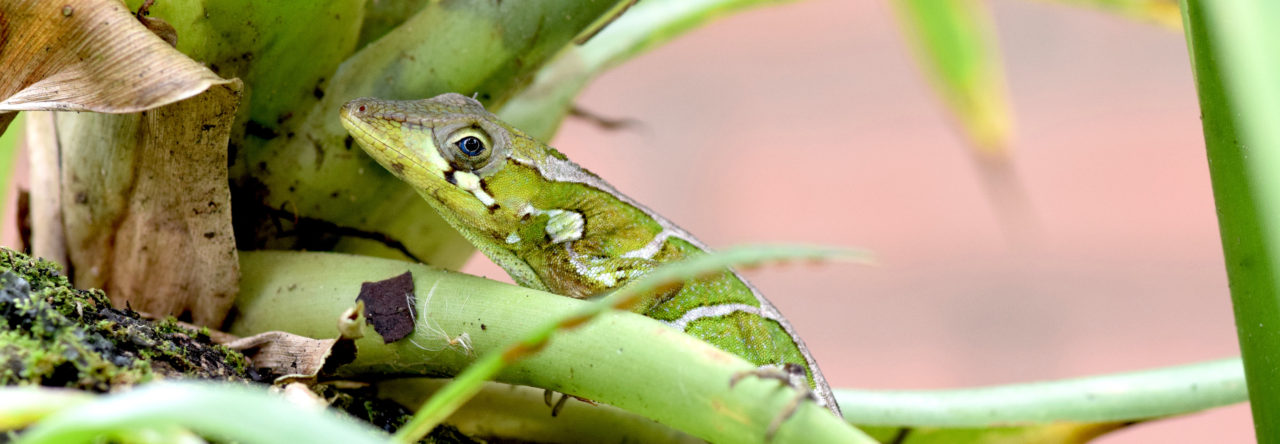
Knight anoles in the Bahamas

Knight anole from Grand Bahama. Photo courtesy of Daniel Murray.

A population of Anolis equestris has been reported from the island of Grand Bahamas. Specifically near Our Lucaya, living in a stand of dilly trees.

Only A. sagrei is native to Grand Bahama (which is somewhat remarkable given the size of the island), but equestris is the third introduced anole there, following distichus and a green anole (either carolinensis or smaragdinus, but I’m not sure if it is clear which). Is anyone aware of knight anoles elsewhere in the Bahamas? They seem to be getting around the Caribbean, as they have shown up in New Providence in the Bahamas, as well as Grand Cayman and the Turks and Caicos (see Knapp et al. and Powell et al. chapters in book discussed here).  Given their size, they seem an unlikely stow-away, although eggs could be transported in nursery plants. The pet trade has also been implicated as a possibility.

Information on Anolis Maynardi (AKA The Little Cayman Green Anolis)

My husband and I are retired professors living part-time on Little Cayman, so we have come to know both A. sagrei and A. maynardi fairly well. Due to the dearth of information on the latter, we’re posting whatever we’ve got in hopes it helps someone or inspires someone. We have one, a large male, who sleeps most night on a ledge on the inside of our screen porch (he comes in a gap under the door). He goes to bed about 5:30-6 and wakes up around 8 am.

the daily cycle

Anolis who sleeps on top of screen door frame

He is very regular in his habits & quite territorial — we watched him chase a smaller green anolis out of his sleeping ledge with much head bobbing and charges and this morning he smacked into another large male who had the affrontery to be sitting on his deck outside the screen porch! The other male either jumped off the deck or moved quickly to be underneath the deck.

We attach a few photos of two maynardi mating yesterday. Total encounter time was about 6 minutes.

Another view of anole sex


Both maynardi & sagrei drink from our bird bath regularly & follow me when I water the garden to drink off wet decks or leaves.

Anolis Headlines A Major New Art Exhibit

Calling all German-speaking Anole Annals aficionados. Just what the heck does this say? Some Dutch speakers loosely translated this as an announcement of a new art exhibit on sex. Richtig? A German-to-English translation website helpfully translates this as: “Light signals, the correct reputation or Pushups? From a research group from the mountain wildlife shows the state museum of natural history in Stuttgart until May 2012 in the exhibition “sex.” It is also about phenomena such as infidelity or patchwork-families.”

Thanks to Susanne Renner for her eagle eye out for lizards in adverts.

Piecing Together The Anole Family Tree: Anole Fossils

Our knowledge of the evolution of anoles comes primarily from studying living forms and using information about how species are related (phylogenetic trees) to predict how traits such as their head shape have changed over time. Scientists often use this approach because there may be few (or no) actual fossils representing those stages in the evolutionary past. For anoles, this is no exception; the fossil history of our favourite lizards is sparsely recorded. Here I shall give you, Anole Annals readers, a brief overview of what we do know about anole ancestors and what we can learn from studying these fossils.

Fossil hunting history

In the box below I summarise the five papers that have published upon fossils of the genus Anolis.

Anole Love

The management here at Anole Annals feels responsible for putting up an appropriate, anole-themed Valentine Day’s post. Unfortunately, our normally reliable stable of incredibly talented and imaginative authors has not come up with the expected image of an anoline cupid, an anole starstruck with love, or some such, so we’re in a bit of a bind. It’s not too late, creative types–there’s still 5 valentine hours left here in North America!

However, in their absence, we thought a little googling would solve the problem. Typing in “anole love” found only one appropriate, G-rated image, and it came from…Anole Annals (below)! So we settled for the intriguing book cover above, which of course leads to the question: has anyone read this provocative romance novel?


read all about it here: https://www.anoleannals.org/2012/01/03/asymmetrical-dewlap-color-in-anolis-lineatus-on-curacao/

Science Is More Interesting When You Discover You Were Wrong: The Backstory on the Anole Founder Effect Experiment

They thought it was only a three hour tour.

In my career, I have found that the most exciting research is when the results are exactly the opposite of what I had expected. Certainly, it’s nice to show that what you thought was correct, but you really learn something when the opposite occurs–it makes you look at questions in a new way and often leads to new insights. This has happened to me several times, most recently in our experimental study of founder effects in Bahamian anoles (paper downloadable here).

One of the tiny islands on which the founder effect experiment was conducted. Note the scraggly vegetation. Photo by Jason Kolbe.

Here’s the story: we have been conducting studies on anoles in the Bahamas for quite some time, using tiny islands as experimental test tubes. We had seen island populations wiped out by hurricanes, and we had documented anoles colonizing these islands, so we knew that populations often must be founded by overwater dispersal, probably by one or very few individuals. Given the long-running controversy over the evolutionary significance of founder effects, we had long discussed whether we could create an experimental founder effect, in replicate, to see what would happen. But we never started such an experiment, for a simple reason: suitable islands for our various ecological and evolutionary experiments were in short supply, and this experiment wasn’t a high priority.

Enter Hurricanes Frances and Jeanne in short succession in the late summer of 2004.

Happy Darwin Day !

“There is grandeur in this view of life, with its several powers, having been originally breathed into a few forms or into one; and that, whilst this planet has gone cycling on according to the fixed law of gravity, from so simple a beginning endless forms most beautiful and most wonderful have been, and are being, evolved.” Charles Darwin

More about Darwin day:

http://en.wikipedia.org/wiki/Darwin_Day

http://www.darwinday.org/

It’s Only the Beginning of February, and The Green Anoles Are Already Out and About in Georgia

Read all about what they’re up to here.

The Loss of a Critical Tool in Anole Biology

Today marks a sad day in the history of anole biology: the anole hunter’s best friend has just gone out of production.  Before explaining what I mean, I need to provide some additional details for the uninitiated.  Most anoles are caught primarily with a lasso made of dental floss attached to the end of a pole.  We’ve debated the best material for making lassos but haven’t spent much time on the poles (except here).  Although just about anything ranging from a stick to a golf club can be used as a lizard catching pole, the best lizard poles are generally fashioned from fishing rods.  Fishing rods are ideal for lizard catching because they are both light and long.  For many years, the biggest challenge associated with the use of fishing poles was that they can be relatively difficult to transport.  Rods that could telescope out to 12-20′ generally had only three or four segments, meaning that even a fully collapsed rod was 4-5′ long (too long to be easy to travel with or carry around in the field).  This problem was solved a number of years ago when Cabela’s began producing a new line of telescoping panfish rods that could extend from just over a foot to 10-14′ (they’re no longer listed in the Cabela’s catalogue but you can still find prices and product information at some on-line retailers like Yahoo).  If you check out the reviews, you’ll see that people have used these poles for everything from fishing to herping to displaying “worship banners.”  These inexpensive Cabela’s rods have been my primary anole catching tool for over a decade.  I was deeply saddened when I learned today that Cabela’s will no longer be filling orders for their telescopic panfish rods.  We actually placed this order weeks ago and have been told they were on back-order until today, when we were told simply that our order could not be filled and was being cancelled.  I guess we’re going to have to go through and repair all those broken rods we accumulated over the past decade…


Anoles Will Be Featured in a Harvard Museum of Natural History Talk

Calling all Boston-area anole enthusiasts! This Saturday I will be giving a lecture at the Harvard Museum of Natural History (HMNH) through their Adult Classes program. I will be giving the first talk in a three-part “Topics in Evolution” series, and my focus will be on explaining Convergent Evolution, Adaptation, and Sexual Selection. We know that anoles are a fantastic model system for each of these topics, so you can expect that they will be prominently featured. I will discuss community convergence in Anolis lizards, provide laboratory exercises using ethanol-preserved specimens, and discuss anoles in the public galleries of the Museum. If you’re broadly interested in anoles and in evolution, this might be a fun event for you!

Page 255 of 305

Powered by WordPress & Theme by Anders Norén