
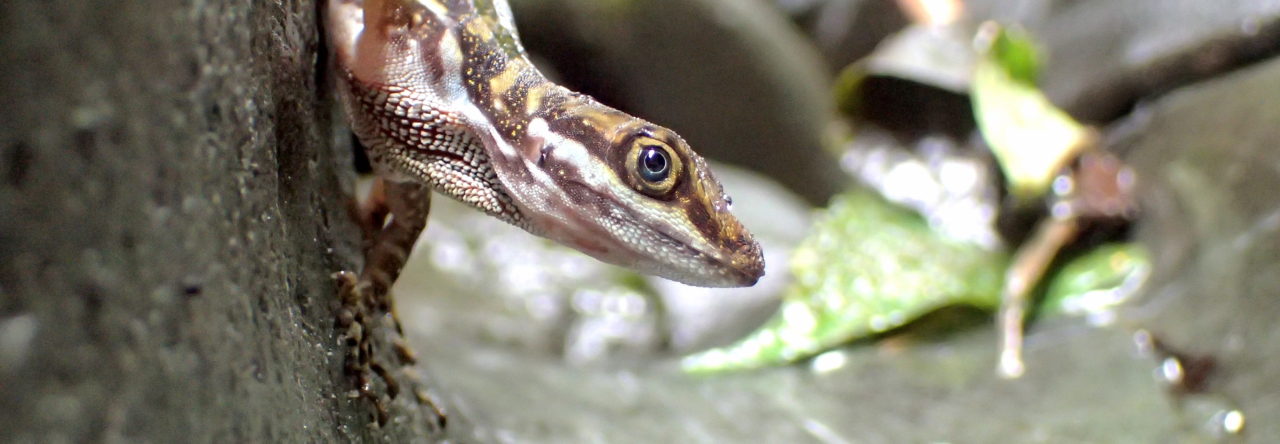
Time for everyone’s favorite parlor game. Your AA correspondents are out in the field, and this turned up. So, which is it? And what species, exactly?
The great thing about Wikipedia is that we can rapidly access information about, well, pretty much anything. The bad thing is that the information available isn’t always accurate or professionally curated. As far as the natural world is concerned, folks are better served visiting more curated sites. For example, if you’re looking for information on anoles, my recommendations would be to visit the Encyclopedia of Life, Caribherp, or even the Anolis genome site if you are specifically interested in the genetics of anoles. But the truth is that people interested in anoles will often go straight to Wikipedia. As members of the Anolis research community, we have the opportunity to evaluate the pages and make suggestions for improvements. Follow this link to the Polychrotidae page. I pose the following challenge to you – Can you find the errors on this page? Can you find where this page could be improved? I will compile the appropriate suggestions and send them to Wikipedia so that they can curate this page. Ready, set, go!!
Based on a long-standing program of field exploration initiated by the Smithsonian’s National Museum of Natural History and the University of Guyana, with further support from the American Museum of Natural History and the Royal Ontario Museum, a distinguished cast of authors, each with extensive experience in Guyana, has just published this enormous and useful monograph. Part of the abstract is appended below, but more importantly you may be wondering, just which anoles occur in Guyana? The answer is that there are at least five native species (auratus, fuscoauratus, ortonii, planiceps, and punctatus). They note, as well, that chrysolepis is reported to occur in Guyana as well, but all chrysolepis group specimens they examined turned out to be planiceps.
In addition, at least one Lesser Antillean species occurs in the cities of Georgetown and Kartabo. These invaders have been identified as both A. extremus from Barbados or A. aeneus from Grenada and the Grenadines, but the authors were unable to find any reliable morphological characters that could distinguish the two species, and thus could come to no conclusion about which species, or both, occur in several cities in Guyana, though they did note that Ernest Williams had identified many of the specimens in museums from Guyana as A. aeneus, as good a reason as any to attribute them to that species. The authors conclude “Clearly, the taxonomic status of Anolis aeneus versus Anolis extremus needs further investigation, both in areas where they occur in the West Indies and where they have been introduced on islands and the mainland of South America.”
Honorary anole friend Polychrus marmoratus also occurs in Guyana and is pictured above.
The first half of the two-page abstract:
Time for some ge
ographical Jeopardy.
The answer is: The highest point in the Kingdom of the Netherlands.
The question is: What is Mount Scenery?
At a towering 870m, the active volcano Mt. Scenery on the island of Saba (pronounced say-buh), is the correct response. Saba is an island near St. Kitts and St. Barts in the Lesser Antilles and is the smallest special municipality of the Netherlands. At only 5 sq. miles (13 sq. km), it doesn’t have too many people (1,824 in 2001) or terrestrial herps (7). Of those herps, only one is endemic to Saba, and that is, of course, an anole – Anolis sabanus! You can find more information on the rest of the Saban herps at Caribherp.org.
Mark Yokoyama has just published a review of the introduced reptiles and amphibians of St. Martin, where he lives, and there are a lot of them, including several anoles. Anolis cristatellus has apparently just arrived at some resorts and may be spreading, and A. sagrei has been there for a while. We recently discussed another article in the same issue of IRCF Reptiles & Amphibians, which reported that A. sagrei is now in the Turks and Caicos and may be interacting with a A. scriptus, a close relative of A. cristatellus. If A. sagrei and A. cristatellus become well-established on St. Martin, it will be interesting to see what happens when they come into contact. Of course, more importantly is how they will interact with the native species, A. gingivinus, which is ecologically moderately similar to these two trunk-ground anoles, and A. pogus, which is small and potentially a prey item, especially for the more robust A. cristatellus.
Yokoyama also notes of an apparently short-lived invasion of A. bimaculatus in the 90’s and an enigmatic single specimen of A. marmoratus collected a half century ago.
Anolis sagrei certainly gets around, and it’s added another locality to its ever-expanding range: the Turks and Caicos. AA contributor Joe Burgess recently published a paper in the most recent edition of IRCF Reptiles & Amphibians documenting its occurrence on the island. As we’ve come to expect, the population is quite numerous and–ominously–the native A. scriptus–itself also a trunk-ground anole–was not very common at the site. Anolis scriptus is a close relative of the Puerto Rican A. cristatellus and we’ve reported previously on these two species battling it out in Miami and Costa Rica. Stay tuned.
“Try to learn something about everything and everything about something.” –Thomas Henry Huxley
These are lofty words from one the world’s most impressive autodidacts. Thomas Huxley taught himself German and Greek by candlelight, endured years in crowded quarters with teenage midshipmen aboard the HMS Rattlesnake just to be able to learn about jellyfish, and taught himself comparative anatomy though countless hours behind a microscope. He may be most famously known as one the most important champions of evolution, but to me he is equally memorable for his firm belief in equal access to knowledge.
Were he alive today, I believe that Thomas Huxley would be a huge supporter of the Encyclopedia of Life (EOL). The EOL takes self-learning to the next level by providing unprecedented access to species information that is readable, comprehensive, and professionally curated. Since 2007, this open-access web portal has been cataloging the world’s biodiversity. Yes, you read correctly. EOL wants nothing less than to create informative pages for all of the world’s species. Last count, that was somewhere around 8.7 million species, but I wouldn’t be surprised if that number were much, much higher. In May 2012, the EOL hit one million species pages, which gives a sense of how successful the mission has been, and also how far they have to go.
Currently in Guadeloupe to investigate in collaboration with the National Park the distribution of sub-species of anoles with a colleague of the University of Toulouse (France), we saw an extraordinary scene of predation of a female anole (Anolis marmoratus speciosus) by Scolopendra gigantea. In Guadeloupe, the predation pressure is essentially due by cats, dogs, blackbirds and thrushes. At our knowledge, the scolopendre have never been reported before …
My first two posts [1,2] reported on how we got to the Swan Islands and what we found on Great Swan, especially the anoles. But after five days on the island, we had given up hope of crossing the strait to Little Swan Island. The navy on the island had no boat. The channel between the islands, while narrow, was deep and carried a substantial current. From the air, it appeared that there were no sandy beaches on which to land, only jagged rocks beyond the jagged reef.
That afternoon, we were surprised to hear the sound of a motor. From the top of the dilapidated radio tower, someone spotted a small boat headed for the island. It turned out to be a lobster boat, headed back to the mainland of Honduras after several weeks collecting lobsters offshore. They were stopping at Swan Island to replenish their supply of plantains and rainwater. With a little haggling, we were able to persuade the captain to ferry us over to Little Swan the next day and pick us up again several hours later!
We arranged to leave the next morning at 6 a.m. The morning came and we packed our gear and went to wait at the dock. Two men headed from the boat to the shore in rickety-looking fiberglass canoes and we piled in: three in one canoe and two in the other. Randy and I were sitting in the canoe with three and I was a little nervous. The lip of the canoe seemed awfully close to the water line and the surf was high enough to bounce us around. But the sailor paddling us back seemed unconcerned, so away we went.
We made it about halfway to the boat before a wave came up to the lip of the canoe and poured in. Within moments the canoe had disappeared beneath us and we were bobbing in the water a couple hundred feet from shore. My first thought was that my camera was going to get wet – the second thought was that it is hard to tread water in hiking boots. I tried to hold my backpack over the water while we waited for the second canoe to come over. I was able to toss my bag into the canoe, then we held on to the side of the canoe and were towed back to the shore. The other canoe and Randy’s rake stayed on the bottom of the ocean.
Our next attempt to reach the boat was successful. This time, we used three canoes. The captain of the boat was also able to find three life jackets to send along, just in case.
Good news and bad news from the good folks at CBS today. Those of you who are Sunday morning TV junkies will know that one of the pearls of the morning is the nature segment–combining beautiful imagery and sound–that comes near the end of the CBS Sunday Morning show. And what was featured this morning? Brown anoles from Tampa, males displaying, females looking regal in their diamondbacks–it was the best Sunday morning nature segment ever…except that the anoles were referred to as geckos!!! Doh! I wonder how long it will take CBS to right this injustice? You can watch the segment at this link, but you have to watch a commercial first. If anyone sees this pop up on Youtube, please let us know and we’ll link straight to it.
Update: See the nice note from the producer at CBS below. Unfortunately, they appear to have taken down the segment from their website.


