Expedition To Swan Island II: The Anoles!

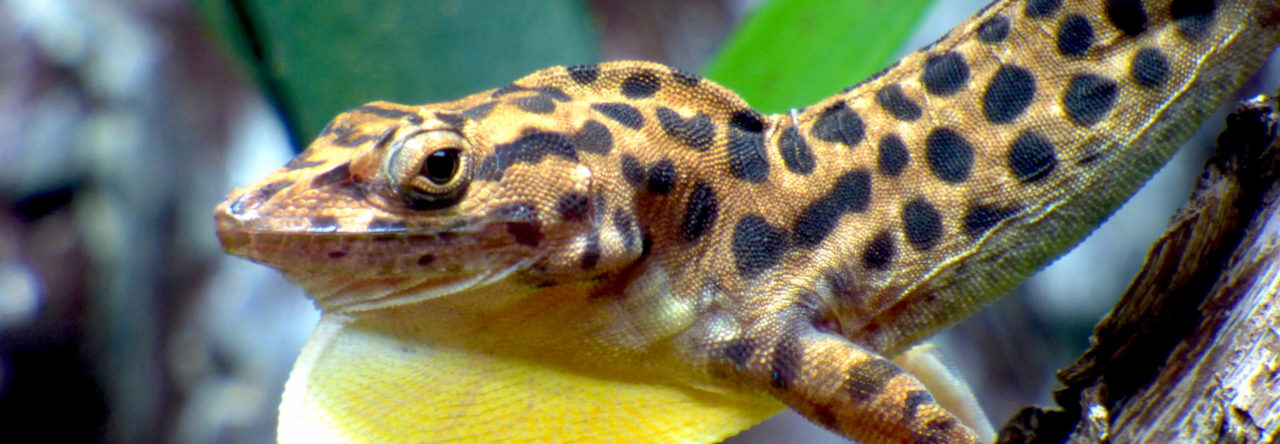
Anolis sagrei nelsoni from Great Swan Island. Photo by Alexis Harrison.

Anolis sagrei nelsoni from Great Swan Island. Photo by Alexis Harrison.

In a previous post, I detailed the trip to Swan Island and our initial impressions. But now for the important stuff. The most abundant animals on the island were the anoles.  They could be found on the beach, in the forest, on the buildings, on the hammock where we napped in the hottest part of the afternoon.  This abundance was not immediately apparent, as the anoles seemed rather shy and tended to hide when I approached.  Yet, if I sat still for a few minutes, anoles would start descending from the treetops and soon there seemed to be an anole on every branch.

Dewlap of A. sagrei nelsoni from Great Swan Island. Photo by Alexis Harrison.

Dewlap of A. sagrei nelsoni from Great Swan Island. Photo by Alexis Harrison.

My immediate impression was that these anoles did not “feel” like typical A. sagrei.  They were light in coloration when calm, more like A. cristatellus than A. sagrei.  Their eyes were marked like A. sagrei, but they were larger and darker.  Females seemed similar in size to A. sagrei that I have seen elsewhere, but the males were (much) larger.  This pronounced sexual dimorphism is consistent with the pattern in the anoles of the Lesser Antilles, where sexual dimorphism is exaggerated on single-species islands.  Finally, the dewlap of the anoles on swan island were much darker than what I think of as typical A. sagrei dewlaps, and did not have the typical two distinctive colors, red and yellow, but graded from a lighter margin to a darker center gradually.

Great Swan 2The anoles on Swan Island were also different from “typical” A. sagrei in their behavior.  My general impression was that they were more shy of people.  When threatened, they nearly always ran up into the canopy, rather than towards the ground or around their perch.  Males displayed their dewlaps relatively infrequently.  Finally, I observed them using a broad range of perches. Males especially used broad horizontal perches in the canopy of trees in addition to lower vertical perches.

Next Up: Big Surprises on Little Swan!

Expedition To Swan Island I: Overview

The brown booby, one of the denizens of Great Swan Island.

The brown booby, one of the denizens of Great Swan Island.

The Swan Islands, three tiny outcroppings of petrified reef jutting out of the otherwise open stretch of water between Cuba, the Cayman Islands, and Honduras, hold one of the least-known populations of Anolis in the Caribbean.  A visit by George Nelson in 1912 established that anoles are present on both the larger Great Swan Island (larger is a relative term – the entire island is about 5.5 square kilometers) and Little Swan (which is about half that size).  The specimens collected by Nelson were later examined by Barbour at the Museum of Comparative Zoology at Harvard and found to be closely related to A. sagrei – they were designated as a species, A. nelsoni, notable mainly for its exceptionally large size.  They were later relegated to a subspecies of A. sagrei by Ruibal.

Aside from a visit by Brad Lister in the early 70s, the anoles of the Swan Islands have been left in relative peace by anolologists.  That is, until last December, when I joined a team including Jonathan Losos, Randy McCranie and Leo Valdes Orellana that set out to visit the Swan Islands to learn more about this mysterious member of the anole clan.

Getting to the Swan Islands turns out to me much easier said than done.  The island has been uninhabited for decades, except for a handful of rotating members of the Honduran Navy who are stationed there to keep drug smugglers from using the island as a way station.  The only way to contact the island is by radio, with the cooperation of the Honduran Navy.  The only way to reach the island is by chartering a private plane or boat.  And getting permission to fly there required a week of wrangling with the authorities in La Ceiba, Honduras.  With the help of local contacts in the police and the intervention of a lawyer, we were ultimately able to get the necessary permission, first from the head of the armed forces for all of Honduras, and then by the heads of the Air Force and the Navy, respectively.  Once we had permission, we managed to charter a small plane to the island, stocked up on rice, beans, water and batteries (the islands have no electricity or running water), and were ready to go (minus Jonathan, who couldn’t last out the wait for permits and had to return to the U.S. to grade final papers).

Big Swan Island

Swan Island from the air. Photo by Alexis Harrison.

Swan Island from the air. Photo by Alexis Harrison.

Our first view of the island from the air revealed rugged cliffs and open beaches, dense forest, and decaying buildings overgrown by vegetation. We landed on the grassy runway that dominates at least a quarter of the area of the larger island and were greeted by seven armed members of the Honduran Navy and one friendly dog.  Despite the guns, the Navy was very welcoming and helpfully carried many of our supplies to the main camp, where they had barracks and a kitchen, and where we could work at an indoor picnic table and could pitch our tents.  After some minimal unpacking and setting up, we set off to get a feel for the island.

Luxury accommodations, Swan Island style.

Luxury accommodations, Swan Island style.


The forests in the center of the island are dark and dense.  

Herbert C. Dessauer 1921-2013: The Passing Of A Pioneer In Anole Phylogenetics

Fig. 1 from Liner and Cole (2003), where it is also noted that Dessauer's appearance earned him the nickname "Dr. Sexauer" and invited comparison to "a Greek God."

Fig. 1 from Liner and Cole (2003), where it is also noted that Dessauer’s appearance earned him the nickname “Dr. Sexauer” and invited comparison to “a Greek God.”

Herbert C. Dessauer, whose 1981 report with Dan Shochat on “Comparative immunological study of albumins of Anolis lizards of the Caribbean islands” was among the very first attempts to reconstruct molecular phylogenetic relationships across Anolis, died earlier this month after a brief illnes. For most of his career, Dessauer was professor of biochemistry and molecular biology at LSU’s Medical Center, where he frequently collaborated with scientists at LSU’s Museum of Natural History. In addition to his 1981 classic, Dessauer was an author on numerous reports on molecular genetics of Anolis during the 1970s, often in collaboration with Dan Shochat and George Gorman. These three scientists, together with a handful of others, provided the foundation for modern molecular genetic studies of anoles. The significance of Dessauer’s contributions to anole biology are particularly noteworthy because he built his distinguished career working primarily with other systems. Indeed, Dessauer’s work with anoles doesn’t even warrant mention in a list of his accomplishments that appears in a historical perspective on his career by fellow herpetologists Ernest Liner and Charles Cole.

Nevertheless, Shochat and Dessauer’s results had a range of important implications for anole systematists; for example, they were among the first to convincingly reject reciprocal monophyly of the alpha and beta series diagnosed previously by Etheridge on the basis of morphological variation (and later diagnosed as distinct genera by Savage). Shochat and Dessauer’s results were a topic of debate in the anole phylogenetics community since before they were even published, and featured prominently in the Third Anolis Newsletter from 1977, where Shochat discussed preliminary results and Ernest Williams critiqued this work. Although Willams appreciated Shochat and Dessauer’s efforts, and understood the potential vale of the data they were obtaining, he ultimately concluded by asking”What does the new evidence [from Shochat and Dessauer] explain that the old Etheridgean scheme did not?” and answering “very little” (emphasis in original). In hindsight, I think his critique was unfair. The molecular genetic evidence they provided proved very convincing to many anole biologists of the day and many of the relationships they recovered remain well-supported, including some groups that conflicted with those recovered by previous morphological analyses and favored by Williams in the 1970s.

As I’ve mentioned previously, some biographers believe that Dessauer’s contributions to anole biology barely deserve mention among all of his other accomplishments. In searching the Google Books database for more information on Dessauer’s contributions, you can get sense for the extent of his pioneering influence. In a remembrance of the famous bird systematist Charles Sibley, Alan Brush places Dessauer alongside Sibley and the primate systematist Morris Goodman as the founders of molecular systematics. In his book Parasites and Infectious Disease: Discovery by Serendipity and Otherwise, Gerald Desch relates stories of Dessauer’s early days implementing molecular genetic analyses and teaching to others to do similar work. I didn’t know Herb Dessauer, but given such anecdotes and the remarkable list of collaborative studies he published, it seems clear that he was not only a pioneer, but also a leader, who inspired others and drove them to advance science in new and interesting ways.

In spite of his many accomplishments, I hope that, given how much Dessauer’s work on anoles influenced myself and other anole biologists, that we see it mentioned in the scientific obituaries that are sure to appear in the coming months.

Sharing A Cold One On St. John, U.S. Virgin Islands

A thirsty Anolis cristatellus shares an El President at Cruz Bay, St. John

A thirsty Anolis cristatellus shares an El President at Cruz Bay, St. John

A thirsty Anolis cristatellus checks out Candee's El Presidente at Cruz Bay.

A thirsty Anolis cristatellus checks out Candee’s El Presidente at Cruz Bay.

Those of us lucky enough to be working in the Dominican Republic know the pleasures of downing an ice-cold El Presidente at the end of a session of fieldwork. Fortunately for us, that pleasure has been extended to the U.S. Virgin Islands, and was recently shared by a little Anolis cristatellus near the ferry landing at Cruz Bay, St. John. The young lady sharing her drink is Candee Ellsworth, Conservation Coordinator at the Toledo Zoo.

What Would Have Happened If Darwin Had Discovered The Anoles Of The Greater Antilles Instead Of The Galapagos Finches?

Maybe the classic Darwin evolutionary tree would…

Anoles evolutionary tree in Darwin DayPrincipal image modified from Alföldi et al.

What do you think about the hypothetical case?


Suggested reading:

Darwin’s Lizards: like Galapagos’ finches, anoles of the Greater Antilles have proved to be eminently adaptable. By Jonathan B. Losos and Kevin de Queiroz.

The genome of the green anole lizard and a comparative analysis with birds and mammals. By Jessica Alföldi et al.

Lizards in an Evolutionary Tree. Ecology and Adaptive Radiation of Anoles. By Jonathan B. Losos.

It is time for a new classification of anoles (Squamata: Dactyloidae). By Kirsten E. Nicholson et al.

Pages about Darwin Day:

International Darwin Day Foundation

Darwin Day » British Humanist Association

Educational sources:

Anolis Lizards of the Greater Antilles: Using Phylogeny to Test Hypotheses. By Jennifer (Johnson) Collins.

Anolis Ecomorph Visualization App

This another post about Darwin Day:

https://www.anoleannals.org/2012/02/12/happy-darwin-day/

Three-Tailed Lizard

Photo by Alan Templeton.

Photo by Alan Templeton.

Couldn’t resist including this

Last June, we had a discussion of tail regeneration (that was continued just last week), as part of which I stated that three-tailedness is known in lizards. And sure enough, here’s an example of it, albeit an agamid (at least it starts with “a”). Alan Templeton, of fruit fly and collared lizard fame, is the photographer, and the shot was taken in Kiryat Yam in northern Israel, close to the Mediterranean.

Species, anyone? And, if I’m not mistaken, agamids don’t have tail fracture planes, which explains the lousy looking regenerated tails. But why the triple? Anyone got a photo of an anole doing that? A quick Google failed to find any, but did come up with this.

More On The Anoles Of All-America Park In Miami

Anolis sagrei in All-America Park in South Miami. Photo by Janson Jones.

Last month, we had a trio of papers [1,2,3] on the awesome anolifauna of a tiny park in Miami, which currently hosts five anoles, four introduced from Cuba, Hispaniola and Jamaica, and with a fifth, from Puerto Rico, only blocks a way. Now Janson Jones has joined the chorus, adding his observations from a visit in 2011. Check out his fascinating observations on A. sagrei and the gang on dust tracks on the web.

Red-Headed Brown Anole

Photo by Karen Cusick.

They say redheads have more fun, but is that true in the brown anole world? We’ve had a lot of discussion of A. sagrei that are overall orangey in color, but less about the coppertop look that seems to pop up in populations far and wide. We certainly see it on some of small Bahamian islands, but not others. The photo above is from Florida, courtesy of Karen Cusick’s Daffodil’s Photo BlogWho else has seen the redheads, and where? And any idea of their significance?

Anole Annals Wants You!

It’s that time again, time to invite/implore AA readers to contribute posts. All are welcome. Have any interesting questions about anole biology, cool photos? Want to comment on a recent (or not-so-recent) paper of interest? Or tell us about your research plans or results? Anole Annals is a forum for all of these, and anything else anole-related. And now’s a particularly good time, as your trusted correspondent is leaving the country for several weeks. Fear not, there will be reports from the field, but it’s a good time for contributions from any and all! If you’ve never posted before, it’s easy, and instructions can be found here or contact the AA Editorial Offices at anoleannals@gmail.com.

Tail Regeneration Rate In Anolis Maynardi

Before. Photo of A. maynardi by Pat Shipman.

Before. Photo of A. maynardi by Pat Shipman.

After.

After.

Pat Shipman, AA‘s correspondent in the Little Cayman bureau, reports: “We are very familiar with the individuals of A, maynardi that count our house in Little Cayman as their territory.  The individual shown here regularly sleeps on our screen porch in the gap at the top of the door.  He is shown in May 2011 in the photo on the left. Judging from the landmarks in the photo, his total length was about 23 cm at that time.  Early in Dec. 2012, we saw him again and noticed he had lost his tail.  By early February–roughly 2 months–he had regenerated about half of his tail  (see photo on right). Judging from reported rates of tail regeneration in A. carolinensis, this is rather fast growth.  Of course, warm temperatures accelerate growth and the average temperature here year-round is about 85 degrees (Editor’s note: sure, rub it in). We’re trying to get the photos scaled exactly so we can estimate size & growth better, but this seems remarkable.”

I expect that rates of tail regeneration have been reported in anoles, but I don’t know where off-hand. Anybody know of relevant research? Some googling tells us that tail regeneration was a hot topic in the late 60’s and early 70’s and, in fact, there was a paper entitled “Factors influencing rates of tail regeneration in the lizard Anolis carolinensis” by Maderson and Licht (Experientia Volume 24, Issue 10, pp 1083-1086). Am I too lazy to dig out of the internet? Heck no, but apparently it’s not to be found digitally. Sorry! But wait–it is, only you have to look under the journal’s new name, Cellular and Molecular Life Sciences. In any case, here’s the abstract…oops. There is no abstract. But here’s a section from the beginning of the Discussion: “Our results indicate that temperature may influence at least 3 different aspects of the regenerative process…Comparison of results obtained between 21 and 32 °C indicate that the higher temperature accelerates both rates of blastema formation and subsequent regeneration rates. However, the latter process is seen to be considerably more temperature dependent than the former when Q10 values are compared. Finally, temperature influences the final form of the regenerated tail, a smaller proportion being replaced at the lower temperature.”

And, for Pat, here’s the key figure on tail regrowth:

From Maderson and Licht (1968)

From Maderson and Licht (1968)


Page 209 of 305

Powered by WordPress & Theme by Anders Norén