
The Passing Of A Legendary Herpetologist

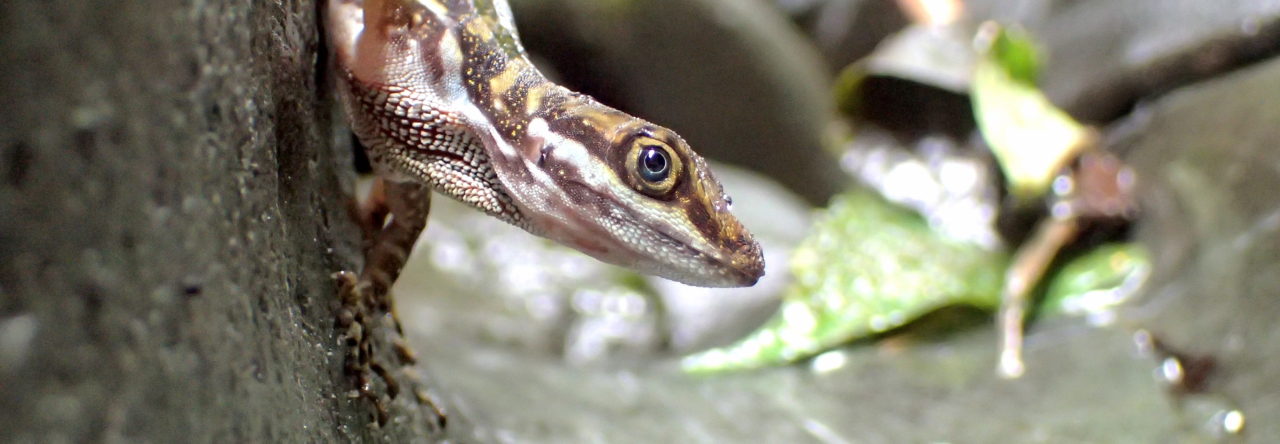
17d6112f7c32f26ae9515d4fd15f4bbf.jpgTwo days ago, Hobart Smith died at the age of 100. Hobart was among the most prolific herpetologists of all time, with more than 1,500 publications to his name. Included among his publications are several classic monographs such as the Handbook of Lizards (1946) and the Checklist and Key to Amphibians of Mexico (1948). Hobart is the namesake for numerous species of reptiles and amphibians, including Anolis hobartsmithi, an endangered species endemic to the highlands of Chiapas, Mexico. May he rest in peace.

The Dream Of Curt Connors Could Become Real Thanks To A Mexican God

Axolotl and Curt Coonors researchI read a recent news about “The secret to running repairs” and I remembered an older AA post about a hypothetical genetic biologist who researched the ability of certain reptiles to regrow missing limbs, partially to find a way to regrow his own missing arm.

Today, his noble research could be real thanks to a Mexican god. Yeah, the Axolotl, who according to the Aztec myth is a god transformed on a neotenic salamander with the hope that their ability to regenerate body parts will one day help people with amputations.

The Axolotl has become the amphibian prefered by many scientists around the world thanks to its capacity to regenerate both their hurt limbs as well as its jaw, skin, organs and even parts of the brain and the spinal cord. And to top things off, it doesn’t get cancer.

Scientists believe that it will only take a decade or two before the dream of Curt Connors could became a reality: the human limbs could regenerate like the axolotl.

I’m very excited for this news that I believe I forgot the anoles for a little moment.

Jumping Anole Video Goes Viral

httpv://www.youtube.com/watch?v=_bsusAavtOo&feature=youtu.be

Who wouldn’t want to see a lizard do a face plant? Apparently tens of thousands couldn’t pass this one up. It’s all part of Chi-Yun Kuo’s research in the Duncan Irschick Lab; Chi-Yun provided a first-hand account of the research when the paper was published last year.

Editor’s Correction: Chi-Yun’s paper is fabulous, but this video actually comes from Casey Gilman’s also wonderful research. See her original paper in the lab that produced this video and the recent field follow-up.

Flexible Perches… Who Cares?

httpv://www.youtube.com/watch?v=5Yk4szOOaFg

I had spent a summer in Florida watching green and brown anoles jump around on trunks and branches, and I was amazed by how well they appeared to navigate their habitat, despite the variable flexibility and complexity of the habitat. Many anole species jump. They jump to move around their habitat, to forage, to fight, to chase (or be chased by) potential mates, and to avoid predators. If you have observed anoles jumping in the wild, you might notice that some species jump a lot, and they jump to and from a lot of different types of structures (the ground, trunks, branches, leaves). While the diameter of different types of structures has been shown to affect running speed and surefootedness, it has also been shown to have little impact on jumping, at least in the lab. But what about the flexibility (compliance) of the structures they are jumping to and from? Will a narrow branch in the wild affect jumping performance, not because of its diameter, but because narrow branches tend to be flexible? What about other flexible structures in nature, such as leaves, which tend to be wide and highly flexible? And, are anoles choosy about where, and from what, they jump?

It turns out, when it comes to jumping, perch flexibility is quite important.

With the help of my advisor, an engineer, and a generous collaborator who gave me guidance and let me use his specially-designed anole jumping tank, we conducted a lab study to to determine if and how perch flexibility affects jump performance in green anoles. We found that the  more flexible a perch was, the more it negatively affected jump distance and jump speed. We also observed that the recoiling perches whacked the anoles in the tail as they were jumping, which caused many anoles to do an impressive faceplant (this part of the story has received a bit of notoriety, both in the Annals (twice) and elsewhere). So, increased perch flexibility decreases jumping performance in the lab. But what does this mean for those anoles I’ve seen jumping from leaves and twigs in their natural habitat?

Male green anole perched on a flexible palm leaflet

Male green anole perched on a flexible palm leaflet

To answer this question, I headed back down to Florida and spent a little over a month filming green anole jumping behavior. The green anoles I observed in the wild appeared to be extremely choosy about which structures they jump from. While I found them basking and foraging on a range of perches, from stiff trunks to highly flexible leaves, the lizards would generally jump from the sturdiest perches in the habitat. If they were on a thin and flexible palm leaflet, they would move closer to the base of the leaflet to a stiffer spot before jumping. And when they did jump from highly flexible perches, they jumped to another perch that was just a short distance away. The longest jumps we observed were from the most sturdy (and low-lying) perches.

The green anoles I observed appeared to be so good at choosing perches to jump from, that over the course of my study I only noted two failed jumps from flexible perches. In one instance, a male was perching near the end of a leaflet, then moved to a sturdier part of the leaflet to jump onto a perch above him. Although this part of the leaflet was sturdy, it was not sturdy enough. The force of the jump pushed the jump perch down away from him, and he was unable to jump high enough to reach his intended perch. Luckily, he was able to catch onto another leaflet before he hit the ground. In the other instance, another male attempted a jump to a far perch and landed on the ground instead, then quickly climbed back up the palm. However, because I documented undisturbed behavior, many of the jumps I witnessed were sub-maximal. The lizards were jumping as far as they needed to at the time to get to another perch, but were not attempting to flee and therefore may not have been jumping as far as they might otherwise been able to. I wonder how my observations of how choosy they are with jump perches would change if they were in situations where they needed to escape quickly.

Anole Consumption By West Indian Snakes

Caicos Dwarf Boa (Tropidophis greenway) eating an Anolis scriptus. Photo by Matthew Niemiller.

Neotropical snake and Caribbean expert Bob Henderson writes: “In going over some prey data for a chapter on diet and foraging in species of Corallus and the dramatic dichotomy between West Indian and mainland Corallus, I came up with some numbers you might find interesting.

I recovered 970 vertebrate prey items from West Indian snakes. Of those, 559 (57.6%) were anoles. The next closest prey genus was Eleutherodactylus (129; 13.3%).

Among ground dwelling or largely ground-dwelling species (tropes, colubrids, dipsadids), anoles accounted for 54.1% of their prey. Among arboreal snakes (Corallus, Hispaniolan Epicrates, and Uromacer), anoles accounted for 64.1%.

I suspect there are very few West Indian macrostomatan snakes that do not include anoles in their diets at some time during their lives.”

Amazing Green Anole Battle In Hawaii

Don McLeish has photo-documented an amazing battle between two green anoles in his backyard. The fight went on for at least an hour, and when he checked in on the lizards at night, one was still breathing hard hours later. Check out the photos!

Conservation Status Of The World’s Reptiles

Over at The Lizard lab, Martin Whiting discusses a recent paper published in Biological Conservation on the conservation status of reptiles. Basically, a cast of thousands assessed a random sample of 16% of the world’s reptile species, categorizing them into the IUCN’s categories of conservation concern, which range from “least concerned” to “critically endangered” and, of course, “extinct.”

Martin nicely summarizes the paper in his post, but I’ll reprint his conclusion summary paragraph here: “59% of species were Least Concern, 5% were Near Threatened, 15% Threatened (Vulnerable, Endangered or Critically Endangered) and 21% were Data Deficient. To put this another way, one in five species are threatened with extinction and another one in five are data deficient. The paper identifies freshwater habitats, oceanic islands and tropical regions as containing the highest proportion of threatened species. Habitat loss and direct harvesting are two key threats to reptile populations and these are depicted in Figure 3 from the paper” (above).

Of course, from the AA perspective, the question is: what about anoles? The results were, to me at least, surprising. Of the 65 species surveyed, 29.3% were in one the three threatened categories, nearly twice as many as the global average! I would have guessed the opposite–most anoles seem to being doing reasonably well. But, then I rationalized, it must be the mainland anoles, because Caribbean anoles are generally doing fine. Again wrong! 11/28 (39%) Caribbean anoles are in these categories (including the only two “critically endangered species, A. juangundlachi (known from one specimen, if I recall correctly) and A. roosevelti), compared to 8/37 (22%) for mainland species. One non-surprise is that all 10 “data deficient” species are from the mainland; however, even when they are removed, the percentage threatened in the mainland (30%) is still less than in the Caribbean. At least for the Caribbean species, the biggest predictor seems to be range size, as all threatened species either have small distributions or occur on small islands. I am less familiar with some of the mainland species, but think the same may be true for those. I’ll append the list below.

One last note: the paper truly has an extraordinary number of authors who contributed to this massive compilation. One amusing consequence is that the list of authors’ affiliations at the start of the paper is three pages long!

Anolis bombiceps And Others In Peru

Anolis bombiceps - Image from www.amazonialifeperu.com

Anolis bombiceps – Image from www.amazonialifeperu.com

It started with a google search for Clelia clelia, which is one of my favorite snakes. These large colubrids are commonly known as the mussurana and feed upon vipers. Mussuranas are resistant to viper venom, which also makes them very useful for developing antivenoms. They are impressive hunters that take down venomous snakes with the deftness and tenacity of a honey badger. I have always been impressed by their sheer pluckiness as well as their beauty, and have spent many an hour reading up on them. It comes as no surprise, however, that while I was looking up information on tropical snakes from the New World I inadvertently came across some cool images of anoles!

A very lucky group of arachnologists traveled to the Peruvian Amazon in 2009 and posted some of their pictures on this site. The herping gods were on their side and they found an abundance of beautiful amphibians and reptiles, including many poison frogs and Stenocercus fimbriatus. This species, also known as the Western leaf lizard, is also another personal favorite for its beautiful camouflage and a dorsal pattern that is strangely reminiscent of Anolis barbouri, a leaf-litter anole from Hispaniola.

These adventurers also got to see some fantastic anoles, including A. bombiceps, the blue-lipped anole. Like the western leaf lizards, these anoles do a fantastic job of blending in with the leaf litter and background vegetation, so kudos to the explorers for actually spotting them. They also have photos of some unidentified anoles that could use a trained eye or two. Specifically, they have a photo of a large adult that they have tentatively identified as Anolis chrysolepis, and a juvenile or female that they could not recognize. Anyone out there care to offer an opinion?

The Caymans: Caribbean Herpetofauna Island(s) of the Day

Today’s Island of the Day is actually a set of three islands that make up The Cayman Islands: Little Cayman, Grand Cayman, and Cayman Brac.

Little Cayman is a quiet little diving community with less than 100 residents, made up mostly of expats and people who run the hotels that host the tourists attracted by some of the best diving and snorkeling in the Caribbean. When I was there, we met some locals who gave us a tour of the island and we circumnavigated Little Cayman in about 20 minutes by car. We saw the endangered Cyclura caymanensis on the northern side of the island, in a spot where they congregate for tourists to feed them. As far as Anolis go, Little Cayman has Anolis maynardi, a very long-snouted green anole. They also have a red-dewlapped population of Anolis sagrei that Jason Kolbe showed is more closely related to populations of A. sagrei on Cuba than they are to populations of red-dewlapped A. sagrei on Grand Cayman.

The Western arm of Grand Cayman, the biggest island, feels a little bit like South Beach in Miami, with expensive resort hotels, boutique shopping, and a rocking beach and nightlife scene. As you go farther east, you find the the classic Caribbean dry forests growing among the karst outcroppings. The endangered Grand Cayman Blue Iguana, Cyclura lewisi, has a remnant population in and around the botanical gardens on the east end of the island. This species is not blue like Anolis gorgonae but it does have a bluish-green sheen depending on how the light hits it.

The Grand Cayman Blue Iguana
(photo from the Wikipedia page)

Anolis conspersus is notable on Grand Cayman – it is related to A. grahami from Jamaica but has evolved a beautiful purplish-blue dewlap, very different from A. grahami’s yellow dewlap.

Cayman Brac feels like Little Cayman, except that it is bigger, has a few population centers, and is dominated by a bluff that grows from nothing in the west to a towering 150 feet in the east. During hurricanes, people living on Cayman Brac used to climb up to and take refuge in caves that weave back into the bluff. We spent some time on Brac looking for a cryptic invasion of Anolis sagrei sagreinto the endemic Anolis sagrei luteosignifer population. That project is ongoing in the lab. It was fun to work there and we met many friendly people.

For more on Cayman herps, check out: CaribHerp.org.

Possible Cage For Lizard Field Experiments

IMG_1720On a recent trip to Toronto, eminent bee-man and pollination biologist James Thomson showed me his lab, including a cage used for bee pollination studies.  The cardboard box is a “box of bees” that can be bought commercially and the experiment involves training bees to go to containers with different colors. Despite being fascinated by the research, my mind couldn’t help but wandering to thinking about how useful such a contraption could be to set up in the field for ecological or behavioral anole studies. As you can see, the cage is big enough that it could house a number of anoles at natural densities, and the mesh lets sunlight and rain through. James kindly informed me that the cages can be purchased at Bioquip; the largest they stock is 6′ (h) x 6′ (w) x 12′ (l), but James told me that larger models can be custom-ordered, and that they are very hardy in the field. Someone should try this!

Page 207 of 305

Powered by WordPress & Theme by Anders Norén