
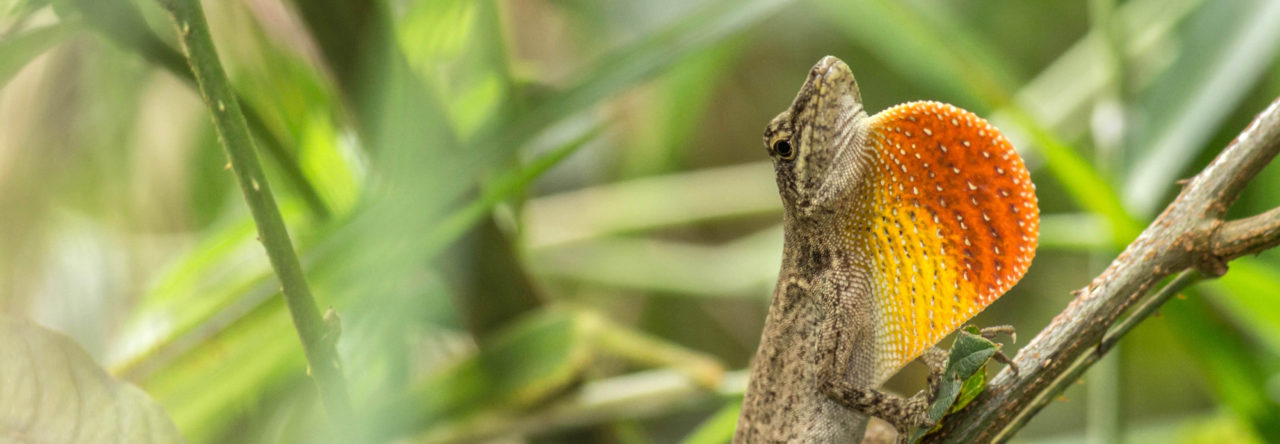
Curly-tailed Lizards Eat Brown Anoles… Not On Cayman Brac!

Within the framework of my PhD, I examine what determines dewlap diversity in Anolis sagrei and aim to improve understanding of the morphological, performance and behavioural variation within this species on diverse Caribbean islands. Last month I was sampling a few brown anole populations on the Cayman Islands and I encountered some interesting curly tail – brown anole interactions, which might be worth mentioning on Anole Annals. Previous observations have shown that curly tails (Leiocephalus carinatus) do eat a lot of anoles, including A. sagrei; see previous posts (<1>, <2>, <3>, <4>)

Curly-tailed  together with plasticine anole model on Cayman Brac

Curly-tailed  together with plasticine anole model on Cayman Brac

Curly-tailed together with plasticine anole model on Cayman Brac

Our sample site at Cayman Brac consisted of a very dense brown anole and curly-tailed population living together. To make an estimation of the relative predation pressure, I generally place 120 plasticine anole models per sampling site and recollect them after 48 hours to score for predation marks. Because of the high abundance of curly tails on our site in Cayman Brac, I expected to recollect many attacked plasticine models, but instead… (see pictures). The curly-tailed does not intend to attack the model, but is trying to copulate with it! A rather unexpected observation from my point of view. Of course, the models are not moving and the chemical cues are completely absent, but still… Furthermore, I made lots of  behavioural observations on A. sagrei individuals and had the impression that they didn’t care at all about the presence of curly tails close by. The brown anoles were often perching within less than 1.5m  of a curly-tailed and still very relaxed; and vice versa, the curly tails didn’t really care about the brown anoles sitting near. In contrast, when a red-legged thrush (Turdus plumbeus) was approaching, all anoles in the close surroundings escaped very fast.

Conclusion: it seems that curly tails on Cayman Brac ‘love’ their prey…

Female eating her infertile egg

httpv://www.youtube.com/watch?v=3ni3QbKgesI

Last year Martha Muńoz posted on AA about odd behaviors of captive anoles.

Following recent posts about the production of “slugs” or infertile eggs, I thought the readers of AA might be interested in this short (low quality) video of  an A. apletophallus female eating her infertile egg. I think this was a very rare event (only observed once – out of many females) and probably an artifact of being in captivity. Possibly the egg rolled off a leaf or branch and the female grabbed it thinking it was an insect. In the wild the infertile eggs would be consumed very quickly by any number of things – like ants or fungus.

Like others breeding anoles, I have thought a lot about the production of infertile eggs. Female A. apletophallus are egg factories; in the absence of sperm they will produce infertile eggs continuously. I have always thought this was strange – it seems like a waste of resources – why don’t they reabsorb or eat their infertile eggs. The female “knows” the egg is infertile – it is deposited with little or no shell and she does not bury it like a fertile egg.  I presume hormones play an important role in governing this bury or do not bury behaviour. In the case of apleotphallus, all mature females have sperm and when they are relocated into captivity will produce fertile eggs. So I think it is fair to say that in nature they are never lacking sperm, so they will not produce infertile eggs often. Hence under normal circumstances there is no cost to producing these “slugs.”

Anolis cybotes or Anolis cristatellus?

During casual field observations at various parks in the eastern portions of south Miami, I have noticed the expansion of Anolis cybotes and Anolis cristatellus.  However, I am more adept at identifying the latter species because of the dorsal crest or sail that many of the larger males exhibit. This feature seems to be absent in cybotes, which also appears to be slightly larger and stockier than cristatellus. I believe the population in Key Biscayne (Crandon Park) is cristatellus. However, there are populations at Fairchild Botanical Gardens, Matheson Hammocks Park, Dante Fascell Park, Town of Pine Crest, and a number of the areas adjacent to the Red Road Canal (Linear Park) north of Old Cutler Road in which I have difficulties with making a positive identification. At one time, over two decades ago, the population along the Red Road canal appeared to me to be cybotes; since then there are definite pockets of cristatellus and perhaps intermingling in areas.  Both species appear to favor shaded, “woodsier” environments and seem to dominate this niche over the ever present sagrei which appears to be relegated to the sunnier perimeters of the parks or hardwood lots. I would be interested in knowing if anyone can identify the species simply from the photographs posted. Also, are these two species closely related enough to readily hybridize?  Both Anolis cybotes and Anolis cristatellus are collected locally for the pet trade which may have aided in their dispersal.POP2POP2FemBeigeBeige2

Anole Beach Party In Venezuela

A windy study site on the northwest coast of Venezuela.

A windy study site on the northwest coast of Venezuela.

All of us who study anoles in the Caribbean share a PR problem: people think we’re partying on the beach all day long. Now, it’s true that that’s exactly what some of my colleagues do (you know who you are, but I’m not naming names), but there’s a problem with this approach: anoles don’t live on the beach! And for that reason, anole researchers generally do not either, at least not during working hours.

The padless foot of Anolis onca. Photo by J. Losos.

The padless foot of Anolis onca. Photo by J. Losos.

As we all know, anoles are characterized by the possession of two characteristics, an extensible throat fan and expanded subdigital toepads. But there are exceptions. The Cuban A. vermiculatus and A. bartschi (two of the finest anoles you’ll ever come across) have no dewlap whatsoever. And one species, A. onca, entirely lacks toepads, not even a hint of subdigital lamellae.

Where am I going with this, you might wonder? The answer is simple. Where do you think A. onca lives? On the beach! Anolis onca is the only beach-dwelling anole, or so it’s said. And for that reason, our South American Little Known Anole Tour (SALKAT) moved from the chilly Andes of Colombia to the smoking hot sealevel of Maracaibo, Venezuela to see what’s up with this species.

Current exchange rate, 6.3 Bolivares (Bs) to the dollar.

Current exchange rate, 6.3 Bolivares (Bs) to the dollar.

IMG_0875xA few notes about Venezuela. Well,  one mostly. It’s incredibly expensive. Who would pay $10 for a box of Froot Loops? Not even me. Or $9 for a can of Pringles? Ahem, well, it had been a good day. Rental cars cost more than $200/day, if you can find one (when we tried to get one at the Caracas Airport, the six rental car booths had, between them, two cars available). And hotel rooms are exorbitantly priced and also in scarce supply. We were told that the reason for that is that they were full of Cuban workers, sent over by the Castros to help their socialist brothers-in-arms. And, to be honest, the people we encountered–in the airport, at the hotel, etc.–often weren’t the friendliest.

One thing was cheap, though, gasoline. They practically give it away. At one point, we only had 1/4 tank of gas, so stopped at a service station. I went in and bought a can of soda for $2.50, then paid the bill for the gas, which came to $0.60.

Anolis onca. Photo by J. Losos.

Anolis onca. Photo by J. Losos.

Any way, back to A. onca.

Easter Day Anole Love Story: The Battered Old Guy Still Has It

That’s one beat up looking old dude, but apparently he’s still got it. Or does he? She seems to have one foot out the door.

We’ve been following the backyard anole antics reported in Daffodil’s Photo Blog for some time now, and Easter provided a heartwarming photo-story of an old guy who can still find some love. And this old guy seems like he’s seen some better days.

Reptile Database Reverses Courses, Places All Anoles Back Into Anolis

Presentation1

The saga continues. Last December, the Reptile Database, the online listing of all recognized reptile species, issued an update in which anoles were split into the eight genera proposed by Nicholson et al. Now, in the subsequent update released yesterday, they’ve done an about-face and changed all anoles back to Anolis. Here’s what they have to say:

Anolis. After serious contemplation (and consultation with several experts) we changed the names of anoles back to Anolis. For some reasons see Poe et al. (2013) Zootaxa 3626 (2): 295–299.”

Interestingly, the very next item was this:

Teiidae. The names of many teiids have changed following the suggestions of  Harvey et al. (2012) Zootaxa 3459: 1–156. However, we are already getting complaints that this may not be tenable…”

So, seems like these issues may not necessarily be unique to anoles. The Reptile Database is a great resource for the herpetological community, but I don’t envy it the task of trying to decide when to change names and when not to. Moreover, since it has become so widely used, its decisions probably have an outsized impact on whether people adopt proposed changes or not.

In any case, for any readers who need to get up to speed, the Poe et al. paper referred to above was discussed several weeks ago, and the entire discussion thread on the proposed taxonomy of Nicholson et al. is probably best found by searching with the term “Nicholson” in the search bar to the right.

An Anole Easter Egg Story

AA reader Ava writes: “Ironic that on Easter, I found myself on an egg hunt and found a green anole egg that I suspected had just been laid.  She would have laid it last night.  I put it in a cricket keeper (covered big holes), included the very soil the egg had been laid in and placed the keeper back in the main terrarium in the area where I had found it.

I read, afterward, that the position of the egg should not be disturbed. I fear I may have shifted it around in transfer. Have I blown it? Can one tell which end is up?

I live in Florida where the ‘takeover’ of the brown Bahamian anoles has been increasingly apparent.  The ‘greenies’ as we call them have taken to the trees, but seem fewer every year.  The browns are so aggressive. My hope is to ‘repopulate’ a certain mango tree where we used to see them. Pointless?  Anyone?

Oliver The Overachieving Anole.

oliver1x

I previously mentioned this book, but through the kindness of author Karin Mesa, I can report on the contents of Oliver the Overachiever. This fine children’s book details the lifestyle of non-conforming independent thinking Oliver, who from the day of his hatching, insisted  on doing things his way. Needless to say, the conservatives were against change, worrying–correctly–about the threats posed by housecats. But Oliver persevered and eventually triumphs, bringing great joy to the anole masses.

This is a fine message to send to young readers. The drawings are full of whimsy and the book is the recipient of the Mom’s Choice Awards in the category “Children’s Picture Books (Suitable For Ages Birth To 9)” and Preferred Choice Award of the Creative Toy Awards 2011. Apparently, this may be the first of many in the Oliver series and, who knows, maybe they’ll span a movie. You can learn more about Karin’s artistic diversity at her website.

oliver2x

Congratulations to Dr. Yoel Stuart, Ph.D.

Collecting data in Mosquito Lagoon. Yoel Stuart manning the helm, with Todd Campbell and Casey Gilman.

Collecting data in Mosquito Lagoon. Yoel Stuart manning the helm, with Todd Campbell and Casey Gilman.

Moments ago, AA stalwart Yoel Stuart successfully defended his Ph.D. dissertation, entitled Character Displacement and Community Assembly in Anolis Lizards. The four chapters include work on species turnover in island and mainland anoles and eleutherodactylid frogs, which was published last year in Proceedings of the Royal Society of London; a review of the evidence for character displacement, just out in Trends in Ecology and Evolution; and a study on rapid evolution of character displacement, which has been discussed previously in these pages.

Let the celebrating begin! Actually, it already has.

Let the celebrating begin! Actually, it already has.

Yoel now moves on to his postdoctoral work in Dan Bolnick‘s lab at the University of Texas in Austin, where he will be studying evolutionary divergence in the Canadian aquatic anole, Gasterosteus aculeatus. Congratulations and good luck, Yoel!

Sexual Dimorphism And Geographic Variation In A Mainland Anole

Morphological differences between the sexes and among populations have been studied extensively in Caribbean anoles, but—like so many other aspects of biology—not so much in mainland species. Studies in the islands suggest that differences, both sexual and geographic, often represent adaptation to different conditions, either the sexes partitioning niches or populations adapting to different circumstances.

Martha Calderon and colleagues have just published a paper in Revista de Biología Tropical on variation in the Colombian anole A. ventrimaculatus. Examing museum specimens from seven populations, they find consistent size dimorphism (males larger) and substantial dimorphism in body proportions. The extent of these dimorphisms, however, varies among sites.

Unfortunately, at this time little is known about the habitat use and general ecology of this species, much less about differences among populations, so evaluation of the potential adaptive significance of this variation awaits further fieldwork.

The paper’s abstract:

Variation in body characteristics related to lizard locomotion has been poorly studied at the intraspecific level in Anolis species. Local adaptation due to habitat heterogeneity has been reported in some island species. However, studies of mainland species are particularly scarce and suggest different patterns: high variability among highland lizards and poorly differentiated populations in one Amazonian species. We characterized interpopulation variation of body size and shape in the highland Andean Anolis ventrimaculatus, an endemic species from Western Colombia. A total of 15 morphometric variables were measured in specimens from the reptile collection of the Instituto de Ciencias Naturales, Universidad Nacional, Colombia. The study included individuals from seven different highland localities. We found size and shape sexual dimorphism, both of which varied among localities. Patterns of variation in body proportions among populations were different in both males and females, suggesting that either sexual or natural selective factors are different in each locality and between sexes. Since this species exhibits a fragmented distribution in highlands, genetic divergence may also be a causal factor of the observed variation. Ecological, behavioral, additional morphological as well as phylogenetic data, may help to understand the evolutionary processes behind the geographic patterns found in this species. Rev. Biol. Trop. 61 (1): 255-262. Epub 2013 March 01.

Page 204 of 305

Powered by WordPress & Theme by Anders Norén