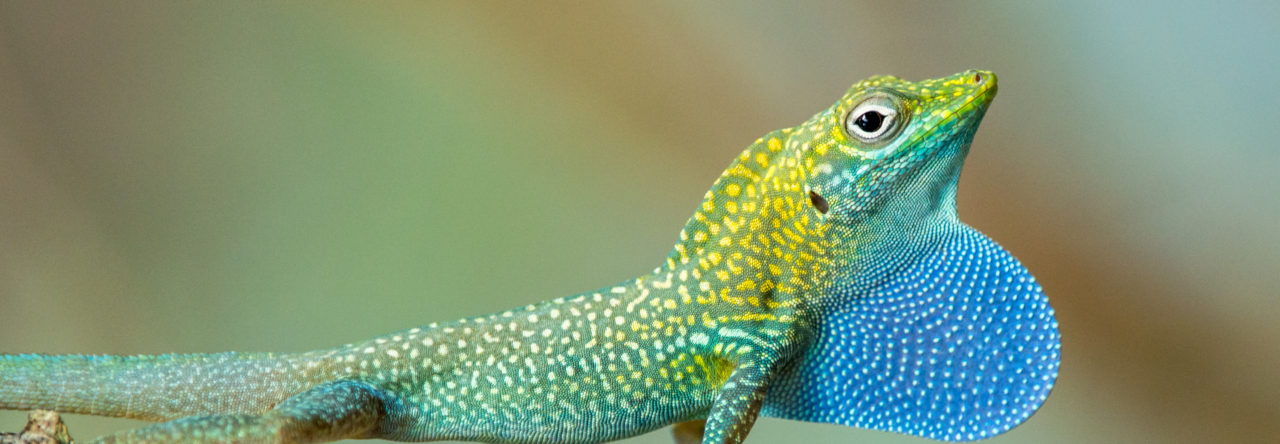
Anolis Carolinensis/Porcatus Hybrid?

Green

Old male passed over winter, tough overlord

For several years now, I have been noticing that Anolis carolinensis has been making a dramatic comeback in south Florida.  In the last five years or so their numbers have exploded.  Their resurgence began in the Florida Keys and they have been working their way north, recently reaching south Miami and now entering into central and northern Miami-Dade County. Unlike the original population of carolinensis, which favored rural environments, this new population is bold and holds its own against sagrei, still dominating the trunk-canopy, but ranging all across different ecological niches including completely urban environments (which carolinensis did not). However, these are simply field observations and conjecture on my part.  Having said that, my theory is that they are actually a vigorous carolinensis-porcatus hybrid.  I believe this not only because of their robust physical constitution when compared with the original carolinensis, but also because some within the population have the scapular ocellus normally found in porcatus while others in the same population do not and many have the white outline (like the old male in the picture), but not the inner dark portion of the ocelli and vice-versa.

Two contenders to take over turf (probably both offspring of old male). Notice one has prominent “eye-spot,” the other (victorious male) does not.

Two contenders to take over turf (probably both offspring of old male). Notice one has prominent “eye-spot,” the other (victorious male) does not.

GreenVictorCloseGreenBat


Ever Seen A Transparent Anole Egg?

transparent_eggAs we have posted previously, the Glor lab has been breeding anoles to assess the degree of reproductive isolation between A. distichus-clade lineages. Most eggs we collect fall into two easily separated categories: white, calcified, viable eggs; and yellow, uncalcified, inviable eggs.  On occasion we get a third type: white, seemingly viable, yet uncalcified eggs. These represent only about 1% of the eggs in our current experiment. We always incubate these, in the hopes that they will develop, but typically they mold early in incubation and, upon dissection, show no signs of fertilization or development. The egg above is our first exception which, when incubated for about 3 weeks, was clearly developing (it has, sadly, since died).

So, AA community, has anyone else seen anything like this?  I would very much like to hear your thoughts, interpretations and comments.

Anoles Modulate Headbob Amplitude To Maximize Detectability Based On Receiver Lizard Distance

Not effective at a great distance

Think about when you want to communicate with someone, but first you have to get their attention. Let’s start with verbal communication. If Fred is across the room, you probably holler out “Hey Fred” a lot louder than if he’s sitting next to you. Now, suppose you’re the non-verbal sort. If Fred’s a long distance away, you’re going to have to wave your hand wildly, maybe even jump up and down, to get his attention. But if he’s nearby, a little wave, even a discreet hand gesture, will suffice. Why we don’t whisper or make slight movements to attract the attention of those far away is pretty obvious–the target won’t hear or see you. But why not yell loudly or gesture emphatically even when the target is nearby (ok, we all know some annoying people who do this, but mostly people don’t)?

Steinberg and LealSignal modulation is an area of great interest in the field of animal communication, and Steinberg and Leal have just published a fascinating study on the Puerto Rican A. gundlachi in Animal Behaviour (pdf). The key to understanding signal modulation is to investigate how signal detectability changes as a function of distance. Building on prior work by Fleishman on A. sagrei, Steinberg and Leal conducted lab studies in which they move a black disk against white paper to determine how much movement is needed to attract the lizard’s attention. Fortunately, this can be easily done with lizards because they have something called the  visual grasp reflex–when something gets their attention, they shift their eye to gaze right at it. Easy to determine in the lab. So, by moving the disk up-and-down different amounts and varying the distance of the lizard, the authors were able to determine the degree of amplitude of movement in the visual field most detectable by the lizards (see figure on right). Notably, there is not only a minimum visual angle, but also a maximal one, above which response declines (and then increases again; for reasons discussed in the paper, Steinberg and Leal focus on the maximal peak in the 0.25-0.75 degree range).

Of course, because the movement is expressed as an angle relative to the visual field, then as the distance to the target receiver increases, larger amplitude movements would be necessary to be detected. Moreover, looked at the other way, because there may be a degree of movement too great to maximally stimulate a response, the amplitude would be expected to decrease at shorter distances.

From North to South (Paleo-islands).

The Hispaniolan Northern Green Anole (Anolis cholorocyanus) is a widespread species in the trunk-crown ecomorph. Its known distribution is almost entirely restricted, as the name indicates, to the north paleo-island of Hispaniola, but also includes Gonave, Tortue and Saona islands, and some portions of local “mesic” (oases) forests and hills south of Valle de Neiba, in the northern slopes of Sierra de Baoruco.

A. chlorocyanus, photographed at Jaragua National Park station in Laguna de Oviedo, Pedernales province.

The individual pictured to the left was photographed the 12th of March 2013 in a far south locality for the species, in the facilities of the Jaragua National Park, NE of Oviedo. Consulting Schwartz & Henderson 1991, and Henderson & Powell 2009, it is mentioned that its occurrence may extend into the Barahona city, which is 53 kms from the recently reported locality (Google Earth, measured as airline distance). Caribherp.com does not display it for that area in the species’ range map. Anolis chlorocyanus is a mesophilic anole as well as a human commensal, so there is the possibility that the species arrived at this disjunct locality by the transportation of construction material used to build the park’s station (several years ago), or arrived on flotsam that often washes ashore in this area of the Barahona peninsula coast (sea currents bring debris and garbage from far east). Since A. chlorocyanus‘s south island counterpart, A. coelestinus, has a restricted range through the Domincan Republic, I haven’t seen any interaction between the two, despite the fact that the latter is also a human commensal (in Pedernales and along the Barahona coast). A similar scenario could be displayed when comparing distributions of other two ecologically (tough xeric) equivalent north and south island species: A. whitemani and A. longitibialis; the former shares a similar distribution with A. chlorocyanus along the Baorucos, and seems to be limited by topographic/climate features or direct competition by its southern counterpart, A. longitibialis. I have observed both species of trunk-ground anoles independently using the same saxicolous-based subtrate in this mountain range, one in the southern (but primarily in the Barahona peninsula’s lowlands), the other in its northern slopes.

Adding some more ecological notes, A. chlorocyanus can often be observed using royal palm trees (Roystonea), usually high near the base of flower/fruit fronds, which when in blossom attract many bees and other insects. A. chlorocyanus as typically seen in Los Haitises, in a royal palm (Roystonea). Photo taken near Caño Hondo.

A. chlorocyanus as typically seen in Los Haitises, in a royal palm (Roystonea). Photo taken near Caño Hondo.

How The Bearded Anole Got Its Name

Anolis pogus. Photo from Wildlife of St. Martin.

The resemblance is uncanny

The diminutive A. pogus of St. Martin is sometimes referred to as the bearded anole. Since anoles lack hair, facial or otherwise, one might wonder where the name comes from. In fact, Mark Yokoyama explains on his Wildlife of St. Martin site, the name is a misnomer, a misguided translation of the specific epithet pogus. Rather than being derived from the Greek pogos, the name is a reference to the cartoon character Pogo the possum! Who else would be behind this than AA faithful Skip Lazell? Anyone have any other favorite anole scientific names?

Anoles And Other Biodiversity Of Haiti: A Calendar

Calendar_June
Haiti has some spectacular anoles found nowhere else. For example, if you go to CaribHerp and click on “Haiti” in left toolbar, you see the 176 species of herps in the country. Then click filter by “Dactyloidae” and you see the 32 recognized anole species.

13 of those are endemic to the country, but there are quite a few in the works (not yet described). One beautiful endemic Haitian species, Anolis monticola, is on the cover of Jonathan’s book “Lizards in an evolutionary tree.” Deforestation continues, with only 1% forest cover remaining, so almost everything will be disappearing soon.

For several years I’ve been doing some intense field work in Haiti, and professional photographers have joined on the trips. In collaboration with the Audubon Society of Haiti (Philippe Bayard, president), we put together a large biodiversity calendar for this year, with text translated in 3 languages. It opens into a 24″ x 12″ poster. Anoles are on the cover and a month is mostly devoted to anoles. After some unexpected delay they have arrived and we’re happy to give them away, for cost of shipping/packing. If interested, see Caribnature for images of the calendar, and instructions to order:

Adventures With Phenacosaurus

Anolis heterodermus. Photo by J. Losos.

Anolis heterodermus. Photo by J. Losos.

Although many generic names have been proposed for species within the anole clade, traditionally only three other than Anolis were widely used: Chamaeleolis, Chamaelinorops and Phenacosaurus. Each of these clades—which at one time were thought to represent early, pre-Anolis derivations from the anoline line—are morphologically distinctive. The former two, Chamaeleolis and Chamaelinorops, need no introduction—they are oddball species that at first pass might not even be recognized as anoles, and that have received a modicum of scientific study. The third clade, Phenacosaurus, by contrast, has been mostly ignored. This is surprising, because at least some species are quite notable morphologically, with head casques, heterogeneous scalation, wild colors, and an all-over prehistoric appearance. Moreover, they live at remarkably high altitudes, at least by anole standards, and have a passing resemblance—some species more than others—to Caribbean twig anoles. Nonetheless, there is almost no literature on the natural history or evolution of these anoles.

Ken Miyata’s 1983 Journal of Herpetology paper is the one exception. In it, he describes the habitat use of A. heterodermus in areas near Bogotá, Colombia. His description paints the species as one that uses narrow perches on bushes and other vegetation, and that is especially plentiful in blackberry bushes. Combined with its short legs, heterogeneous body and head scalation and elongate and compressed body, reminiscent of twig anoles like A. valencienni, one might entertain the possibility that it is in functional terms a mainland twig anole.

A year and a half ago, we reported in AA on our studies of another phenacosaur, the much smaller A. orcesi from Ecuador. Our studies conclusively demonstrated that it is in all respects like a twig anole—behaviorally, it moves extremely slow; ecologically, it is found almost entirely on narrow surfaces; and morphologically, it is a Caribbean twig anole doppelgänger. But in one respect, A. orcesi was a disappointment—it looks just like any old anole, without the wildly prehistoric aspect for which the larger phenacosaurs are renowned. For this reason, it was time to examine another phenac, and what better choice could there be than A. heterodermus, the subject of Miyata’s study, supposedly common near Bogotá, and appropriately wild in appearance?

And so Rosario Castañeda, Anthony Herrel and I converged on Bogotá in late February for just this purpose, joined by Rafael Moreno, a graduate student at Universidad Nacional de Colombia, who has just completed his masters degree research on this species, with one fine paper out and more in the works. Our plan was simple: go to appropriate spots on the outskirts of Bogotá, locate lizards in the vegetation, watch them and record habitat use and behavior, then capture them and bring them back to the field lab to measure sprinting and biting capabilities and to examine their stomach contents.

Dewlap Research On Grand Cayman

Tess Driessens, but that’s no lizard

Channel 27 in Grand Cayman has just aired a report on the doctoral work of Tess Driessens (co-winner of the 2012 Anole Photo contest!) and Simon Baeckens (actually, from their webpages, this seems like Tess’s project). They’re studying the diversity of dewlap color in Anolis sagrei by looking at brown anoles throughout their range.

Female Green Anoles Exhibit Limb Length Plasticity In Natural Habitats

carolinensis by michele johnsonMuch has been written about how differences in relative limb length allow anoles to successfully occupy distinct portions of the arboreal habitat. Most research has focused on large-scale patterns of diversity, which are presumably the result of natural selection. But limb length could also be more finely tuned using an alternative process, whereby an individual’s morphology responds to environmental cues experienced throughout development. This process is known as phenotypic plasticity. We already know that anole limbs exhibit plasticity in the lab (e.g., Losos et al. 2000, 2001 – A. sagrei; Kolbe and Losos 2005 – A. carolinensis), with lizards raised on narrow perches having shorter limbs than those raised on broad perches.  But what about lizards in their natural environments; could plasticity in limb length allow lizards to become more specialized to their particular microhabitat in the wild?  This was the question that Trinity University (San Antonio) undergraduate Alisa Dill asked in summer 2010, working with fellow undergraduate Andrew Battles, regular AA contributor Thom Sanger, and me.

We studied green anole lizards in three plots in Palmetto State Park, in southeastern Texas (Figure 1).

Figure 1 from Dill et al. In press. Study plots in Palmetto State Park. The star on the small map of Texas (bottom left) indicates the location of the park.

Figure 1 from Dill et al. In press. Study plots in Palmetto State Park. The star on the small
map of Texas (bottom left) indicates the location of the park.

The three plots differed dramatically in perch availability – one was in a dense dwarf palmetto stand in a closed forest, another was trees and bushes surrounding an open field, and the third was in a light forest with many small vines and twigs. We found that female lizards in the third plot (with the narrowest perches) had significantly shorter hindlimbs than females in the other two plots, although males did not differ in limb length among the plots.  Juveniles also did not differ in limb length across the three plots, consistent with the idea that the female’s developmental experience on varying perches may influence their adult limb length.

Why this difference between the sexes?  (This difference is also consistent with results from the laboratory studies mentioned above.)  We also observed where males and females were found in their habitat and how they locomoted through it to determine if differences in behavior between the sexes could affect the way the developing lizards interact with their environment. We found that females performed fewer locomotor behaviors, spending more time on particular perches; thus, perhaps the perches had a stronger influence on female limb length than on males, who used many more perches as they move through their environment.

There is much more work to be done to further test the hypothesis of plasticity in a natural environment. After all, the previous lab experiments were performed by growing lizards on either a wooden 2×4 or a small dowel, a much simpler environment than a forest with many perch options. It would be ideal to perform a “common-garden” experiment where juvenile lizards are transplanted between environments with different perch diameters. We also don’t yet understand the developmental mechanisms that cause limb plasticity in anoles, but more information about those mechanisms will help determine why the sexes respond differently to differences in their microhabitat.

You can read more about our study in our recent publication in the Journal of Zoology, available online now in Early View.

References:

Dill, A.K., T.J. Sanger, A.C. Battles and M.A. Johnson. In press. Sexually dimorphisms in habitat-specific morphology and behavior in the green anole lizard. Journal of Zoology.

Kolbe, J.J. & Losos, J.B. (2005). Hind-limb length plasticity in Anolis carolinensis. J. Herpetol. 39, 674–678.

Losos, J.B., Creer, D.A., Glossip, D., Goellner, R., Hampton, A., Roberts, G., Haskell, N., Taylor, T. & Ettling, J. (2000). Evolutionary implications of phenotypic plasticity in the hindlimb of the lizard Anolis sagrei. Evolution 54,301–305.

Losos, J.B., Schoener, T.W., Warheit, K.I. & Creer, D. (2001). Experimental studies of adaptive differentiation in Bahamian Anolis lizards. Genetica 112-113, 399–415.

Advice Needed: GPS Tags For Giant Bronze Geckos?

Here’s a question for AA readers from Nancy Bunbury, from the Seychelles Island Foundation, who is conducting some exciting work on large gecko interactions, ecological roles, and niche separation in the palm forests of the Seychelles:

Giant-bronze-gecko-on-tree“The main species in question is Ailuronyx trachygaster (first field study on this amazing species) and one thing we would love to do is look at movements and territory size (also because we suspect it’s the main pollinator for the coco de mer which has huge conservation and inevitably commercial value). We are looking into GPS tags for the geckos (which are about 150g in weight) but it seems the technology for such a small tag requiring GPS and remote downloading is not yet available. Do you happen to know if such tags have yet been developed and who I might be able to contact for them (I’ve tried the standard larger companies for animal tracking devices)?”

Any suggestions?

Page 205 of 305

Powered by WordPress & Theme by Anders Norén