

Read all about in Janson Jones’ latest anole post over on Dust tracks on the web and more on the ever dangerous broad-headed skinks at this recent post.

Better Janson than a brown anole
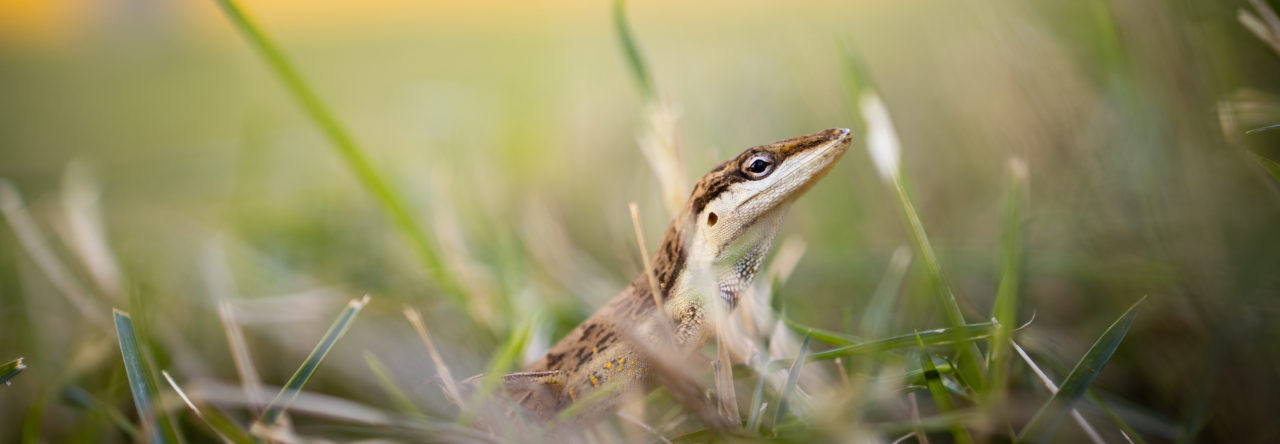
Read all about in Janson Jones’ latest anole post over on Dust tracks on the web and more on the ever dangerous broad-headed skinks at this recent post.
Better Janson than a brown anole

Green anole (Anolis carolinensis). Photo courtesy of Karla Moeller.
Ensembl Release 71 includes many updates for Anolis carolinensis, including the addition of the Arizona State University (ASU) Anole Genome Project annotation recently published in BMC Genomics (Eckalbar et al., 2013). This release includes an updated Ensembl gene set and aligned RNA-Seq data from a number of tissues, including embryo, lung, liver, heart, dewlap, skeletal muscle, adrenal gland, ovary, and brain, which have been added to the track viewer. These RNA-Seq data from individual tissues and from the ASU reannotation or the “Anole Genome Project” can be viewed just below the Ensembl gene tracks, as in this example.
 Rob Heathcote posted this photo as a comment on Sean Giery’s post on bird predation on anoles, but the photo is so spectacular that we need to make sure everyone sees it.

A few years ago I asked an ornithologist friend of mine what urban birds such as starlings and house sparrows ate. His answer was that it was probably a mix of bottle caps, cigarette butts, and McDonald’s French fries. I’m only partially satisfied with that answer, and so try to keep an eye on what urban birds eat wherever I go.
Since moving to Miami four years ago, I’ve observed several cases of birds consuming anoles. After watching a Common Grackle feed an anole to a fledgling a few days ago, I thought I’d compile and share these observations with AA readers.

Is this an embarrassment of anoles? Image from petparadise.info.
For natural history students, professionals and enthusiasts some of the most entertaining, albeit fairly useless, facts are the collective nouns used to describe a group of organisms. From taxon to taxon, collective nouns are literary (a murder of crows), descriptive (a prickle of porcupines or a sneak of weasels), mundane (a shoal of sticklebacks), and even absurd (an aurora of polar bears).
When I first read the headline of Jonathan’s latest dispatch to the New York Times Scientist at Work blog, An Embarrassment of Anoles, I briefly thought that anoles had their very own collective noun. But alas, I was wrong and a group of anoles isn’t (yet) referred to as an embarrassment.
In a quick flurry of googling I found words for groups of various amphibians and reptiles: crocodiles (bask), cobras (quiver), iguanas (mess), frogs (knot), toads (knot), salamanders (congress) and lizards (lounge), to name a few. But nothing for anoles!
Does anyone know of a collective noun for anoles or, failing that, have a suggestion?

Twin embryos of A. apletophallus dissected from a single egg that failed to hatch.
During my research project on A. apletophallus I dissected many eggs that failed to hatch but I was very surprised to discover two embryos in this egg. The female had mated in the wild and laid many normal single embryo eggs before and after this one. Twin embryos have been observed in other lizards (e.g Agama agama (Herptelogica 1967,23:57), leopard geckos and bearded dragons) but I did not find any previous report in anoles. Thought it my interest the AA readers. Anyone else seen this?

March 2013 was a strange March in my neck of the woods: the American southeast. Down south, we had a number of remarkable cold waves pass through the early-spring season. Though these cold fronts weren’t quite as dramatic as those entirely-scientifically-accurate and precisely-represented megastorms-of-doom depicted in the hit motion picture The Day After Tomorrow, they were still quite impressive in their own right. Definitely more freeze warnings than I’m used to in March… at least in Florida and Georgia. Not so much in Alaska. Up there, it’s frigid mayhem as usual.
Anyhow, at the end of March, my family headed down from Valdosta, Georgia to Mt. Dora, Florida (a bit north/northwest of Orlando in Lake county) to visit with Kid A’s grandparents. There wasn’t too much hiking / outdoor-activity scheduled for that weekend. Easter was the name of the game. Wabbits. Well, Easter wabbits and the season finale of The Walking Dead. Still, as is often the case in central Florida, sometimes you don’t really have to look very far to find some cool stuff, particularly when the weather finally warms up after a delayed and tedious late-winter departure…

Anolis tigrinus. Photo by Anthony Herrel
The last leg of our Little Known Mainland Anole Tour took us to the mountains above Caracas, in quest of Anolis tigrinus. A “mystery anole” photo of that species was put up on AA in December, and savvy readers quickly pegged it as a mainland species, noting it’s twig anole-like appearance. Moreover, the only publication on the natural history of this species, by Ugueto, Rivas, Barros, and Smith, suggested it was a twig anole as well. Given our previous work that had identified the twig anolishness of A. proboscis in Ecuador and A. (Phenacosaurus) heterodermus in Colombia (earlier in this trip), we’re beginning to see a trend: twig anoles seem to be the one kind of West Indian ecomorph that has evolved many times on the mainland (the A. pentaprion clade is another candidate).

Colonia Tovar
So, fresh from the beaches of Maracaibo, we headed to the mountains in quest of the tiger anole. A last minute change in plan led us to the little town of Colonia Tovar at about 7000 feet in elevation. We didn’t know what to expect from TC, but Wikipedia describes it as “Germany in the Caribbean.” Established by settlers from Baden (now part of Germany) in the 1850’s, the town gradually declined for a century, before reinventing itself as a kitschy tourist trap in the 1960s, and now it’s booming. And it was delightful. All of the buildings seemed straight out of Bavaria, there were brewhauses and wienerschnitzel (see photo at bottom of post), the waitresses wearing their fraulein get-ups.

The friendly locals in Colonia Tovar
We stayed at a delightful little hotel, Cabañas Heidelberg. And for no extra charge, we were able to go lizard hunting in the little patch of woods out back.

According to Ze Frank, this screen capture shows the cover of the children’s book “Lizard Has A ****** Day.”
If you’re not already familiar with Comedian Ze Frank’s True Facts Series, you need to check them out. Frank interweaves interesting facts about wildlife with hilariously (off)color commentary. He’s done videos on everything from star-nosed moles to dung beetles (I was first alerted of the series by a comment made by Tracy Heath over at the new Treethinkers blog). I was recently viewing True Facts About The Tarsier, and was shocked to see this puny little Southeast Asian quasi-monkey feeding on one of my favorite lizards. At around 1:26 into this video, Frank notes that the Tarsier is “the only entirely carnivorous primate, eating insects, rodents, reptiles and small birds. This incidentally is the cover of the children’s book “Lizard Has A ****** DAY.” Very funny. Of course, its practically impossible that a tarsier in nature would be feeding on what appears to be a green anole (Anolis carolinensis). As far as I’m aware A. carolinensis is not been reported from any of the Southeast Asian islands occupied by the tarsier. Thus, if there’s we’ve learned from this video, it is that this lizard is having a ****** day because somebody just thrust it into the waiting arms of a captive tarsier.
httpv://www.youtube.com/watch?v=6Jz0JcQYtqo

Those of you who noticed when the answer was briefly revealed, please don’t spill the beans. Very few AA readers, or anyone else, have seen this one!
Powered by WordPress & Theme by Anders Norén