Category: New Research Page 60 of 67

Not Your Typical Genome: Homogeneous Anole Genome Lacks Isochores Common in Other Amniotes

Figures from Fujita et al. illustrating relative homogeneity of GC content across the anole genome (left) and shifts in GC3 along branches in the vertebrate tree, with black branches indicating descreases of GC3 and gray branches indicating increases of GC3 (right).

Genomes are rarely homogeneous aggregations of Gs, As, Ts, and Cs.  Indeed, variation in  basepair frequency can have important implications for how genomes, and the organisms they generate, evolve.  Regions with relatively homogenous GC content that extend for more than 300 kb known as isochores are prominent features of previously sequenced amniote genomes.  Isochores are associated with a range of important variables, including gene density, intron length, DNA replication timing, and gene expression.  GC-rich isochores also tend to experience high rates of recombination, resulting in elevated effective population sizes and increased efficiency of purifying selection relative to drift.

A Little Worm “Told” Us …

Studying the brown anole (Anolis sagrei) in Taiwan has presented me with numerous new opportunities, one of which is an introduction into parasitology.

A Kiricephalus pattoni nymph under the skin of a female brown anole (Anolis sagrei), collected in southwestern Taiwan.

The first parasites I found in A. sagrei in Taiwan were relatively large worm-like parasites that are often visible as a lump under the skin of the lizard. Unfortunately, my first samples were lost by the person I had sent them to for identification. But luckily, I found some more, and with the assistance of C.R. Bursey and S.R. Goldberg, the parasites were identified as the nymphs of the pentastome, Kiricephalus pattoni. Together we reported A. sagrei as a new host of this parasite in Taiwan (Norval et al., 2009).

Growing Limbs – But Not the Kind With Leaves.

Stages of limb development for A. sagrei

As lineages rapidly diversify, such as in the history of anoles, does their developmental-genetic architecture constrain the rate or direction of evolutionary change? In other words, could the processes controlling the production of variation, the variation that natural selection acts on, affect patterns of phenotypic evolution by generating some phenotypes more readily than others? While theoretical discussions like these have been prevalent for over a century, developmentally-based constraints were not formalized in the context of modern biology until the 1980’s, fueled by an influential paper by Maynard-Smith and colleagues and the re-synthesis of evolutionary and developmental biology. Since then evo-devologists have been testing the plausibility of developmental constraints by examining the developmental bases of traits that have independently evolved multiple times; phenotypes that have repeatedly evolved using the same mechanisms may be indicative of constraint (because the precise interpretation of these patterns and appropriate level of analysis are contentious I will leave further theoretical discussion of constraint to future conversations).

In a recent paper, for which I am the lead author, we set out to examine whether developmental constraints could have affected diversification of anole limb morphology.

How Many Times Have Lizard Dewlaps Evolved?

Polychrus gutturosus flashing its stuff. Photo from http://www.bijagual.org/images_reptiles/reptiles_image_links/pages/polychrus_guttorosus_3_JPG.htm

One interesting implication of the recent finding that Anolis and Polychrus are not closely related concerns the evolution of the dewlap. The two genera were long thought to be close relatives in part because they both possess what appear to be similar dewlaps. The new phylogeny indicates that these structures are not indicative of common ancestry, but rather that the two clades have convergently evolved very similar structures. 

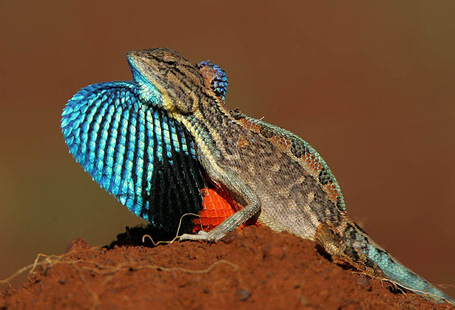
Dewlap-like structures have, in fact, evolved repeatedly in iguanian lizards (the clade that contains iguanids [in the old, broad sense], agamids, and chameleons). Some of these dewlaps are different from that of anoles—such as the flap of iguanas and the triangular dewlap of Draco—but the dewlaps of the agamid genera Sitana and Otocryptis are dead ringers for those of anoles. In fact, one might argue that Sitana out-anoles anoles with its regal fan pictured below.

Sitana ponticeriana. Photo by Niranjan Sant from Lizards in an Evolutionary Tree

More On New Dactyloa Phylogeny

Barely even kissing cousins: A. aequatorialis on the left and A. fitchi (photo thanks to Chris Funk) on the right.

The new Castañeda and de Queiroz phylogeny of Dactyloa is an important advance in our understanding of anole phylogenetics. Prior to this paper, relationships among clades within Dactyloa had been little studied; indeed, the monophyly of Dactyloa was in question, with a viable alternative being that Dactyloa is a paraphyletic group from which the rest of Anolis sprang. Not only have Castañeda and de Queiroz convincingly laid this possibility to rest, but they have identified five strongly supported clades. As the previous AA post on this paper noted, these clades are geographically coherent, revealing five geographically distinct theaters of Dactyloa diversification.

The paper has important implications in several other respects:

1. Size evolution: Dactyloa is known for its giant anoles (officially defined by Lazell as an anole exceeding 100 mm in snout-vent length). Almost all giant Dactyloa belong to the latifrons clade, all members of which, save one, are giants.

2. Convergence: In a number of cases, species that were thought to be closely-related were found to occur in different clades. The most amazing of these are A. aequatorialis and A. fitchi (pictured above), so similar in appearance and ecology that they were thought to be sister taxa that replaced each other on opposite sides of the Andes. However, it turns out that they are not at all closely related and belong in different clades.

3. Evolutionary divergence: an underexplored aspect is the extent of evolutionary diversification within clades of Dactyloa. Though much remains to be learned, it is clear that diversification has been quite extensive, as a number of the clades contain an ecomorphological array of species. The Western clade, for example, contains species such as festae, peraccae, chloris, aequatorialis, and gemmosus, which are very distinct from each other morphologically and utilize different parts of the structural habitat. Collecting the necessary morphological, ecological and behavioral data to trace the pattern of Dactyloa radiation will be an exciting challenge in the coming years!

In sum, this paper importantly advances our understanding of anole evolution. If now we could only crack that Norops nut!

New Phylogeny for the Dactyloa Clade of Anolis

Phylogenetic tree from Castañeda & de Queiroz's concatenated dataset (left), instability of relationships among five major clades resulting from analyses of mtDNA (top center) and nDNA (bottom center), Anolis (Phenacosaurus) heterderma from Juan Salvador Mendoza's Flickr (http://www.flickr.com/photos/ecoterror/page6/) (top right), and geographic distributions for major clades identified by Castañeda and de Queiroz (bottom right).

A few days ago, I discussed a paper that proposes assignment of anoles to a new family called Dactyloidae.  Today, I want to call attention to another new paper about anole systematics and taxonomy that involves a clade beginning with ‘dactyl’: the Dactyloa clade of Anolis.  The Dactyloa clade includes around 80 species of anoles found across southern Central America, northern South America, and the southern Lesser Antilles.  Although most anole biologist believe that its best to continue recognizing the species in this clade as members of a unified Anolis, the Dactyloa clade does seem to represent one of the few genera proposed by Guyer and Savage that is largely monophyletic (albeit with the addition of species previously assigned to Phenacosaurus).

In a paper published in Molecular Phylogenetic and Evolution, Castañeda and de Queiroz generate new phylogenetic trees for this group based on DNA sequence data from three loci (two mitochondrial and one nuclear) sampled across 40 of 82 previously recognized species, two new species, and 12 outgroup taxa.  Castañeda and de Queiroz’s analyses of concatenated and individual gene datasets using GARLI and MrBayes recover support for five well-supported and geographically cohesive clades within Dactyloa.  Three of these clades closely match groups defined based on previously morphological and biogeographic analyses:  Phenacosaurus, the roquet series, and the latifrons series.  Two of the clades identified by Castañeda and de Queiroz were not diagnosed by previous morphological analyses, but do make sense biogeographically: one of these clades occurs across the eastern cordillera of the Colombian Andes and the Venezuelan Andes (the “eastern” clade of Dactyloa) and the second can be found across the western and central cordilleras of the Colombian Andes, the western slope of the Equadorian Andies and  the Pacific lowlands of Panama, Colombia, and Ecuador (the “western” clade of Dactyloa).  The monophyly of two clades previously identified by morphological analyses – the aequatorialis and punctatus series – is strongly rejected by the new molecular data, reaffirming problems that have long plagued taxonomic studies of mainland anoles based on morphological data.  Relationships among the five well-supported and geographically-cohesive clades identified by Castañeda and de Queiroz are poorly supported and unstable among analyses, seemingly due to short basal branches.  Although their results clearly indicate the need for taxonomic revision of Dactyloa, Castañeda and de Queiroz reasonably suggest that any such revisions should await more comprehensive species-level sampling is available.

New Multilocus Phylogeny Confirms that Polychrus is Not Sister to Anolis

A time calibrated tree from Townsend et al. and photographs of Polychrus (from http://reptile-database.reptarium.cz/species.php?genus=Polychrus&species=gutturosus), Anolis, and Basiliscus (from http://scienceblogs.com/tetrapodzoology/2009/01/something_new_about_basilisks.php)..

For decades, anole have been assigned to Polychrotidae, a family or subfamily of Iguania whose core members have always included Anolis and Polychrus.  In spite of the  morphological similarities shared by these genera, molecular studies conducted over the past decade have consistently recovered a non-monophyletic Polychrotidae and have never recovered strong support for a sister relationship between Polychrus and Anolis.  In recent Bayesian and maximum likelihood analyses of 29 loci sampled from 47 iguanians and 29 outgroup taxa, Townsend et al. (2011) drive the final nail in the coffin of the notion that Anolis and Polychrus are closely related and form a clade that should continue to be recognized as Polychrotidae.  The sister-group relationship between Anolis and Polychrus is completely absent from the posterior distribution of trees generated from Townsend et al.’s 29-locus concatenated dataset and this relationship appears in only one or two of their 29 single-gene trees.  As a result, Townsend et al. limit Polycrhotidae to Polychrus and resurrect the family name Dactyloidae for Anolis.  Although they acknowledge that Dactyloidae is a less intuitive name for this clade than Anolidae, the latter is junior synonym of the former, having been coined by Cope (1864) some 20 years after Fitzinger (1843) recognized Dactyloidae.  Students of squamate phylogenetic systematics should definitely check this paper out, Townsend et al.’s results concerning Polychrotidae are only one of their many interesting insights.

Hedges Team Rediscovers Anolis darlingtoni

Image of Anolis darlingtoni from http://www.philly.com/philly/blogs/evolution/A-Long-Lost-Lizard-is-Found-in-Haiti.html

Last week, Blair Hedges led a team of scientists, journalists and naturalists on a helicopter tour of some of the most remote forested habitats remaining on Haiti’s Tiburon Peninsula.  For anole enthusiasts, this expedition’s most remarkable find was the rediscovery of Anolis darlingtoni, an enigmatic species that hasn’t been seen since 1984.  As reported by Faye Flam at Philly.com, expedition member Miguel Landestoy spotted a single animal sleeping around 2m up in a tree fern.  This seems to have been the only darlingtoni recovered by the expedition, but full trip details are still filtering in.

Even with this rediscovery, Anolis darlingtoni remains the rarest anole on Hispaniola, and the one that is the most immediate danger of extinction.  Luke Mahler and I went to a great deal of trouble to search for A. darlingtoni in remnant forests at the western end of the Tiburon Peninsula a few years ago and came up empty, so I know that finding this species is no easy feat.  My congratulations to Blair, Miguel, and the rest of the team!

Anole Genome Research: New Primers for All!

Table from Portik et al.'s Conservation Genetics paper reporting new primer pairs for amplification of nuclear loci (left side) and a phylogeny generated using some of these loci from Stanley et al.s' 2011 MPE paper on cordylids (right panel).

A new study by Portik et al. used the anole genome to develop more than 100 new primer pairs for the amplification of nuclear-encoded DNA from squamates, some of which have already proven useful for inferring relationships within and among species.  Portik et al.’s carefully thought out strategy for marker development – which focused on rapidly evolving protein-coding loci – ensures that their loci will be particularly useful for phylogenetic analyses.  First, Portik et al.  focused on intronless protein-coding genes, with the goal of limiting length variation and simplifying alignment.  Second, recognizing  low variability relative to non-coding regions as a potential limitation of protein-coding loci, Portik et al. focused exclusively on developing markers from loci that are  more variable than the first third of RAG-1 (one of the most useful and widely-used of the nuclear genes used  previous phylogenetic studies of squamates).  This strategy yielded 104 genes and led to development of primers for 170 gene fragments ranging from 407-2,492 bp.  Portik et al. conducted limited PCR testing on 70 of these loci and found varying degrees of success across five squamate families, including Scincidae, Varanidae, Agamidae, Cordylidae, and Gekkonidae.  More importantly, some of the loci have already proven useful for phylogenetic studies of skinks (Portik et al. 2010 , Portik et al. 2011), cordylids (Stanley et al. 2011) and iguanids (anole genome paper, which is currently in press at Nature).

While high throughput sequencing technology will eventually render PCR primers and Sanger sequencing nothing more than curiosities from a previous generation, this time is  at least a few years away.  In the meantime, Portik et al. have given the herpetological community some very useful new tools to play with.

Competition, Predation, and Selection: The Usefulness of Scientific Debate

Kidd Cay, one of the islands included in the Calsbeek and Cox (2010) study (photo from Losos and Pringle, 2011).

Chances are that if you read this blog, then you also tend to note when Nature publishes something anoley.  Thus, you’re probably already aware that last week Losos and Pringle published a reply to a paper by Calsbeek and Cox that appeared in Nature last year.  In that paper, C&C concluded that competition is a more important agent of selection than predation for island anoles.  In their reply, L&P point out limitations in the original study’s major assumptions, experimental design, and statistical analyses.  Rather than go into all the gory details, I suggest you look at their reply directly.  Just don’t let your non-anolologist colleagues or family members get a look at their Fig. 1a or you’ll lose any credibility you might have once garnered by speaking about the rigours of field work.  As is usual, C&C have also published a reply to the reply where they respond to the criticisms, re-performing some analyses.  Again, I don’t want to focus on the details; I’d rather let each reader decide for themselves.

Personally, I enjoy reading replies and replies to replies and if it gets to a reply to a reply to a reply, well even better!  It’s the way science should work – someone publishes something, there is debate, and the scientific community self-corrects if necessary.  However, recently an article in Ecosphere entitled “Do rebuttals affect future science?” by Banobi et al. challenged this view.

Page 60 of 67

Powered by WordPress & Theme by Anders Norén