Category: New Research Page 59 of 67

Dewlap Color, Gene Flow, Habitat Specialization, and Speciation: A Tale of Two Contact Zones

Dewlap variation in Anolis distichus in Hispaniola. The photos at the bottom show the change in dewlap color along the two transects in the recent study by Ng and Glor.

Despite all of the research on anole evolution conducted in the last 40 years, one important question still eludes us: how does speciation in anoles occur? This, of course, is of fundamental importance, because the great species richness of these lizards implies that speciation has run rampant in this group. So, we’d like to know why.

We don’t know much about speciation in anoles, but we do know a little. First, it is thought that the dewlap plays an important role. Sympatric anole species almost never have identical dewlaps, and experimental and observational evidence suggests that anoles use their dewlaps for species-recognition. Hence, understanding anole speciation may, to a significant extent, reduce to understanding the factors that cause populations to evolve differences in their dewlaps.

A different perspective on anole speciation relates to the classic question of whether allopatry is necessary or whether, as suggested by many recent studies, natural selection driving differentiation—whether in allopatry or not—is a more important stimulus to genetic differentiation. Recent work in the Lesser Antilles by Thorpe and colleagues has argued that environmental differences are the primary drivers of genetic differentiation within anoles, a result also suggested by Leal and Fleishman’s studies on A. cristatellus in Puerto Rico.

In this light, perhaps the most enigmatic anole is Anolis distichus of Hispaniola.

Perch Compliance and Dumb Luck

Thanks to Duncan Irschick’s insistence that I start a project immediately upon my arrival in the PhD program at UMass, Amherst (and inspiration from a passage in Lizards in an Evolutionary Tree stating that the effects of perch instability on anole locomotion had not yet been examined – thanks, Jonathan!), I spent part of the summer of 2011 studying the effects of perch compliance (flexibility) on green anole ecology and jumping performance in the wild. This followed my examination of the effects of this perch characteristic in the lab over the last two semesters (manuscript under review).

However, finding an ideal field site for this study proved a bit more challenging than I had anticipated. Yoel Stuart invited me to work with him on a project examining the effects of interspecific competition on diet in Anolis carolinensis and A. sagrei using stable isotope analysis last summer (we continued this project through 2011), and I based my vision of an ideal field site on my experiences watching green anoles hop and run around on slender (and quite flexible) mangrove branches. I envisioned a site with plenty of small to medium diameter branches and larger trunks for the anoles to frolic on, which would provide me with plenty of data on how these lizards use compliant perches in the wild.

After a FULL week of searching (with plenty of field site advice from Yoel), I settled on a site with the type of habitat structure I had originally been seeking, as well as many small cabbage palms (< 3m) along the forest edges.

Measuring Bite Force In Anoles: The Video

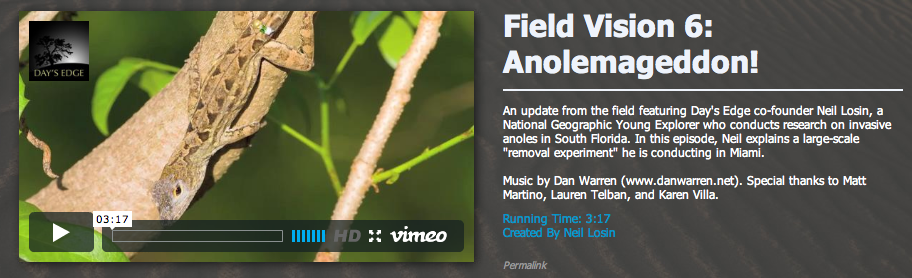
The latest anole flick from Day’s Edge Productions. If you haven’t seen some of their previous work, try this one. And for an interview about this film with filmmaker and UCLA grad student Neil Losin, go here.

The Evolution of Female Pattern Polymorphism

In many species of anoles, females vary in their back patterning, some gaudily adorned with saddles, diamonds, or crosses, others sporting simple lines and speckles, some sad lasses with no markings at all. Although such female pattern polymorphism has long been noted and its adaptive significance studied (for example, here), no one has compiled a list of which species exhibit it and which don’t, much less examined patterns of FPP evolution.

Until now. In a very nice paper, Paemelaere et al. have surveyed the literature and recorded the presence or absence of of FPP in 179 anole species. They find a wide variety of interesting findings. First, there is phylogenetic signal: closely-related species tend to be similar in the presence or absence of FPP. Nonetheless, second, FPP has evolved and been lost many times—overall, at least 28 evolutionary transitions, with more gains than losses. The ancestral condition, incidentally, appears to be an absence of FPP. Third, there is great biogeographical heterogeneity (see figure above). FPP is far-and-away most common among mainland anoles, and is also reasonably common in the Lesser Antilles, but much less common in the Greater Antilles. Within the mainland anoles, it is particularly members of the Norops club that have FPP; much less among dactyloids. However, Norops also occurs on Cuba and Jamaica, and there they don’t exhibit much FPP.

One additional interesting pattern not remarked upon by Paemelaere is that among Greater Antillean species, FPP occurs primarily in trunk-ground anoles, having evolved at least three times independently on different islands (in three members of the sagrei clade on Cuba; A. cristatellus on Puerto Rico; and three members of the cybotes clade on Hispaniola).

Variation in Population Density in Anolis Aeneus on Union Island

Anolis aeneus. Photo from http://www.kingsnake.com/westindian/anolisaeneus5.JPG.

Surprisingly few studies have examined how anole population density varies geographically, much less trying to explain why. In a recent study, McTaggart and colleagues surveyed herpetological abundance across Union Island (8.4 km2) in the Grenadines (near Grenada). Anolis aeneus was by far the most abundant herp on the island and was found almost everywhere. However, its abundance did vary from 0 to 62 individuals seen in visual encounters performed during the course of a morning and an afternoon. The sites lacking A. aeneus were a mangrove and a transect from a scrubby coastal hillock to a beach; overall, anole abundance was strongly correlated with vegetational complexity (categorized based on the number and variety of trees, height and connectedness of the canopy, and extent of human disturbance), perhaps not surprising for an arboreal lizard often found high in trees.

Notes from a Common Garden Experiment

The cages in which females are individually housed during the common garden experiment. Each cage has a bamboo perch and a plant in potting soil where the lizard can lay her eggs.

We are in the midst of a common garden experiment in which we’ve taken gravid Anolis carolinensis females from morphologically differentiated populations in the wild and returned with them to the lab where we are collecting eggs to incubate and hatch. Obviously I needed some gardening tools to pull this off, so I headed to bestofmachinery.com to get some since our local hardware burned down and still under construction.  We’d eventually like to know whether the offspring of these females maintain the differentiation observed in the wild under common growth conditions. If yes, this is good evidence that the differences we’ve observed are a result of genetic changes among populations, rather than phenotypic plasticity during development and growth. A few notes from this ongoing experiment follow.

headed

bestofmachinery.com

bestofmachinery.com

bestofmachinery.com

bestofmachinery.com

bestofmachinery.com

What Do You Get When You Combine Three Lizards and a Chicken?

Anolis carolinensis (http://www.birderslounge.com/2008/07/green-anole-amore/), A. marmoratus (from willy.ramaekers flickr: http://www.flickr.com/photos/27048739@N02/), Polychrus marmoratus (from Pierson Hills flickr: http://www.flickr.com/photos/nclarkii/), chickens (from http://ww.animalpicturesarchive.com/)

New primers for sequencing nuclear loci from Anolis!

Availability of genomic loci for sequencing has long been a major stumbling block to evolutionary inference in non-model taxa.  In anoles, for example, several decades of work relied almost exclusively on mitochondrial DNA.  As part of the Anole genome sequencing initiative, my lab group collaborated with the Broad Institute to identify conserved primers that can be used to amplify nuclear loci from across Anolis.  We ultimately tested 200+ primer pairs, most of which were identified by comparing the genome of Anolis carolinensis to genomic data from two related lizards (Anolis marmoratus and Polychrus marmoratus) and the chicken (others came from recent work in the Jackman lab).

Anolis Video from Day’s Edge

Another video about Anolis research from Day’s Edge Productions. Cool research! Great footage!

Anole Genome Paper Published Today!

Image copyright Andrew M. Shedlock.

The anole genome paper is out in Nature today (although links on Nature’s own page only take you to a list of authors at the present time, I’m assuming this glitch will be fixed shortly).  Nature also published a brief commentary highlighting some of the most interesting discoveries from this work.  For more coverage of work related to the genome, check out this post and stay tuned to Anole Annals – we’ll have a bunch more genome posts over the next few days.

Does Global Climate Change Threaten Tropical Lizards?

Anolis allisoni (photo from http://www.kingsnake.com/westindian/anolisallisoni2.JPG)

Everyone’s worried about global warming. For a long time, frogs hogged the herpetological spotlight, with concern that the global amphibian crisis might be driven by climate change. However, in recent years, there has been a growing realization that lizards may be in trouble, too, and again the finger has been pointed at climate change.

One hypothesis put forward by Ray Huey and colleagues is that as temperatures warm, open-adapted species will be able to invade forests, which previously had been too cool for them, and the cool-adapted forest lizards, living in a now warmer home and faced with competition from the invaders, would have nowhere to go and would be in big trouble.  Preliminary data from Puerto Rico support this model, and Huey and colleagues have returned to the enchanted island to further test the hypothesis.

Michael Logan, a graduate student at Dartmouth, has set out to test this idea elsewhere, working in the Bay Islands off the coast of Honduras. These islands are particularly interesting because they are one of the few places where Caribbean and mainland anole faunas meet, with members of the sagrei and carolinensis species groups of Cuba coexisting with several mainland species. This juxtaposition is interesting in its own right, but it turns out that the Caribbean species are warm-adapted, open-living species, whereas the mainland species are cool-adapted, forest types. Logan’s goal is to test the hypothesis that as warming occurs, the warm-adapted species will be able to enter the forest, with potentially adverse effects on the species therein. In a recent issue of Biodiversity Science, a newsletter put out by Operation Wallacea, Logan reports preliminary results from last year’s field season, and they’re not what you might expect.

Page 59 of 67

Powered by WordPress & Theme by Anders Norén