Category: New Research Page 61 of 67

A Hearty Meal Impairs A Lizard’s Jumping Ability

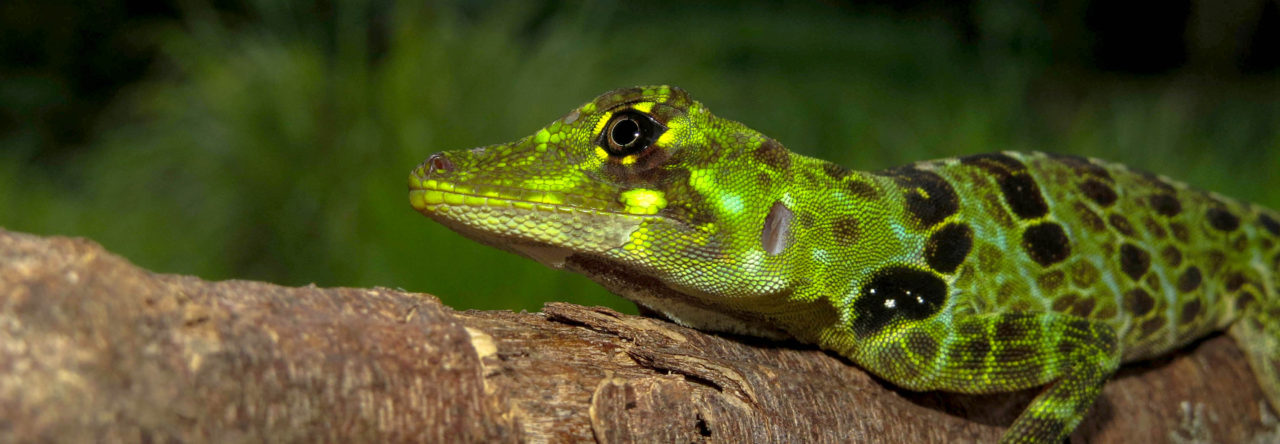
Jumping green anole. Photo from http://www.people.umass.edu/chiyun/Site/Research.html

Ever try playing softball after a barbecue? Doesn’t work so well, does it? Now imagine trying the long jump–just the thought makes me a little queasy. But animals in the wild have to do this all the time. Does it affect their performance? Lizards and other animals are known to have their running abilities diminished by carrying a large load, such as a meal or eggs, but no one previously has looked at the effect of increased weight on jumping.

Until now. In a recent paper, Kuo et al. increased the weight of green anoles 30% by wrapping a weighted cloth around their midsection and then induced them to jump (pdf of the paper here). As a control, they wrapped light paper around the lizard in the same manner. As you might expect, the encumbered anoles were less proficient leapers; jump distance declined 18% and takeoff speed 10%. However, their accuracy, as judged by ability to land on a target, was not affected.

Anole Research Cleans Up on Awards at JMIH

A figure illustrating dewlap color variation in the distichus species group from Anthony Geneva's award winning poster.

Two posters on anole evolution presented at JMIH last weekend were honored with SSAR poster awards.  Anthony Geneva, a PhD student at the University of Rochester took home the prize in the Evolution, Genetics, & Systematics category for his poster on “A Multi-locus Molecular Phylogeny of Distichoid Anoles.”  Mingna Zhuang, an undergraduate researcher at UC Berkeley, won in the Ecology, Natural History, Distribution, & Behavior category for her poster on “Comparative Gliding Performance of Anolis carolinensis and Anolis sagrei.”  Although not on anoles, it also bears noting that Daniel Scantlebury’s study of adaptive radiation in Sphaerodactylus – which has been inspired partly by work on Anolis – won the SSAR’s Henri Seibert Award for best student talk on Evolution/Systematics.  Congrats to Anthony, Mingna, and Dan!

Is An Anole Smarter Than a Fifth Grader?

Manuel Leal and Brian Powell have just published a paper in Biology Letters demonstrating that lizards are smart. Before getting to the details, though—here’s the important point: check out the videos! They’re pretty amazing (here, scroll down and click on the videos).

Here’s the story: working with the Puerto Rican trunk-crown anole, A. evermanni, Leal and Powell presented lizards with an experimental apparatus in their home cages with two wells, in one of which was a dead phoenix worm (whatever that is). Next to the well with the worm was a little round disc similar to a poker chip. The lizards learned to go to the well and find and eat the worms. Then the experimenters placed the chip halfway over the well. Again, no problem.

Now comes the cool part. The experimenters completely covered the well containing the worm with a blue chip. Remember, these are Anolis lizards that usually find their prey by looking for movement—they don’t go digging around in the underbrush. Still, four out of the six lizards figured out how to get the mealworm: two of them bit the chip and removed it from covering the well, while two others figured out how to use their snouts as a lever to flip the chip off the well. This is pure problem-solving, and it uses novel behaviors, rather than simply transferring a natural behavior to a new context! And the two lizards that failed to get the worm came up with their own solution, hitting the center of the chip with their snout—but this was ineffective in dislodging the chip.

Once the lizards had learned to find the worm under the chip, the experimenters then conducted a discrimination trial, giving the choice of a blue chip and a yellow chip. Without error, the lizards always went to the blue chip; subsequently, they were presented a blue chip versus a blue-and-yellow chip, and they still had no problem.

Pretty amazing for a lizard, if you ask me, but it gets even better.

JMIH 2011: More Anole Posters

The Sunday night poster session at JMIH 2011 had a few more anole offerings.  Melissa Moody from Iowa State reported on a laboratory experiment on the developmental and fitness consequences of varying Anolis sagrei egg incubation temperature and humidity.  Anolis sagrei eggs seem relatively robust to the variation experienced during this experiment.  Paul Cupp of Eastern Kentucky University asked whether ground skinks (Scincella lateralis) and green anoles (Anolis carolinensis) could detect chemical deposits from the Eastern Milk Snakes (Lampropeltis triangulum); he found evidence that the skinks could detect these deposits while the anoles could not.  Finally, Mingna Zhuang discussed comparative gliding performance of Anolis carolinensis and Anolis sagrei.  She found that A. carolinensis is a considerably better glider, perhaps due to the fact that it has a flatter gliding posture than A. sagrei.

The Anole Phylogeny at JMIH

In addition to a number of Anole posters yesterday, the Joint Meeting of Icthyologists and Herpetologists featured a talk by Rich Glor entitled “Phylogenetics and Diversification of Anolis Lizards.” In his 12 minutes Rich covered a lot of material. He described: the key components in diagnosing an adaptive radiation (speciation, adaptation and the more controversial extraordinary diversification), how the properties of adaptive radiations result in problems resolving their phylogenies (particularly when diversification rates are extraordinary), leveraging the anole genome project to generate and analyze new, informative loci for anole phylogenetics, the impact of incomplete data matrices on the ability to accurately infer phylogenies, and closed with a presentation of the latest, greatest genus-wide phylogeny of Anoles.

JMIH 2011: Posters, posters, posters!

Today’s JMIH poster session was an anole lover’s paradise!  Five posters featured molecular phylogenetic work on anoles, including studies of A. humilis (John Phillips from Central Michigan University), A. limifrons (Jenny Gubler from CMU), the pentaprion group (Julian Davis from the University of New Mexico), the distichus group (Anthony Geneva from the University of Rochester), and the ricordii group (Shea Lambert from the U of R).

Thermal Ecology of Anolis cristatellus

The recent literature has been full of doom and gloom regarding the prospects for lizard survival in the face of global climate change (e.g., Sinervo et al. 2010).  A talk by Alex Gunderson from Manuel Leal’s lab at Duke University provided some important new insights on how our favorite lizards are likely to weather this storm.  Gunderson investigated thermal ecology of Anolis cristatellus at nine localities, including four mesic and five xeric locales.  His data included thousands of field collected temperature records from live animals and copper models as well as data on preferred body temperature and sprint speed performance across a range of temperatures.  Temperature data from live animals and co-distributed copper models showed that the xeric, but not the mesic, populations are behavioral thermoregulators that tend to be found in cooler spots than the randomly placed copper models.  Even with the benefit of behavioral thermoregulation, the xeric forest lizards were consistently active at temperatures that exceeded their preferred body temperature.  When Gunderson integrated these findings with data on sprint speed performance and climate change, he found that the xeric forest animals are likely to suffer significant reductions in performance associated with climate change.  Gunderson ended with a teaser by showing that he has accumulated comparable data on performance across a range of temperatures for all the other Puerto Rican anoles.  Next year’s talk should be a blockbuster!

Anole Talks and Posters at the 2011 Herp Meetings

Lots of anole action at the herp meetings starting on Wednesday in Minneapolis. Listed below are the talks and posters found by searching for “anol” in the online program abstract. If you know of others, please let us know. And…if you’re going to attend the meetings, how about posting on the talks and posters, so those of us not in the northlands can stay up to speed? Abstracts can be found by going here (I just read through them–some great stuff!).

Talks (NOTE: Gunderson’s talk on thermal ecology of A. cristatellus was originally scheduled for Saturday, but has just been rescheduled for Friday at 2:30 in Conrad B & C)

Friday, 2:30 pm: Alex Gunderson. Geographic Variation in the Thermal Ecology and Physiology of Anolis cristatellus and its Implications in a Changing World

Saturday, 2 pm: Rich Glor. Phylogenetics and Diversification of Anolis Lizards

Sunday, 8:45 am: A. Reedy. Maternal Nest-site Choice in the Lizard Anolis sagrei: A Unique Research-based Educational Model for Youth at an Urban High School

Sunday, 2:45 pm: J. Deitloff. Hemipenes vs. Dewlaps: Which Morphological Characters Can be Used to Delineate Species in Anoles?

Sunday, 2:45 pm: H. Waddle. Brown Anole Presence Reduces Occupancy of Green Anoles in Southern Florida Natural Areas

Posters:

Saturday, Poster 14: J. Phillips. Evolutionary and Biogeographic Relationships Among Species of the Anolis humilis Complex

Saturday, Poster 15: J. Davis. A phylogenetic analysis of the Anolis pentaprion Species Group

Saturday, Poster 16: J. Gubler. Investigation of the Evolutionary Relationships Among Species of the Anolis limifrons Complex

Saturday, Poster 75: A. Geneva. A Multi-locus Molecular Phylogeny of Distichoid Anoles

Saturday, Poster 76. S. Lambert. Molecular Systematics of Hispaniolan Crown-giant Anoles

Sunday, Poster 21: M. Moody. Egg Environments have Large Effects on Embryonic Development, but have Minimal Consequences for Fitness-Related Phenotypes in a Lizard (Anolis sagrei)

Sunday, Poster 35: M. Zhuang. Comparative Gliding Performance of Anolis carolinensis and Anolis sagrei

Sunday, Poster 44: P. Cupp. Responses of ground skinks, Scincella lateralis, and Green anoles, Anolis carolinensis, to Chemical Deposits of Eastern Milk Snakes, Lampropeltis triangulum

Anole Genome Paper Revision Submitted

After receiving three generally positive reviews in the first round, the revised version of the manuscript reporting the genome sequencing of A. carolinensis has just been submitted. Hopefully, it won’t be long now! Stay tuned.

Evolution Meeting 2011: Evolution of Genetic Architecture During Adaptive Radiation

Joel McGlothlin received the 2011 Dobzhansky Prize, given to an outstanding young scientist in the field of evolutionary biology. Successfully fending off technical AV difficulties, Joel gave a fascinating talk in which he examined the idea that evolution should occur along lines of least genetic resistance, which are determined by the genetic correlations among traits. This hypothesis predicts that as traits diverge, they should diverge in ways that mirror the trait genetic correlations. Moreover, one would expect that this effect would attenuate over time, so that more distantly related species would show less evidence of diverging along these lines.

Page 61 of 67

Powered by WordPress & Theme by Anders Norén