
Category: New Research Page 42 of 67

Sexual Dimorphism In Relative Digit Length In Lizards and Frogs

In recent years, a quirky area of research has developed in which researchers measure the length of the second and fourth digits on the hand and foot, calculate the ratio (2d:4d) and then compare this ratio between the sexes. Surprisingly, in many species there are consistent differences between males and females. In mammals, that ratio is smaller for males, whereas in birds, the opposite occurs. But few studies have looked at the other vertebrate classes.

With this in mind, Direnzo and Stynoski recently calculated digit ratios for several common Costa Rica anoles and frogs. The abstract of their paper, published in Anatomical Record last year, tells the story:

“It is now well documented that androgen and estrogen signaling during early development cause a sexual dimorphism in second-to-fourth digit length ratio (2D:4D). It is also well documented that males of mammalian species have a smaller 2D:4D than females. Although there are discrepancies among 2D:4D studies in birds, the consensus is that birds exhibit the opposite pattern with males having a larger 2D:4D than females. The literature currently lacks substantial information regarding the phylogenetic pattern of this trait in amphibians and reptiles. In this study, we examined 2D:4D in two species of frogs (Oophaga pumilio and Craugastor bransfordii) and two species of lizards (Anolis humilis and Anolis limifrons) to determine the existence and the pattern of the sexual dimorphism. Male O. pumilio and C. bransfordii displayed larger 2D:4D than females in at least one of their two forelimbs. Male A. humilis had larger 2D:4D than females in both hindlimbs, but smaller 2D:4D than females in both forelimbs. Male A. limifrons may also have smaller 2D:4D than females in the right forelimb. Finally, digit ratios were sometimes positively related to body length, suggesting allometric growth. Overall, our results support the existence of the 2D:4D sexual dimorphism in amphibians and lizards and add to the knowledge of 2D:4D trait patterning among tetrapods.”

How Is A Baby Anole Like An Insect?

Green anole, emerging on the experimental scene. Photo by Justin Walguarnery.

They really are small. Photo by Justin Walguarnery

In their rate of heating and cooling. A recent paper by Walguarnery et al. reveals that baby green and brown anoles change temperatures at a remarkably rapid rate, much higher than that reported for most other vertebrates and comparable to that of insects. The reason would seem to be obvious: they are small, with a large surface-to-volume ratio, and thus they gain and lose heat rapidly. Moreover, the typical lizard posture, with body resting on the substrate, enhances the rate of conductive transfer of heat.

Brown anoles, too. Photo by Justin Walguarnery

The authors point out that this finding has interesting implications for our understanding of habitat partitioning between species. In particular, if the body temperature of juvenile anoles very rapidly equilibrates with the operative environmental temperature of the exact spot they occupy, then individuals can very precisely regulate their body temperature, whereas the slower change of larger lizards makes it more difficult to finely adjust body temperatures by moving from one spot to another.

As part of the study, the authors also measured the preferred body temperature of lizards in laboratory gradients and found that juvenile green anoles preferred to be 2 degrees warmer than brown anoles. This result is particularly interesting because previous work on adult lizards had found that brown anoles prefer warmer temperatures. Assuming that this is a real effect and not an artifact of differences between the methodologies of the two studies, this finding raises interesting questions: why do temperature preferences change ontogenetically, and what implications do these changing preferences have for patterns of habitat partitioning? From my own personal experience, adult brown anoles usually appear to occur more frequently in hot and exposed positions than green anoles, and it hasn’t been obvious to me that the habitat use of juveniles of the species is any different, but I have to admit I haven’t paid that much attention to the little fellas. Like anole biology more generally, the thermal ecology of juvenile anoles is a little explored and potentially important area for future research.

But enough of my blathering. Let’s hear what the author, Justin Walguarnery, has to say about the paper:

“The study was conducted as part of a series of investigations into how two of the most widespread Anolis species interact early in life. In particular, we were interested in identifying patterns of behavior and physiological ecology present immediately after hatching. Our goal here was to observe species characteristics defining the fundamental niche that might be constrained, modified, or obscured later in life.

New Species Of Chamaeleolis!

AA contributor and anole breeder extraordinaire Veronika Holáňová and colleagues have just described a new species of Chamaeleolis, Anolis sierramaestrae, from–where else?–the Sierra Maestra of eastern Cuba. The species, described in a paper just published in Acta Societatis Zoologicae Bohemicae, differs in a variety of scalation details from the other five species in this group, and the paper includes a very useful pictorial guide to distinguishing among them.

In addition, check out this nifty x-ray.

Anolis Sagrei Invades Mainland Asia

Who knows how far this fellow’s genes will spread through Asia?

These pages have chronicled the appearance of the brown anole (Anolis sagrei) in farflung places around the globe, including throughout the CaribbeanHawaii, Costa Rica, and Taiwan, among others. A new paper in Nature in Singapore reports a first: an established population in mainland Asia, in Singapore. The site of the invasion, and apparently for now the only locality for the population, is a new park, Gardens by the Bay. As Wikipedia reports, Gardens by the Bay is “an integral part of a strategy by the Singapore government to transform Singapore from a “Garden City” to a ‘City in a Garden’. The stated aim is to raise the quality of life by enhancing greenery and flora in the city.” Like many invasive anole populations, this one probably was founded by stowaway lizards or eggs transported in potted plants, but this is just conjecture.

As a sidenote, as far as I am aware, this paper is the first to implement the new Nicholson et al. anole classification, explicitly citing the paper as rationale for referring to the species as Norops sagrei.

IBS Update: Sub-Fossil Anoles on Anguilla

Hello once again from the IBS in Miami. As I mentioned in my last post, anole presentations are a little thin on the ground here (though not around the conference centre where, with the help from some locals, we saw sagrei, carolinensis, equestris and distichus today).

I did have the opportunity yesterday to check out the the second of two anole presentations here – a new look at the sub-fossil lizard communities, with a focus on a question familiar to many readers of this blog: What’s the deal with A. pogus on Anguilla?

Has A. pogus ever been on Anguilla? Nope.

The study is being led by Melissa Kemp, from Liz Hadly’s lab at Stanford. Melissa has re-analyzed lizard dentaries from excavations on Anguilla that featured heavily in an anole character displacement versus taxon cycle debate in the early 90s.

By analyzing the size distribution of anole dentaries dating back 10,000 years on Anguilla, Melissa argues that not only is there a lack of evidence for a taxon-cycle involving A. pogus, but that there’s no evidence that A. pogus has occurred (in meaningful numbers) on the island at all! To further test this, Melissa has sequenced a portion of cytochrome b for five specimens thus far, all of which have turned out to be A. gingivinus, with more sequences coming down the pipeline.

Anoles aren’t the only lizards Melissa has uncovered – with Thecadactylus, Ameiva and Leiocephalus all present. Anoles have dominated the fauna in all but the earliest (and sparsely sampled) time slice and Leiocephalus was historically present (but probably not abundant) but disappeared several thousand of years ago and has not reappeared in the sub-fossil record since.

This was my first exposure to sub-fossil analysis of lizard communities and I was definitely impressed. I don’t have a sense of how much similar work there is in the literature (but I’m sure readers of the blog can educate me), but there seems substantial scope to collaborate with zoo-archaeologists to get more specimens and data on past trait variation and anole assemblage composition.

Amber Geckos From The Dominican Republic

We’ve had a lot of hoohaw in these pages about amber Anolis, but anoles are not the only lizards represented in the Dominican amber fauna. In particular, a number of fine specimens of amber geckos are known from the D.R., as well as from amber deposits elsewhere. One such species is Sphaerodactylus dommeli. Embarrassing as it is to anole aficionados, this specimen has at times been suggested to be an anole, hard as it may seem to confuse such a lowly gecko with something as magnificent as an anole. In any case, Daza et al. have just published a magnificent analysis demonstrating that the specimen is, indeed, a gecko, and providing tips on how to avoid such unwholesome confusion in the future. Moreover, confirmation of the specimens identity will allow it to be used as a calibration point in future molecular studies of Sphaerodactylus phylogeny.

Updates From SICB – How Does Climate Warming Threaten Anoles?

Anolis bicaorum from Utila, Bay Islands, Honduras. Photo by J. Losos.

Will global warming allow the blue-headed anole, A. allisoni, to move into the forest in the Bay Islands? This individual was photographed on Roatan by J. Losos.

Climate warming is a sad reality that environmentally defines our era. Over the next century, conservative estimates suggest that air temperatures will rise about 3° C. One imperative in research is to try to understand how reptiles, whose physiology is tightly linked to thermal environment, are going to be impacted by these increasing temperatures. During a symposium honoring Ray Huey, a leading biologist (and an anologist, to boot!), Michael Logan of Dartmouth College gave a talk on how small-scale estimates of thermal variation, rather than weather stations, yield interesting and perhaps counterintuitive results for how tropical lizards will be impacted by hotter temperatures. Predictions of potential impact to date rely heavily on temperature data gathered from weather stations – those provide a resolution of one square kilometer. For small reptiles, like tropical anoles, he argues that we need a finer resolution. To this end, Logan launched several operative temperature devices (sensors that perceive temperature as a lizard would, rather than just air temperature) on Cayo Mayor and Utila, which are islands in the Bay Island Archipelago in Honduras. We’ve discussed the anoles of the Bay Islands here on our blog before. On Cayo Mayor, Anolis lemurinus is found in the closed-canopy forest, while the blue-headed lizard,  A. allisoni is found in more open habitats. A close relative of A. lemurinus, Anolis bicaorum, is found throughout Utila. Because closed-canopy forests are more thermally homogenous (less variation in available temperatures due to less access to sun and shade patches), the expectation is that, under a scenario of climate warming, the open habitat species A. allisoni should be able to invade A. lemurinus‘ habitat. Logan says that A. allisoni will not invade the forest habitat, although the details of the analysis suggest to me that they might. From what I saw, increasing temperatures in the forest should allow A. allisoni to invade the newly available warm habitat. He does find that A. lemurinus should experience a loss in potential daily activity hours because of increasing temperatures, putting this species at risk. The common species (A. bicaorum) will actually experience more hours of activity and likely benefit, at least in the short term, from increased temperatures. Logan concludes that more micro-scale measurements provide the appropriate resolution for studies of thermal performance in lizards, and will be the wave of the future.

Winners Are Right-Brained – Visual Lateralization In Aggressive Encounters

Aggressive encounter between anoles. Both opponents are watching each other with their right eyes. Photo: Johnson Lab, Trinity University

Have you ever gotten an angry look from an anole? Has he ever displayed at you, demanding that you get out of his territory? If so, chances are that if an anole was giving you the stink eye, he with using his left side! I’m blogging live from the Society for Integrative and Comparative Biology (SICB) meeting in San Francisco. My first stop has been to view Michael Patton’s poster examining the neuroanatomy of aggressive behavior. Patton is a senior undergraduate student at Trinity University working with Dr. Michele Johnson. Early birds at SICB have the opportunity to put their posters up for early viewing, so I got a sneak peek of his work last night although he’s not slated to present until Saturday.

For his project, Michael addressed the question of brain lateralization in aggressive displays. Some evidence suggests that anoles tend to favor their left side during competitive encounters. Patton and colleagues built on these studies by examining behavioral laterality in the field and neuroanatomy in the lab in the same individuals. Through observations of wild A. carolinensis, Patton found support for this idea – the winning male tended to view his opponent from his left side!

Anolis Carolinensis Phylogeography: A Tale Of Two Studies

Figure 1 from Campbell-Staton et al. 2012.

This past summer, two groups of authors published reports on the phylogeography of the only anole native to the continental United States: Anolis carolinensis. Each report sought to characterize genetic diversity across this species’ range by identifying genetically distinct populations, inferring historical demographic events, estimating the absolute timing of diversification events, and testing the hypothesized impact of riverine barriers and Pleistocene glaciation on geographic differentiation.

Because these two reports effectively appeared simultaneously (Tollis et al.’s report appeared on June 7th in PLoS ONE and Campbell-Staton et al.’s report was accepted for publication on June 18th at Ecology and Evolution), and do not cite or discuss one another’s work, I thought it would be worth writing a post that compares and contrasts their results and conclusions.  I’m going to focus in particular on three specific results reported by both groups of authors: (1) diagnosis of geographically and genetically distinct populations, (2) inference of historical demographic processes within populations, and (3) estimates for the timing of A. carolinensis diversification.  While the two studies largely agree on the first two results, they appear to disagree somewhat on third.

1. Diagnosis of geographically and genetically distinct populations

Research on Anole Frugivory

Sondra Vega, a graduate student at the University of Puerto Rico, writes:

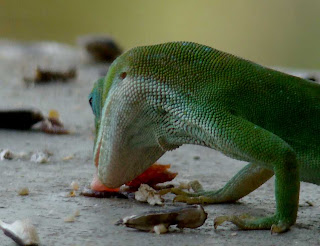
A green anole eating a piece of fruit that fell from a bird feeder. Photo from http://4.bp.blogspot.com/_I_xaKqQzxyY/R4g96myXR_I/

In lizards, omnivory/frugivory is considered unusual and particular of some species; even though dietary studies indicate that many species add plant products to their diet.  In spite of the fact that seeds and fruits have been reported in stomach content or fecal pellets of Anolis, their importance and contribution to the diet of these lizards is still unknown. At present, the general consensus is to categorize Anolis as strict insectivores.  Therefore the extent by which omnivory/frugivory plays a role in the Anolis diet still needs to be assessed.

My research aims to determine how the variations in food abundance in two forests at the northern limestone region of Puerto Rico affect the degree of omnivory/frugivory and trophic position of Anolis lizards. I am using stable isotope technology to analyze the omnivory/frugivory and trophic position of the Anolis lizard as well to quantify the importance of fruits to the diet of the omnivorous Anolis species.  Stable isotopes are a novel technique that has the potential to elucidate diets, capture interactions such as trophic omnivory, and track energy or mass flow through ecological communities.   The information will help to better comprehend the functional role of Anolis lizards in the dynamic and structure of food webs and in ecosystem function, as well as the dynamics of vegetation in tropical forests.  Although this project is focused on anole lizard species of Puerto Rico, the findings are of relevance for understanding of islands where lizards are also a dominant component of ecosystems.


Page 42 of 67

Powered by WordPress & Theme by Anders Norén