Category: New Research Page 43 of 67

Six-Toed Anole

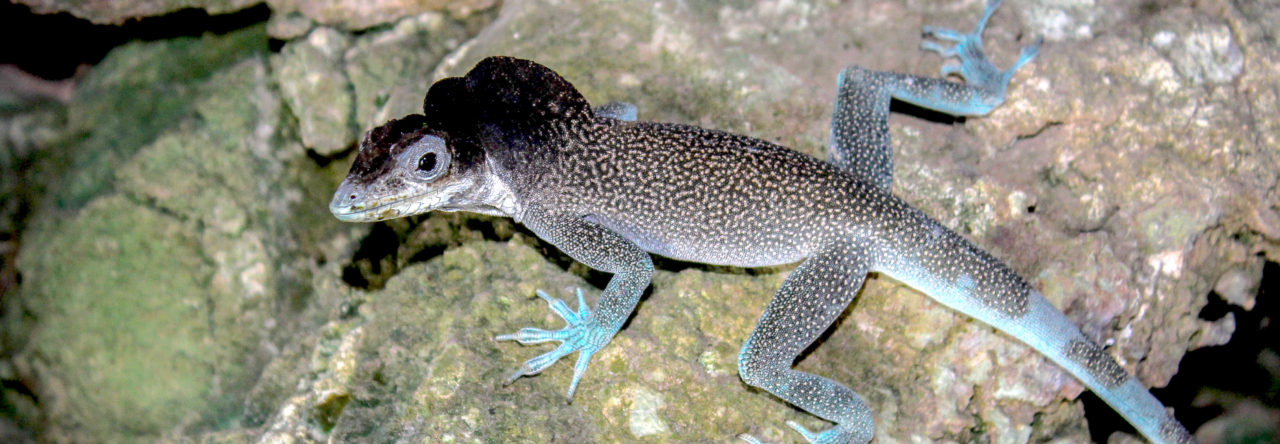
Ventral and dorsal view of polydactyl anole, click to enlarge.

As Rich Glor mentioned recently, we are in the second year of an experimental hybrid cross between two bark anole species.  Although we are still early in this year’s experiment, we have had about 50 eggs hatch and, surprisingly, two have had malformed forelimb digits. The first was missing two toes on one of its forelimbs and died a few days after hatching. The second (pictured above) hatched with six toes, but has been otherwise healthy. Each of these toes has an intact claw, and at least one has lamellae. The fourth digit (from closest to the body counting outwards) seems to lack the (expected) scansor and is permanently bent upwards.

Mats Olsson and colleagues (2004) found malformations in the limbs and jaws and kinked backbones in crosses between populations of Lacerta agilis. Of the over 800 hatchlings in last year’s F1 experiment, we found a few animals with malformed spines, but not a single animal with digit or jaw issues. It’s particularly interesting (to me at least) that these issues have manifested in the backcross generation, an issue I hope to investigate further as more animals hatch.

Polydactyly has been reported in captive-bred crested geckos (Correlophus ciliatus), but I couldn’t find anything about anoles. Has anyone else seen something similar in anoles? If so, please let us know in the comments.


Morphology And Molecules Give Fundamentally Conflicting Results For Lizard Phylogeny

Photos by Gabe Gartner and Kurt Schwenk.

This is a little far afield for anole aficionados, but recent years have seen a revolution in our picture of lizard (including snake) phylogeny. Traditionally, based on morphological analysis, lizards were thought to split into two groups, the iguanians (including anoles, other iguanids, agamids, and chameleons) and scleroglossans (everything else, including snakes). However, starting with a paper by Townsend et al. in 2004, a different picture emerged in which iguanians were nested high in lizard phylogeny, closely related to anguimorphs (such as alligator lizards, gila monsters, and monitors) and snakes. A series of subsequent studies came to essentially the same conclusion, most recently the output of the “Deep Scaly” NSF Tree of Life project which sequenced DNA from 44 genes.

Two views of lizard phylogeny. From Losos et al. (2012)

I think that most of the field had come to accept that the molecular tree was correct. But along comes a paper by the morphology team of Deep Scaly, a remarkable analysis in which 194 species were all micro-CT scanned and examined in others ways, leading to a data set of more than 600 morphological characters, 247 never previously used in phylogenetic studies. Analyzed with state-of-the-art methods, the results resoundingly support the original morphological tree and give absolutely no morphological support for the new molecular tree. The authors do an excellent job in not being strident in insisting that the morphological tree is correct, but just highlighting how very unusual morphological evolution must have been if the molecular tree is correct. Moreover, the authors note that based on analyses including the molecular data, the “Archaeopteryx” of squamates, Huehuecuetzpalli mixtecus, is placed high in the phylogeny, rather than in the basal position where morphology has long placed it. If, indeed, the molecules are right, what does that say about our ability to ever reliably place fossil species in a phylogeny?

Either the morphological or the molecular tree is incorrect, and either molecular or morphological data have been evolving in a way for which there is no good explanation. This is truly a conundrum, which was the point of a perspective piece just published by David Hillis, Harry Greene, and me. We don’t have any answers, but thought it was an interesting enough question worthy of further attention.


Research On The Hormonal Mechanisms Regulating Sexual Behavior In Green Anoles

Earlier this year, we mentioned a paper by Juli Wade reviewing research on the green anole, which has become a model organism for integrative studies of reproductive behavior in vertebrates. One example of such research is a paper recently published in her laboratory by Cohen and Wade in which levels of testosterone were experimentally manipulated to see the effect of this hormone on gene expression in different regions of the brain. The abstract gives the details better than I could:

“Aromatase and 5alpha-reductase (5-alpha-R) catalyze the synthesis of testosterone (T) metabolites: estradiol and 5-alpha-dihydrotestosterone, respectively. These enzymes are important in controlling sexual behaviors in male and female vertebrates. To investigate factors contributing to their regulation in reptiles, male and female green anole lizards were gonadectomized during the breeding and non-breeding seasons and treated with a T-filled or blank capsule. In situ hybridization was used to examine main effects of and interactions among sex, season, and T on expression of aromatase and one isozyme of 5-alpha-R (5-alpha-R2) in three brain regions that control reproductive behaviors: the preoptic area, ventromedial nucleus of the amygdala and ventromedial hypothalamus (VMH). Patterns of mRNA generally paralleled previous evaluations of intact animals. Although no main effects of T were detected, interactions were present in the VMH. Specifically, the density of 5-alpha-R2 expressing cells was greater in T-treated than control females in this region, regardless of season. Among breeding males, blank-treated males had a denser population of 5-alpha-R2 positive cells than T-treated males. Overall, T appears to have less of a role in the regulation of these enzymes than in other vertebrate groups, which is consistent with the primary role of T (rather than its metabolites) in regulation of reproductive behaviors in lizards. However, further investigation of protein and enzyme activity levels are needed before specific conclusions can be drawn.”

The Hatching Season is Upon Us

Here at the Glor Lab we’re in the second year of a major anole breeding experiment.  Specifically, PhD student Anthony Geneva is completing the second generation of an experimental study of reproductive isolation that was the subject of his poster at the Evolution meetings this past summer (see this previous post on Anole Annals for more on this poster).  I’m happy to report that egg production thus far has been steady and that the we’ve had hatchling emerging for a few weeks now.  In the photo above, you can see a baby just emerging from an egg in the foreground and other eggs individually incubating in vermiculite in the background.  We’ll have more to report on this experiment in the coming weeks.  We’re particularly interested in sharing information on how we’ve encouraged breeding this year by manipulating light and humidity, and in learning how others might have tried to do the same.

More On Mexican Anoles: Gunther Sinks Guentheri

We recently posted the lovely guide to Mexican anoles prepared  by Gray et al., which featured photographs of 46 species and attracted a lot of attention. Close on its heels comes a new paper in Zootaxa by Gunther Köhler who examines two little known species, A. cumingii and A. guentherii, each known from a single specimen. To make a not very long story short, Köhler examined the type (and only) specimens of both species and concluded that neither is a valid species: cumingii is sunk within A. sericeus and guentherii into the Jamaican A. grahami. In the latter case, it is much more likely that the type locality of “Mexique” for the 1870’s vintage specimen is incorrect than the alternative, that a population of grahami occurs somewhere in Mexico.

This would seem to be a major setback in Anolis’s inexorable climb to the 400 species plateau (put most recently at 386 in a paper I read). Fear not, though—these species have been so poorly known that they were not included in most species listings, including the Gray et al. poster (except A. forbesi).

Köhler concludes by noting that there are a number of other extremely little-known Mexican species requiring further examination, concluding: “However, there are still several nominal species associated with the anoline herpetofauna of Mexico that are of uncertain status, such as Anolis adleri Smith 1972, A. damulus Cope 1864, A. forbesi Smith and Van Gelder 1955, and A. simmonsi Holman 1964. I agree with Lieb (2001) that, as has been the case with the two species treated in the present paper, some, if not the majority, of these enigmatic taxa will be shown to be synonyms of well-known species.” As mentioned, A. forbesi is illustrated in Gray et al.’s guide, and they note that they intend to sink adleri and simmonsi into other species.


Genetic And Morphological Divergence In Anolis Roquet: Roles Of Ecological Differences And Historic Isolation

For a number of years, Roger Thorpe and colleagues have been studying patterns of geographic variation in Anolis roquet on the island of Martinique. This species is famous–along with A. marmoratus on Guadeloupe to the north–for the tremendous amount of phenotypic variation that occurs on a relatively large island, so great that Skip Lazell described six subspecies of A. roquet. The photo above illustrates how different looking these populations can be.

Martinique is an unusual island, unique in the Caribbean as far as I’m aware, in that it is an amalgam of several different islands that were distinct for millions of years before being united by a volcanic eruption that poured out lava that connected them. Previous work has shown that there is still a clear genetic signature of this historic isolation, with different lineages occupying their ancient homelands. In addition, Martinique harbors considerable environmental heterogeneity, from sealevel to the 1400 meter peak of  Mount Pelée. Much of the mountainous area is cloaked in rainforest, whereas in the rainshadow of the mountains, the environment is quite dry.

This situation has allowed Thorpe and colleagues to ask: which drives divergence more, historic isolation (i.e., allopatry) or the divergent selection pressures that occur in different environments? To examine this question, they have sampled along transects that either cross the boundaries where two lineages meet or that cross environmental transition zones within a single lineage. These transects are exhibited in the figure above–the white lines are the separation among the lineages, the background color represents the environment, and the red lines are the transects (note that the transects cross the lineage boundary at one end, but those sites were excluded from the analysis). Across these transects, the authors measured genetic and morphological differentiation, the latter by examining body patterning and the color of the dewlap and body, as well as limb dimensions and scalation.

The results reported in their most recent paper show that both isolation and environmental differences can lead to divergence, though more predictably so for the latter.

The Signaling Environment From An Anole’s Perspective

The Anolis dewlap is a recurrent topic of discussion on Anole Annals. This is not surprising considering that it is commonly viewed as playing a role in many aspects of social interaction, including species recognition and even sexual selection, although, I am unaware of empirical studies supporting sexual selection in the context of female choice.

A recent post by Ian Wang asked the question, “Does This Dewlap Go With My Signalling Environment?” In order to answer this question I would encourage the readers of Anole Annals to have a discussion of what really is an “anole’s signaling environment.”

The paper by Ng et al. (2012) presents some interesting results, and I would encourage everyone to read this paper. The amount of data presented in this paper is impressive, with the authors combining molecular, dewlap reflectance, and satellite data (i.e., GIS data) to evaluate if there is a relationship between dewlap traits and climatic variables across populations of A. distichus. As the precision of GIS data increases, the ability to explore questions at a finer geographical scale is becoming more common. This paper nicely illustrates this approach. Additionally, A. distichus is a nice system for the study of dewlap variation. In fact, in my opinion, one of Al Schwartz’s (1968) best anole monographs describes all sorts of geographic variation in the distichus complex. This monograph is a must read for all Anole Annals fans, with beautiful plates and a lot of natural history data.

One of the main findings of Ng et al. is that geographic variation in dewlap coloration is correlated with the “habitat types” in which populations are found. Interestingly, habitat type seems to have a stronger signal than geographic or genetic distance between populations. I have to admit that I am biased, but this is music to my ears. However, before we jump into further conclusions, I feel that it is important to take a step back and evaluate the question I posed at the start of this post – namely, what is the “signaling environment”?

Does This Dewlap Go With My Signalling Environment?

Geographic variation in dewlap coloration in A. distichus on Hispaniola (from Ng et al.)

Animals regularly need to communicate with one another (both within and between species) and have developed a variety of signals, some quite elaborate, for doing so.  In some cases, we see extensive variation in these signals across the range of a species, raising the questions of how and why this occurs.  As Julienne Ng, Emily Landeen, Ryane Logsdon, and Rich Glor explain in a new Evolution paper, there are essentially three possible explanations.  Signals may diverge due to random drift, the pressures of sexual selection, or adaptation to local signaling conditions.  The latter possibility, in which signals evolve to match local habitat or environmental conditions, is a particularly interesting scenario.

In their study, Ng et al. examined geographic variation in the dewlaps of Anolis distichus, which vary from yellow to orange/red across Hispaniola.  They recorded reflectance spectra from the dewlaps of 36 different populations, extracted annual precipitation, surface temperature, and percent tree cover variables from GIS data layers, and tested for associations between dewlap and environmental variation.  Because dewlap variation could potentially be influenced by the relatedness of two populations in space or through shared ancestry, Ng et al. also corrected their data sets to remove the effects of spatial autocorrelation and phylogenetic relationships, important extra steps that will hopefully become commonplace in future studies.

It turns out that in drier habitats, A. distichus display smaller, brighter, yellow dewlaps, whereas in wetter habitats, they display larger, less bright, orange dewlaps.  Dewlaps also tended to be more orange in cooler environments with more tree cover.  Interestingly, this pattern is actually opposite that observed by Leal and Fleishman (2004) in A. cristatellus on Puerto Rico, which have brighter dewlaps in drier areas.  Thus, like any good study, this one raises a series of interesting new questions in the course of answering several others.  As Ng et al. point out, it will be interesting to see what future studies tell us about the mechanistic underpinnings of environmentally-associated dewlap divergence.

Finally, I think that the first line in Ng et al.’s paper is an especially good one: “Signals involved in sexual selection and species recognition – the peacock’s tail, the rhinoceros beetle’s horn, and the swordtail’s sword, to name just a few – are some of evolution’s most spectacular outcomes.”  Hopefully, with the impressive recent work done on its ecologically and evolutionarily important variation, researchers in other systems will take note that the anole’s dewlap clearly deserves to be added to this list too.

Ng, J., Landeen, E. L., Logsdon, R. M. and Glor, R. E. 2012. Correlation between Anolis lizard dewlap phenotype and environmental variation indicates adaptive divergence of a signal important to sexual selection and specie recognition. Evolution. doi: 10.1111/j.1558-5646.2012.01795.x

Leal, M., and Fleishman, L.J. 2002. Evidence for habitat partitioning based on adaptation to environmental light in a pair of sympatric lizard species. Proc. R. Soc. Lond. Ser. B 269:351–359.

 

Feeling isolated? New Research by Wang et al. Shows You’re Not The Only Anole Feeling That Way

Proportion of population genetic divergence accounted for by isolation-by-environment and isolation-by-distance in 17 Anolis species (from Wang et al.)

Identifying the factors contributing to population genetic divergence is important for understanding how many evolutionary processes play out in geographical space. Plus, it’s just plain interesting. In a new paper in Ecology Letters, Ian Wang, with Anole Annals stalwarts Rich Glor and Jonathan Losos, tested the roles of environment and distance in determining spatial patterns of population genetic divergence of 17 anole species on the Greater Antilles. To give the game away (spoiler alert!), the short answer is that both play a role, with some interesting variations among islands and species. However, it’s not just Wang et al.’s results that are interesting (more on those later), but also how they went about getting them.

Wang et al. tested two (not mutually exclusive) hypotheses for population genetic divergence. The first was isolation-by-distance (IBD), where distance and dispersal barriers prevent gene flow among populations. The second was isolation-by-environment (IBE), where there is either selection against dispersers, or a preference to remain in the environment where individuals are locally adapted. To test these hypotheses for each species, the authors first quantified environmental dissimilarity among populations using the Worldclim dataset, MODIS vegetation data, and elevation. Next they measured geographic distances among populations, but with a twist. To incorporate the idea that certain environments will be easier to disperse through than others, Wang et al. constructed environmental niche models. They then used the resulting (reverse) suitability values as a proxy for the ‘resistance’ of an area to movement and calculated the weighted distance between populations using two methods: least-cost pathway and all-possible-paths (circuit distance).

Armed with these measures of environmental dissimilarity and geographic distance, Wang et al. used structural equation modeling to determine the contribution of IBE and IBD to genetic divergence (they redid the analysis a few other ways, to ensure their results were robust. Short answer: they were). They found that both IBE and IBD had a role, but that distance was of greater importance, with collinearity being much less of an issue than I, at least, initially guessed. Their results were relatively consistent across species and islands, though a few species, mostly Hispaniolan, were exceptions (you’ll have to read the paper to find out which ones). Regardless of whether you’re more interested in the general pattern across species (and islands), or in the exceptions, Wang et al.’s study will undoubtedly generate more research questions and spur future work.

Lastly, one of the paper’s aspects I liked best was how the authors used environmental niche models. Species distribution/environmental niche/ecological niche/spawns-of-hell models get a lot of flak from a lot of sources. Much of this is even deserved – however, this is often more the fault of the modeller than the model. As Wang et al. have shown, such models can still provide useful and interesting insights into ecological and evolutionary process. In fact, anole biologists are leaders in new and informative ways to exploit such models. Wang et al.’s paper certainly continues this (emerging) tradition.

Wang, IJ, Glor, RE & Losos, JB. 2012. Quantifying the roles of ecology and geography in spatial genetic divergence. Ecology Letters. doi: 10.1111/ele.12025

Physiological Adaptation On Ecological Timescales – New Research By Alex Gunderson And Manuel Leal

Anolis cristatellus from Puerto Rico. Photo taken by Liam Revell

Anolis lizards are a model system for studies of evolutionary ecology because they are remarkably adaptable creatures. We know from long-term studies conducted by Jonathan Losos, Dave Spiller, Tom Schoener, and others that anoles can rapidly adapt their behavior and morphology over ecological timescales. For example, the presence of a ground-dwelling predator (Leiocephalus carinatus) forged a strong selective gradient in favor of A. sagrei with longer hindlimbs within a single generation. Interestingly, in a follow-up study the long-term effect of this predator is that A. sagrei evolves shorter hindlimbs, as they will tend to perch higher off the ground, where the perch diameter is narrower than near the ground. These studies of rapid morphological evolution puts anoles in the a very exclusive club with the likes of stickleback fishes, Peromyscus beach mice, guppies from Trinidad, Galapagos finches, and few others, as vertebrate systems in which evolutionary change on ecological timescales has been confidently demonstrated.

A notable exception to Anolis ‘evolvability,’ however, is thermal physiology. The thermal physiology of reptiles is generally evolutionarily conserved – taxa separated by millions of years and found in very different thermal environments will often share similar physiological patterns. But recent research has suggested that some physiological metrics may not be as static as previously thought, and that Anolis invasions provide an excellent opportunity to see how labile physiology actually is.

Page 43 of 67

Powered by WordPress & Theme by Anders Norén