
Category: New Research Page 41 of 67

Diet Overlap Between Brown Anoles And A Native Lizard In Taiwan

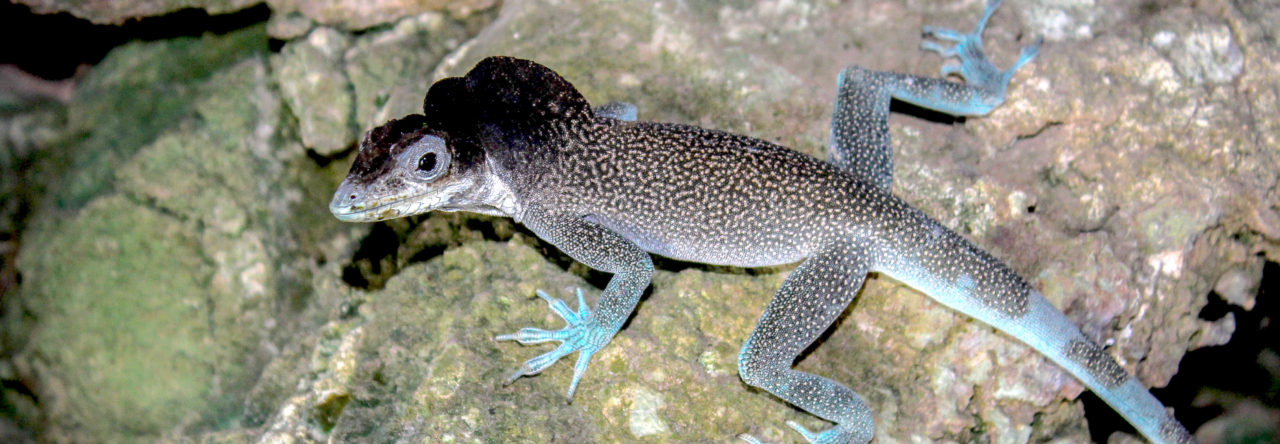
Large prey taken by brown anoles (top two photos) and Swinhoe’s tree lizard (bottom two).

Starting in the 1970s, Caribbean anoles became a model system for studying community ecology, especially interspecific competition. Such studies generally focused only on anole species. Though seemingly chauvinistic, this anolocentrism is reasonable in many localities, where resource competition probably is primarily between anole species (although there was a boisterous debate in the 1980s on the extent to which anoles and insectivorous birds might compete).

However, this is not always the case. In Central and South America, for example, the much greater non-anole saurifauna than on Caribbean islands makes it likely that anoles may experience much greater resource competition with non-anole lizards, as well as other taxa. And the same may be true for anoles introduced to far-flung regions.

Take, for example, the brown anole in Taiwan, which occurs with the native Swinhoe’s tree lizard. Like brown anoles, the agamid is found on the ground and low on tree trunks, and thus might be considered a trunk-ground anole. Being only slightly larger than brown anoles, the tree lizard probably eats much the same food. Gerrut Norval posted a while back on the amazingly large prey that brown anoles and tree lizards eat in Taiwan, and now he and colleagues have published a paper documenting the extensive diet overlap between the species (Gerrut previously provided a post on the background to this study, including some interesting information and photographs on the research methods). Very likely they are strong competitors, although Norval et al. argue that the size discrepancy means that the effect is asymmetric. However, at least in some areas, brown anoles have much higher densities, meaning that their aggregate effect on tree lizards may be just as great as the reverse.

Brown anoles are most dense in hot, open areas, whereas the tree lizards reign supreme in shaded habitats, suggesting that environmental effects mediate the outcome of interspecific interactions between the two species. In addition, this difference indicates that reforestation efforts would be a good conservation move to stem the effect of the brown anole invasion.

Did the Adaptive Radiation of Anoles Happen in Stages?

Do events unfold in a predictable sequence when organisms undergo adaptive radiation? Anoles have diversified in many ecologically important characteristics as they have radiated both in the Caribbean and on the mainland. As one of our best-understood cases of extraordinary evolutionary diversification, they make a great system in which to ask how ecological diversity builds up during adaptive radiation.

The idea that anoles radiated in stages dates to at least 1972, when Ernest Williams derived some hypotheses from his observations of Puerto Rican Anolis in particular, drawing upon earlier work by Stanley Rand and Rodolfo Ruibal. Williams noticed that the most closely related species on Puerto Rico tend to belong to the same ecomorph class and occupy similar structural habitats (e.g. branches, trunks or twigs), but occur in different thermal habitats (e.g. closed forests or hot open areas). He proposed that anoles on Puerto Rico diversified first in structural habitat, and later in thermal habitat, a pattern that might scale up to the entire adaptive radiation of Anolis. While this idea has been discussed many times, and helped to inspire more general hypotheses about stages of radiation (e.g. Streelman and Danly 2003), until now it had not been tested using modern analytic techniques that incorporate phylogenetic information for many species.

Figure 11 from Williams (1972), modified to show only the 8 species in the main Puerto Rico radiation.

Figure 11 from Williams (1972), modified to show only the 8 species in the main Puerto Rico radiation.

The Dream Of Curt Connors Could Become Real Thanks To A Mexican God

Axolotl and Curt Coonors researchI read a recent news about “The secret to running repairs” and I remembered an older AA post about a hypothetical genetic biologist who researched the ability of certain reptiles to regrow missing limbs, partially to find a way to regrow his own missing arm.

Today, his noble research could be real thanks to a Mexican god. Yeah, the Axolotl, who according to the Aztec myth is a god transformed on a neotenic salamander with the hope that their ability to regenerate body parts will one day help people with amputations.

The Axolotl has become the amphibian prefered by many scientists around the world thanks to its capacity to regenerate both their hurt limbs as well as its jaw, skin, organs and even parts of the brain and the spinal cord. And to top things off, it doesn’t get cancer.

Scientists believe that it will only take a decade or two before the dream of Curt Connors could became a reality: the human limbs could regenerate like the axolotl.

I’m very excited for this news that I believe I forgot the anoles for a little moment.

Flexible Perches… Who Cares?

httpv://www.youtube.com/watch?v=5Yk4szOOaFg

I had spent a summer in Florida watching green and brown anoles jump around on trunks and branches, and I was amazed by how well they appeared to navigate their habitat, despite the variable flexibility and complexity of the habitat. Many anole species jump. They jump to move around their habitat, to forage, to fight, to chase (or be chased by) potential mates, and to avoid predators. If you have observed anoles jumping in the wild, you might notice that some species jump a lot, and they jump to and from a lot of different types of structures (the ground, trunks, branches, leaves). While the diameter of different types of structures has been shown to affect running speed and surefootedness, it has also been shown to have little impact on jumping, at least in the lab. But what about the flexibility (compliance) of the structures they are jumping to and from? Will a narrow branch in the wild affect jumping performance, not because of its diameter, but because narrow branches tend to be flexible? What about other flexible structures in nature, such as leaves, which tend to be wide and highly flexible? And, are anoles choosy about where, and from what, they jump?

It turns out, when it comes to jumping, perch flexibility is quite important.

With the help of my advisor, an engineer, and a generous collaborator who gave me guidance and let me use his specially-designed anole jumping tank, we conducted a lab study to to determine if and how perch flexibility affects jump performance in green anoles. We found that the  more flexible a perch was, the more it negatively affected jump distance and jump speed. We also observed that the recoiling perches whacked the anoles in the tail as they were jumping, which caused many anoles to do an impressive faceplant (this part of the story has received a bit of notoriety, both in the Annals (twice) and elsewhere). So, increased perch flexibility decreases jumping performance in the lab. But what does this mean for those anoles I’ve seen jumping from leaves and twigs in their natural habitat?

Male green anole perched on a flexible palm leaflet

Male green anole perched on a flexible palm leaflet

To answer this question, I headed back down to Florida and spent a little over a month filming green anole jumping behavior. The green anoles I observed in the wild appeared to be extremely choosy about which structures they jump from. While I found them basking and foraging on a range of perches, from stiff trunks to highly flexible leaves, the lizards would generally jump from the sturdiest perches in the habitat. If they were on a thin and flexible palm leaflet, they would move closer to the base of the leaflet to a stiffer spot before jumping. And when they did jump from highly flexible perches, they jumped to another perch that was just a short distance away. The longest jumps we observed were from the most sturdy (and low-lying) perches.

The green anoles I observed appeared to be so good at choosing perches to jump from, that over the course of my study I only noted two failed jumps from flexible perches. In one instance, a male was perching near the end of a leaflet, then moved to a sturdier part of the leaflet to jump onto a perch above him. Although this part of the leaflet was sturdy, it was not sturdy enough. The force of the jump pushed the jump perch down away from him, and he was unable to jump high enough to reach his intended perch. Luckily, he was able to catch onto another leaflet before he hit the ground. In the other instance, another male attempted a jump to a far perch and landed on the ground instead, then quickly climbed back up the palm. However, because I documented undisturbed behavior, many of the jumps I witnessed were sub-maximal. The lizards were jumping as far as they needed to at the time to get to another perch, but were not attempting to flee and therefore may not have been jumping as far as they might otherwise been able to. I wonder how my observations of how choosy they are with jump perches would change if they were in situations where they needed to escape quickly.

Conservation Status Of The World’s Reptiles

Over at The Lizard lab, Martin Whiting discusses a recent paper published in Biological Conservation on the conservation status of reptiles. Basically, a cast of thousands assessed a random sample of 16% of the world’s reptile species, categorizing them into the IUCN’s categories of conservation concern, which range from “least concerned” to “critically endangered” and, of course, “extinct.”

Martin nicely summarizes the paper in his post, but I’ll reprint his conclusion summary paragraph here: “59% of species were Least Concern, 5% were Near Threatened, 15% Threatened (Vulnerable, Endangered or Critically Endangered) and 21% were Data Deficient. To put this another way, one in five species are threatened with extinction and another one in five are data deficient. The paper identifies freshwater habitats, oceanic islands and tropical regions as containing the highest proportion of threatened species. Habitat loss and direct harvesting are two key threats to reptile populations and these are depicted in Figure 3 from the paper” (above).

Of course, from the AA perspective, the question is: what about anoles? The results were, to me at least, surprising. Of the 65 species surveyed, 29.3% were in one the three threatened categories, nearly twice as many as the global average! I would have guessed the opposite–most anoles seem to being doing reasonably well. But, then I rationalized, it must be the mainland anoles, because Caribbean anoles are generally doing fine. Again wrong! 11/28 (39%) Caribbean anoles are in these categories (including the only two “critically endangered species, A. juangundlachi (known from one specimen, if I recall correctly) and A. roosevelti), compared to 8/37 (22%) for mainland species. One non-surprise is that all 10 “data deficient” species are from the mainland; however, even when they are removed, the percentage threatened in the mainland (30%) is still less than in the Caribbean. At least for the Caribbean species, the biggest predictor seems to be range size, as all threatened species either have small distributions or occur on small islands. I am less familiar with some of the mainland species, but think the same may be true for those. I’ll append the list below.

One last note: the paper truly has an extraordinary number of authors who contributed to this massive compilation. One amusing consequence is that the list of authors’ affiliations at the start of the paper is three pages long!

New Guide To The Reptiles And Amphibians Of Guyana

guyana

guyana2

Based on a long-standing program of field exploration initiated by the Smithsonian’s National Museum of Natural History and the University of Guyana, with further support from the American Museum of Natural History and the Royal Ontario Museum, a distinguished cast of authors, each with extensive experience in Guyana, has just published this enormous and useful monograph. Part of the abstract is appended below, but more importantly you may be wondering, just which anoles occur in Guyana? The answer is that there are at least five native species (auratus, fuscoauratus, ortonii, planiceps, and punctatus). They note, as well, that chrysolepis is reported to occur in Guyana as well, but all chrysolepis group specimens they examined turned out to be planiceps.

In addition, at least one Lesser Antillean species occurs in the cities of Georgetown and Kartabo. These invaders have been identified as both A. extremus from Barbados or A. aeneus from Grenada and the Grenadines, but the authors were unable to find any reliable morphological characters that could distinguish the two species, and thus could come to no conclusion about which species, or both, occur in several cities in Guyana, though they did note that Ernest Williams had identified many of the specimens in museums from Guyana as A. aeneus, as good a reason as any to attribute them to that species. The authors conclude “Clearly, the taxonomic status of Anolis aeneus versus Anolis extremus needs further investigation, both in areas where they occur in the West Indies and where they have been introduced on islands and the mainland of South America.”

Honorary anole friend Polychrus marmoratus also occurs in Guyana and is pictured above.

The first half of the two-page abstract:

Anole Taxonomy Debate Summarized In Herp Review

herp reviewThe most recent issue of Herpetological Review (December 2012) includes an article by Ted Townsend, “Proposal to Alter Anole Taxonomy and Ecological Nomenclature.” Townsend does an admirable job of summarizing the issues and, most importantly, includes a shout out to Anole Annals (“an internet forum frequented by anole researchers”). Also notable is the wacky photo that appears to the left of the article (and the left of this text).

Phylogenetic Diversity-Area Relationships For Anoles

Figure 3 from Helmus and Ives (2012)

For 50 years, scientists have been cataloguing the relationship between area of islands or other patches of habitat and the number of species they contain. In general, the bigger the area, the greater the number of species. In recent years with the rise of interest in incorporating a phylogenetic perspective to all manner of questions, some have wondered how the phylogenetic variety (the degree of relatedness among species) changes with area. In an important new paper, Helmus and Ives take a theoretical perspective to understand what the expectation is for the relationship between phylogenetic diversity and area. Most excitingly, they illustrate their method using data from anoles on Caribbean islands.

Here’s how they describe what they’ve found: “While there was a strong relationship between Anolis species richness and Caribbean island bank area (Fig.3A; Losos 1996, Losos and Schluter 2000), we found no overall relationship between Anolis phylogenetic diversity and island bank area (Fig. 3B) …The greatest variation in phylogenetic diversity was associated with the overall level of in situ speciation … [T]here is a strong PDAR for the seven Caribbean island banks with at least one in situ speciation event (Fig. 4A). The estimated phylogenetic diversity values of these seven banks are dominated by in situ speciation as opposed to among-island allopatric events (Cuba had 2, 47, 49 colonizations, in situ events, species richness, respectively; Hispaniola had 4, 33, 37; Puerto Rico had 3, 11, 14; Jamaica had 1, 5, 6; Guadeloupe had 1, 3, 4; Grenada had 1, 1, 2; and St. Vincent had 1, 1, 2). The strong Anolis SAR causes a strong positive PDAR for these banks because species richness and the number of in situ speciation events positively correlate (Figs. 3A and 4B). If island assemblages were only derived from in situ speciation, then, according to the neutral macroevolutionary model we used, phylogenetic diversity is expected to positively increase, and then plateau with the number of in situ speciation events (Fig. 4C), which is the same relationship we found for the seven island banks (Fig. 4B). On at least the four Greater Antilles islands, island area sets a limit to the number of Anolis species that can arise via in situ speciation (Rabosky and Glor 2010). Thus, when there are no external colonizations that add large amounts of external evolutionary history to island assemblages, positive PDARs are expected.

It is the balance of ancestral colonizations to in situ speciation, therefore, that affects regional phylogenetic diversity. This balance is thought to be determined by a race between colonists, where initial colonist species will diversify if another colonist species does not arrive and establish too soon after the initial colonization event (Gillespie 2004). For Anolis, this balance is related to island area, the timing of island emergence and species diversification, and island isolation (Losos 2009). For example, the largest island bank, Cuba, is the center of Caribbean Anolis diversity and was likely colonized twice, by the ancestor of most Caribbean Anolis, and possibly to all Anolis (Nicholson et al. 2005), and more recently by a colonist species from Hispaniola, whose ancestor was originally Cuban (Mahler et al. 2010). Cuba thus contains a large amount of phylogenetic diversity, not because it has received outside colonists, but because it is large in area and contains old diverse lineages that have arisen via in situ speciation. Small and spatially isolated banks such as those in the lower Lesser Antilles (e.g., Grenada) have had few ancestral colonizations and few in situ speciation events that together result in low phylogenetic diversity. In contrast, species assemblages on small and non-isolated banks (e.g., the Acklins bank of the Bahamas) are completely derived from among-island colonization’s, and thus, have high phylogenetic diversity similar to the Cuban bank (Fig. 3B). Macroevolutionary simulations should thus be extended to include these isolation effects. However, the model and the Anolis data suggest that, in general, PDARs should be flat for oceanic islands whose species assemblages are an outcome of both in situ speciation and multiple colonizations.”

Figure 4 from Helmus and Ives (2012).

Experimental Study Of Reproductive Isolation In Uta

Uta stansburiana mating. Image from http://cabezaprieta.org/

The side-blotched lizard, Uta stansburiana, is one of the most widely-studied lizard species, thanks largely to work by Barry Sinervo and colleagues on the evolution of  alternative mating strategies (a.k.a. the rock-paper-scissors game in lizards).  The most recent report on the evolution of this interesting species investigates reproductive isolation between two populations of Uta that diverged within the last 22,500 years.  One of these populations is found on lava flows and the others if found off the lava flows.  This report by Corl et al. (2012) is noteworthy because recent work on a range of other organisms suggests that some “rules” for the evolution of reproductive isolation are shared across the tree of life.  Do these rules also apply to lizards?

To my knowledge, patterns of reproductive isolation have only been investigated experimentally in one other genus of lizards: Lacerta (Rykena 1991, 1996; Olsson et al.  2004). This work with Lacerta suggest substantial intrinsic reproductive isolation between species resulting from low fertility and high rates of developmental defects in hybrid crosses. Studies of Lacerta also support Haldane’s Rule because females hybrids (ZW) suffer more fitness consequences than male hybrids (ZZ).

By conducting experimental hybridization studies between these two populations of Uta, Corl et al. (2012) were able to show that significant reproductive isolation has evolved between populations, largely in the form of pre-zygotic post-mating isolation; inter-population crosses produce significantly more unfertilized than fertilized eggs relative to intra-population crosses.  Corl et al.’s results are also consistent with at least one general rule for the evolution of reproductive isolation that has been reported in other organisms; asymmetric reproductive of isolation between the two Uta populations is consistent with Darwin’s Corollary to Haldane’s Rule.

How does all this relate to anoles?  My lab is interested in this work because we’re in the midst of a major project designed to answer questions about intrinsic reproductive isolation in Anolis.  Anthony Geneva reported on some preliminary results of this work earlier this year and we hope to have more to report sometime in the near future.

Rykena, S. 1991. Hybridization experiments as tests for species boundaries in the genus Lacerta sensu stricto. Mitteilungen aus dem Zoologischen Museum Berlin 67:55–68.

Rykena, S. 1996. Experimental interspecific hybridization in the genus Lacerta. Israel Journal of Zoology 42:171–184.


Anole Genome Reannotated

Get all the details in the newly posted paper by Eckalbar et al. in BMC Genomics “Genome reannotation of the lizard Anolis carolinensis based on 14 adult and embryonic deep transcriptions,” just posted on BMC Genomics. Here’s the low-down: “The green anole lizard, Anolis carolinensis, is a key species for both laboratory and field-based studies of evolutionary genetics, development, neurobiology, physiology, behavior, and ecology. As the first non-avian reptilian genome sequenced, A. carolinensis is also a prime reptilian model for comparison with other vertebrate genomes. The public databases of Ensembl and NCBI have provided a first generation gene annotation of the anole genome that relies primarily on sequence conservation with related species. A second generation annotation based on tissue-specific transcriptomes would provide a valuable resource for molecular studies. Here we provide an annotation of the A. carolinensis genome based on de novo assembly of deep transcriptomes of 14 adult and embryonic tissues. This revised annotation describes 59,373 transcripts, compared to 16,533 and 18,939 currently for Ensembl and NCBI, and 22,962 predicted protein-coding genes. A key improvement in this revised annotation is coverage of untranslated region (UTR) sequences, with 79% and 59% of transcripts containing 5′ and 3′ UTRs, respectively. Gaps in genome sequence from the current A. carolinensis build (Anocar2.0) are highlighted by our identification of 16,542 unmapped transcripts, representing 6,695 orthologues, with less than 70% genomic coverage. Incorporation of tissue-specific transcriptome sequence into the A. carolinensis genome annotation has markedly improved its utility for comparative and functional studies. Increased UTR coverage allows for more accurate predicted protein sequence and regulatory analysis. This revised annotation also provides an atlas of gene expression specific to adult and embryonic tissues.”

Page 41 of 67

Powered by WordPress & Theme by Anders Norén