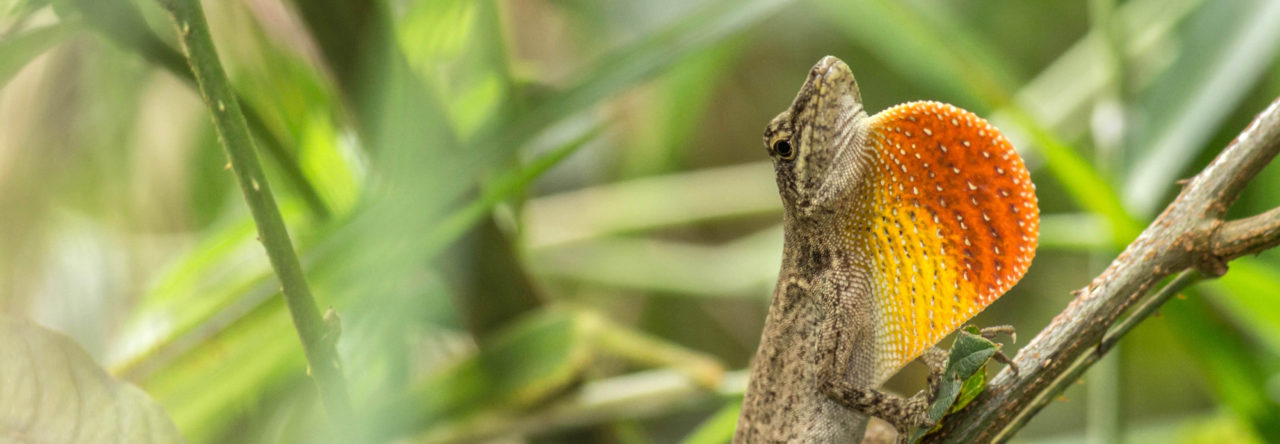
A brown anole in its unnatural habitat; Rishon LeZion, Israel. Photo: Aviad Bar
Shai Meiri, School of Zoology & the Steinhart Museum of Natural History, Tel Aviv University
uncshai@tauex.tau.ac.il
In late April 2021, someone posted a facebook image of a lizard seen in a residence garden in Rishon LeZion, a satellite city of Tel-Aviv, Israel (approximately 31.9611N, 34.7889E). Aviad Bar, one of the best herpetologists in Israel, identified it as a brown anole (Anolis sagrei Duméril & Bibron, 1837) and went there to investigate. He found around ten lizards in that garden, and managed to catch two of them. The preliminary identification was verified, and the lizards were later deposited in the national collections at the Steinhardt Museum of Natural History, Tel Aviv University, after the Israeli Nature and Parks Authority (INPA; the governmental body in charge of protecting nature in Israel) were consulted.
Anolis sagrei is potentially very bad news. It is one of the best models for the study of evolution in nature over short time scales across the animal kingdom (a more or less random sample of works includes: Losos et al. 2004, Schoener et al. 2005, Calsbeek and Cox 2010, Losos and Pringle 2011, Stuart et al. 2014, Kamath et al. 2020, Stroud et al. 2020, Donihue et al. 2021). But it is also one of the worst reptile invaders worldwide, alongside flowerpot snakes (Indotyphlops braminus), the mourning gecko (Lepidodactylus lugubris) red-eared sliders (Trachemys scripta – we have those in Israel now too) and some Hemidactylus geckos (e.g., H. turcicus, which we may have helped to provide; H. frenatus). To date Anolis sagrei has invaded several states in continental USA (e.g., Florida, Louisiana, Texas), as well as Grand Cayman Island, Bermuda, Jamaica, Grenada, St. Vincent, the Canary Islands, multiple areas in Mexico, Belize, Honduras, Costa Rica, Panama, Ecuador, Hawaii, Taiwan, and Singapore (Sexton and Brown 1977, Kraus 2009, Norval et al. 2012, Amador et al. 2017, Capinha et al. 2017, Stroud et al. 2017, Solis et al. 2017, Batista et al. 2019).

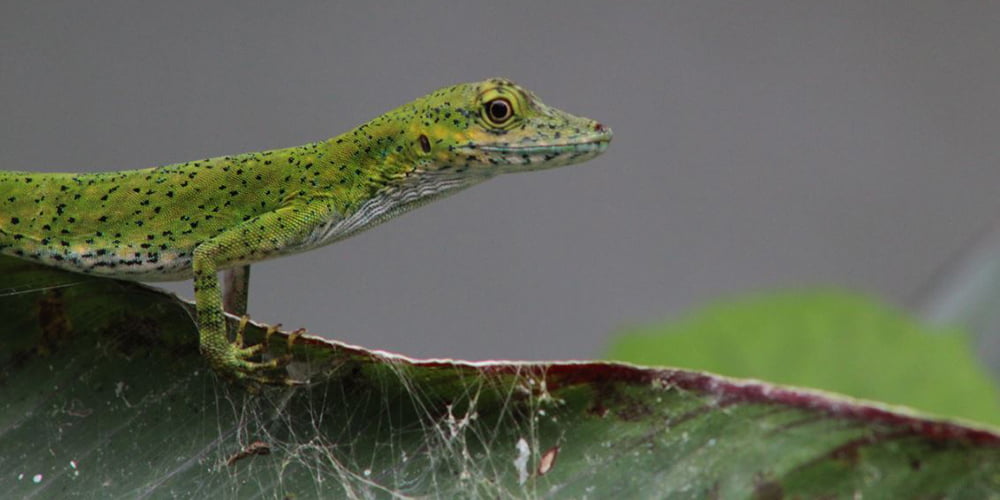
A brown anole caught in Rishon LeZion. Photo: Aviad Bar.
Furthermore, Anolis sagrei is known to compete with native anoles, mainly Anolis carolinensis a system very frequently studied (reviewed in Kraus 2009, and see e.g., Echternacht 1999, Losos and Spiller 1999, Gerber and Echternacht 2000, Stuart et al. 2014, Kamath et al. 2020). Effects on other anoles were also suggested (Losos et al. 1993 for A. conspersus; Batista et al. 2019 for Anolis gaigei), and competition with other lizards has been hypothesized (e.g., Stroud et al. 2017, Batista et al. 2019). Thus, a new record of A. sagrei from outside its native range is no cause for a celebration.
How did A. sagrei reach Israel? One hypothesis, raised by INPA, is that eggs have been transported accidentally in shipments, likely from the USA. We know A. sagrei eggs remain viable for weeks, and can even withstand some exposure to sea water (Hsu et al. 2021). There is a plant nursery not far from the place where A. sagrei was found in Israel, and reptiles have often been accidentally transported with plant shipments (e.g., the flowerpot snake; see e.g., Perry et al. 2006, Losos 2013, Auguste et al. 2018). Indeed, a shipment of wood from Italy arriving in Israel early in 2019 contained live Podarcis siculus (specimens were transferred to the Steinhardt Museum of Natural History, and I identified them there). The USA is the #1 exporter of goods to Israel and considering A. sagrei is widespread in the US, it is a reasonable assumption.
A more plausible explanation soon emerged, however. Anolis sagrei has been in the pet trade in Israel for some time. Some third-party reports to Aviad Bar suggested that a private reptile enthusiast living in Rishon LeZion has been very successful in breeding Anolis sagrei and has simply been releasing juveniles or hatchlings into his back garden. Apparently, this has been going on for at least two and potentially 4-5 years. Thus, the source of the invasion seems to have been intentional (and illegal) introduction of individuals to nature.
The INPA asked me to write a report on potential threats posed by the brown anole and its chances of establishment and spread (Meiri 2021), then held a consultation, and commissioned Aviad Bar to survey the anole population in Rishon LeZion, and adjacent natural areas. Additionally, other Israeli herpetologists have tried to find the species around the area where it was first reported. The survey encountered some unexpected difficulties. For one, the recent horrible and useless spat of fighting between Israel and Hamas, which could and should have been avoided by both sides, caused unnecessary suffering on both, and seemed to have served only the extremely short-term purposes of “leaders” of both sides. Lizards had nothing to do with this apparently. The fighting forced the surveyors to stop the survey multiple times to take cover in shelters of complete strangers from incoming rockets. Luckily, none of them was hurt. Many people welcomed the surveyors into their garden and allowed them to look for and collect lizards. The survey (Bar 2021) was recently submitted to the INPA.
Anoles have been found in five streets in Rishon LeZion, with a maximum linear extent of ~500 m. Lizards have been found active by day on walls, fences, vegetation and on the ground, and to sleep on branches at night – typical anole behavior. Worryingly, anoles of all sizes, from adults >60 mm SVL to small hatchling-sized individuals, were found throughout the study area, strongly suggesting the lizards breed in Israel. Anolis sagrei breeds extremely fast, especially in regions where it is invasive where it matures early and reduces its already incredibly short inter-laying interval (e.g., Jensen et al. 2008, Fetters and Mcglothlin 2017). Basically, one gets the impression (or at least I do) that introduced Anolis sagrei lay eggs (almost) as fast as domestic chickens. It seems to further be helped by light pollution – growing faster and reproducing earlier where artificial lights are available at night (Thawley and Kolbe 2020) – like they are in Rishon LeZion.
Anoles were also highly abundant. Aviad (Bar 2021) found 101 anoles during his survey, and Akiva Topper and Oren Kolodny have found 28 in a single night. For comparison, the second most abundant reptile found during Aviad’s survey was the common chameleon, Chamaeleo chamaeleon – with 15 specimens. The third most abundant was the commensal (and in Israel, native) house gecko, Hemidactylus turcicus (10 animals). In fact, only 41 reptiles other than A. sagrei were found in the survey, of all species (including those identified only from tracks!). Thus in terms of abundance, A. sagrei seems to outclass all other reptiles put together by a factor of at least 2.5-to-1. That this species can be extremely abundant in places it has invaded is well known (e.g., Campbell and Echternacht 2003).
While A. sagrei has invaded many places the world over, it seems to have been confined to tropical or subtropical countries (and the subtropical parts of the USA), and this is the first report of it inhabiting higher latitudes and non-tropical climates (except perhaps some potential places in the USA). One hope expressed early was that the relatively cool Mediterranean winters prevailing in central Israel will prove detrimental for anoles. Yet, like it probably does in some cities in the USA, A. sagrei seem not to mind what goes for winters near the Mediterranean coastlines of Israel. A combination of the climatic effects of the warm puddle that is the eastern Mediterranean Sea and warm microhabitats likely found in urban residential gardens seem to allow it to easily survive the winter. Watering of said gardens likely allows it to easily survive the arid climate of the long Israeli summers (where very little rain, if any, falls in April or October, and virtually none in between). Thus, urban areas seem to present for the anoles the kind of climate and microhabitats it thrives in in its native and introduced range.
Could it spread outside of the cities? As far as we know following Aviad’s survey (Bar 2021), no anoles were found in natural areas bordering its current urban distribution. The little water available there for most of the year may preclude its establishment. But it is highly likely that, if accidentally transported, it could easily establish in habitats where abundant water is available year-round. Such as streams and pools, artificial and natural.
How much of a threat is posed by Anolis sagrei to Israeli nature is less certain. As far as I know few have tried to estimate its effect on arthropod and other prey-species communities (but see Losos 2011,2020). I certainly cannot guess it. Actual reports of Anolis sagrei impacting other vertebrate taxa seem to be confined to its effect on congenerics (even Stroud et al., 2017, only mentions potential impacts), of which Israel has none. But a super-fecund, and highly abundant, species such as the brown anole could potentially compete with other small terrestrial and arboreal lizards (and juveniles of larger species), of which the Israeli coastal plain has many (Bar et al. 2021). I can easily envision it competing with, and potentially preying on lizards such as Mediodactylus orientalis, Hemidactylus turcicus, Phoenicolacerta laevis and Heremites vittatus – at least juvenile ones (and it could easily prey on adult Ablepharus rueppellii, if it can find it in the grass and leaf litter).

Aviad Bar with other lizards he recently caught (Varanus griseus). These ones are unlikely to be harmed by any anole and in fact are totally unrelated to this story. But Aviad sent the picture to me alongside the anole photos, and it was just too good to waste.
Right now, probably 2-5 years after it first invaded, A. sagrei seems to be doing extremely well in its new introduced range in Israel – but it is still probably very localized. This means that we have a unique opportunity to deal with it before it spreads further. Our record of dealing with reptile invasions in Israel is abysmal. Few reptile species have been introduced to Israel: Cyrtopodion scabrum, Trachemys scripta and more recently (Jamison et al. 2017) Tarentola annularis (Meiri et al. 2019, Bar et al. 2021). As far as I know, no attempt has been made to stop the spread of C. scabrum and T. scripta. The story of T. annularis is even more telling. Despite being larger, meaner, and potentially far more aggressive species than A. sagrei, and being introduced to a single locality, very little has been done to try and curb its invasion. One person was employed, for a few months, to try to control what was already a population numbering in the thousands – and even this effort was stopped for lack of funding (read: being of very low perceived priority).
I hope this will not be the case with Anolis sagrei too. We have the potential to stop the invasion, still in its infancy, in its tracks. The INPA seem to have the will (and certainly has the means) to do it, and I wish them luck and perseverance. This is an outlet of anole lovers so please don’t get me wrong. I do not wish for Israel to be the next test case of fascinating scientific work on the rapid evolution of Anolis sagrei. We want to keep anoles those wonderful and lizards we read about in papers and books (e.g., Roughgarden 1995, Losos 2009). I want us to keep on having to go and find them in places we find exotic (if there is anything Rishon LeZion is not, it is exotic). I want to engage with the scientists who study them on their own turf. Let’s keep anoles in the Neotropics where they belong.
References
Amador, L., Ayala-Varela, F., Narvaez, A. E., Cruz, K. and Torres-Carvajal, O. 2017. First record of the invasive brown anole, Anolis sagrei Dumeril & Bibron, 1837 (Squamata: Iguanidae: Dactyloinae), in South America. Check List 13: 2083.
Auguste, R.J., Dass, K. and Baldeo, D. 2018. Discovery of the Puerto Rican crested anole, Anolis cristatellus Duméril & Bibron, on Trinidad. Caribbean Herpetology, 63: 1-2.
Bar, A. 2021. Summary of a preliminary survey to evaluate the establishment and distribution of the species brown anole (Anolis sagrei). Report to the chief ecologist of the Israeli Nature and Parks Authority, Pazbar, Herzlia. In Hebrew.
Bar, A., Haimovitch, G. and Meiri, S. 2021. Field guide to the amphibians and reptiles of Israel. Edition Chimaira, Frankfurt Am Main. In Press.
Batista, A, Ponce, M., Garces, O., Lassiter, E. and Miranda, M. 2019. Silent pirates: Anolis sagrei Dumeril & Bibron, 1837 (Squamata, Dactyloidae) taking over Panama City, Panama. Check List 15: 455-459.
Calsbeek, R. and Cox, R. M. 2010. Experimentally assessing the relative importance of predation and competition as agents of selection. Nature 465: 613-616.
Campbell, T. S. and Echternacht, A. C. 2003. Introduced species as moving targets: changes in body sizes of introduced lizards following experimental introductions and historical invasions. Biological Invasions 5: 193-212.
Capinha, C., Seebens, H., Cassey, P., Garcia‐Diaz, P., Lenzner, B., Mang, T., Moser, D., Pysek, P., Rodder, D., Scalera, R. and Winter, M. 2017. Diversity, biogeography and the global flows of alien amphibians and reptiles. Diversity and Distributions 23: 1313-1322.
Donihue, C. M., Kowaleski, A. M., Losos, J. B., Algar, A. C., Baeckens, S., Buchkowski, R. W., Fabre, A. C., Frank, H. K., Geneva, A. J., Reynolds, R. G., Stroud, J. T., Velasco, J. A., Kolbe, J. J., Mahler, D. L. and Herrel, A. 2020. Hurricane effects on Neotropical lizards span geographic and phylogenetic scales. Proceedings of the National Academy of Sciences, USA, 117: 10429-10434.
Echternacht, A. C. 1999. Possible causes for the rapid decline in population density of green anoles, Anolis carolinensis (Sauria: Polychrotidae) following invasion by the brown anole, Anolis sagrei, in the southeastern United States. Anolis Newsletter 5: 22–27.
Fetters, T. L. and Mcglothlin, J. W. 2017. Life histories and invasions: accelerated laying rate and incubation time in an invasive lizard, Anolis sagrei. Biological Journal of the Linnean Society 122: 635-642.
Gerber, G. P. and Echternacht, A. C. 2000. Evidence for asymmetrical intraguild predation between native and introduced Anolis lizards. Oecologia 124: 599–607.
Hsu, M. H., Lin, J. W., Liao, C. P., Hsu, J. Y. and Huang, W. S. 2021. Trans-marine dispersal inferred from the saltwater tolerance of lizards from Taiwan. PLoS One, 16: e0247009.
Jamison, S., Tamar, K., Slavenko, A. and Meiri, S. 2017. Tarentola annularis (Squamata: Phyllodactylidae): a new invasive species in Israel. Salamandra 53: 299-303.
Jensen, J. B., Camp, C. D., Gibbons, W. and Elliot, M. J. 2008. Amphibians and reptiles of Georgia. University of Georgia Press, Athens.
Kamath, A., Herrmann, N. C., Gotanda, K., Shim, K. C., LaFond, J., Cottone, G., Falkner, H., Campbell, T. S. and Stuart, Y. E. 2020. Character displacement in the midst of background evolution in island populations of Anolis lizards: a spatiotemporal perspective. Evolution 74: 2250-2264.
Kraus, F. 2009. Alien reptiles and amphibians. A scientific compendium and analysis. Springer Verlag, Berlin.
Losos, J. B. 2009. Lizards in an evolutionary tree: ecology and adaptive radiation of Anoles. University of California Press, Berkeley.
Losos, J. B. and Pringle, R. M. 2011. Competition, predation and natural selection in island lizards. Nature 475: E1-E2.
Losos, J. B. and Spiller, D. A. 1999. Differential colonization success and assymmetrical interactions between two lizard species. Ecology 80: 252-258.
Losos, J. B., Marks, J. C. and Schoener, T. W. 1993. Habitat use and ecological interactions of an introduced and a native species of Anolis lizard on Grand Cayman, with a review of the outcomes of anole introductions. Oecologia 95: 525-532.
Losos, J. B., Schoener, T. W. and Spiller, D. A. 2004. Predator-induced behaviour shifts and natural selection in field-experimental lizard populations. Nature 432: 505-508.
Meiri, S., Belmaker, A., Berkowic, D., Kazes, K., Maza, E., Bar-Oz, G. and Dor, R. 2019. A checklist of Israeli land vertebrates. Israel Journal of Ecology and Evolution 65: 43-50.
Meiri, S. 2021. The brown anole in Israel, assessing the invasion pathway, establishment potential and potential threats. Report to the chief ecologist, Israel Nature and Parks Authority. In Hebrew.
Norval, G., Huang, S.-C., Mao, J.-J., Goldberg, S. R. and Slater, K. 2012. Additional notes on the diet of Japalura swinhonis (Agamidae) from southwestern Taiwan, with comments about its dietary overlap with the sympatric Anolis sagrei (Polychrotidae). Basic and Applied Herpetology, 26: 87-97.
Perry, G., Powell, R. and Watson, H. 2006. Keeping invasive species off Guana Island, British Virgin Islands. Iguana, 13: 273-277.
Roughgarden, J. 1995. Anolis lizards of the Caribbean: ecology, evolution, and plate tectonics. Oxford University Press, Oxford.
Schoener, T. W., Losos, J. B. and Spiller, D. A. 2005. Island biogeography of populations: an introduced species transforms survival patterns. Science 310: 1807-1809.
Sexton, O. J. and Brown, K. M. 1977. The reproductive cycle of an iguanid lizard Anolis sagrei, from Belize. Journal of Natural History, 11: 241-250.
Solis, J. M., Ayala-Rojas, C. G. and O’Reilly, C. M. 2017. New records for two reptiles from the Bay islands, Honduras. Mesoamerican Herpetology 4: 669-671.
Stroud, J. T., Giery, S. T. and Outerbridge, M. E. 2017. Establishment of Anolis sagrei on Bermuda represents a novel ecological threat to Critically Endangered Bermuda skinks (Plestiodon longirostris). Biological Invasions, 19: 1723-1731.
Stroud, J. T., Mothes, C. C., Beckles, W., Heathcote, R. J., Donihue, C. M. and Losos, J. B. 2020. An extreme cold event leads to community-wide convergence in lower temperature tolerance in a lizard community. Biology Letters, 16: 20200625.
Stuart, Y. E., Campbell, T. S., Hohenlohe, P. A., Reynolds, R. G., Revell, L. J. and Losos, J. B. 2014. Rapid evolution of a native species following invasion by a congener. Science 346: 463-465.
Thawley, C. J. and Kolbe, J. J. 2020. Artificial light at night increases growth and reproductive output in Anolis lizards. Proceedings of the Royal Society of London B. 287: 20191682.