

From the back cover: “Anolis lizards have been used in the development and testing of fundamental theories in ecology and evolution, and they have served as important models in behavioral ecology.” The cover photo is credited to Dan Warner.
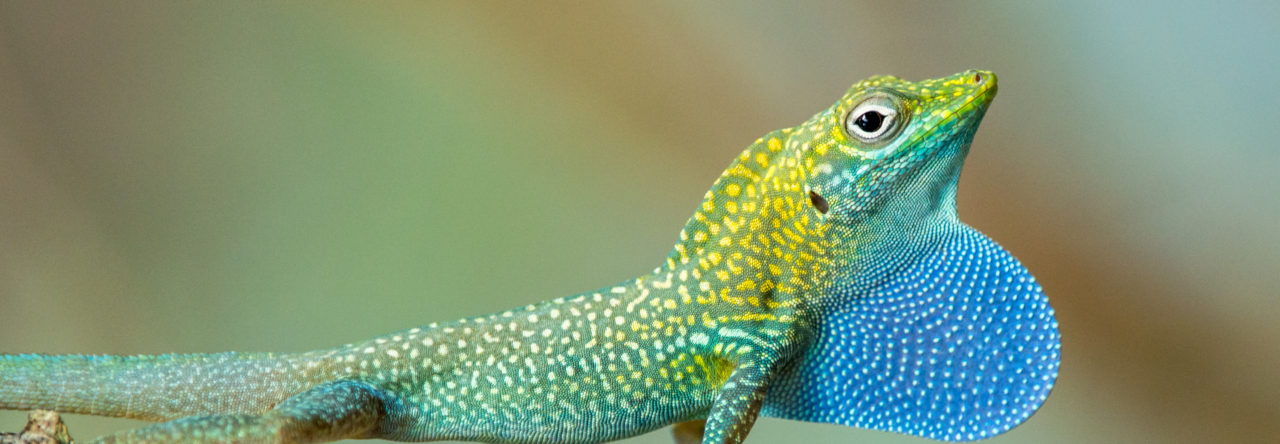
From the back cover: “Anolis lizards have been used in the development and testing of fundamental theories in ecology and evolution, and they have served as important models in behavioral ecology.” The cover photo is credited to Dan Warner.

Figure 1 from Pauw (2006)
Anton Pauw of Stellenbosch University in South Africa writes:
“I am reading Lizards in an Evolutionary Tree and find it fascinating to see how many parallels there are with my one of my study systems, oil-secreting orchids. While the anoles have differentiated across a series of niches provided by a plant, the orchids have differentiated across a series of niches provided by an animal. The orchids segregate the body of the shared pollinator among them so that each places its pollen on a unique segment of the oil-collecting bee. Orchid speciation generally involves shifts between bee species (with placement site conserved), but some speciation also occurs through shift in pollen placement site within the bee , so that sister species occupy for example the first and second segment of the front leg respectively. Anyway, I thought that you too might find these parallels interesting, so I have attached two papers on the topic. I like the comparison of your Fig. 3.2 with Fig. 1 in the attached 2006 paper.”
The other paper is here. Incidentally, apparently no one has posted a picture of an anole sitting on an orchid on the internet.

Photo from http://www.petworldshop.com/
We’ve had a number of posts in recent months on the remarkable variety of anole species available in the pet trade (for example, here and here), particularly in the Europe. Another aspect of the pet trade, however, is the volume at which it occurs, and in this case, it is probably a few common species that make up the bulk of the trade. A recent paper in the Herpetological Journal explored reptile and amphibian commerce in Great Britain over a ten-year period from the mid-1990’s to mid-2000’s. The paper has some interesting points on various aspects of the dynamics of the trade, including how price has changed, the role of captive breeding, and other points. Anoles aren’t a central focus of this paper, but it does report that the price of anoles has increased over time, even after correcting for inflation: 26% in both A. carolinensis and A. sagrei, but only 4% in A. equestris. This was about middle of the pack for lizard species surveyed. Some had become more expensive—more than 400% more in Parson’s chameleon—but about half the species had become cheaper, green iguanas dropping by 69% at the other extreme.
I summarized what I could learn about the anole trade in Lizards in an Evolutionary Tree. It isn’t much, but here’s what I had to say: From 1998–2002, more than 250,000 A. carolinensis and more than 100,000 A. sagrei were legally exported from the United States; in the same period, as many as 30,000 anoles of various species may have been imported into the U.S. Figures for imports into other countries are unavailable, but may be large because there are many reptile hobbyists in Europe. The United States is the only country likely to have much domestic trade in anoles, and these numbers, too, are great because many A. carolinensis and A. sagrei are captured and sold within the United States, not only for the pet trade, but also to laboratories, educational supply companies, and zoos. Data on the magnitude of this trade is scarce, but more than 250,000 anoles were collected in Florida in a four-year period in the early 1990s (this number may be a substantial underestimate because dealers were not required to report the number of the introduced A. sagrei and as a result, most did not do so.). in Louisiana, nearly a million A. carolinensis a year were collected in the mid-1990s, but that number has declined to around 350,000 per year in 2006, apparently as a result of declining demand, rather than shortage of anoles.
The website anolissen.nl has a collection of reasonably high quality anole videos, including one of Terry Ord’s behavior research, featured yesterday, as well as A. allisoni from Cuba fighting; many Cuban species displaying, including A. allogus (or was it A. ahli?) and A. mestrei; A. cuvieri displaying; A. punctatus displaying; a green anole (who can identify it?) eating a butterfly; and a bonus outgroup track of Polychrus acutirostris, as well as others.
 Field Assistants (2-3) needed for field research on the behavior and ecology of the lizards Anolis sagrei and Leiocephalus carinatus on Great Abaco Island, Bahamas. The projects are part of a long-term study evaluating behavioral plasticity and its consequences on ecological and evolutionary processes. Assistants will be in charge of collecting focal observations and general ecological data. Duties include assisting in data collection, analyzing video recordings, habitat characterization, and data entry. Assistants must be flexible in their needs, comfortable living and working in close quarters, and able to work under hot and humid conditions. Assistants must enjoy watching and describing the behavior of animals for long periods of time, while working under relatively isolated conditions. Prior experience conducting fieldwork is desirable but not required. This can be a great opportunity for undergraduates with an interest in pursuing graduate studies in behavioral ecology or herpetology. An overview of the day-to-day activities related to this project can be found at
http://chipojolab.blogspot.com
Positions will run from 16 May to 13 June 2011. We offer a living stipend ($1,440/month), plus room & board and cost of transportation to the field-site. Field assistants will need to provide their own personal gear, including a backpack and life-jacket. Research will take place on relatively small islands, and short trips in a small boat are part of the daily activities. Email a cover letter, resume, and contact info for two (2) references to:
The review of applications will begin immediately.
Manuel Leal
Department of Biology
Duke University

Photo from http://www.dpchallenge.com/image.php?IMAGE_ID=18556
Just back from a talk on primate color evolution. I was gratified to see that the opening slide of the talk included a picture of an anole—didn’t expect that in a monkey talk! However, the image used was the one above. Anole seminar aficionados know that this is a no-no—this image has been used in more talks than is humanly imaginable! The reason is simple: when you Google (or Google Image) Anolis, this image is one of the first couple that pop up. And it’s seemingly a nice picture, so people tend to use it. All the time. But look more closely. This guy is not the Adonnis of the anole world. Rather, his schnozz is very beat up. This fellow should not be the poster child for the anole world. I had always assumed that he was a captive animal, who had rubbed his snout raw against an aquarium wall, as often happens. However, the recent post on fighting A. carolinensis illustrates that perhaps this guy is a fighter, not a lover, and bears the scars of his battles. In any case, a word to the wise: use another anole photo in your presentations.
Dale Hoyt (dhoyt5@charter.net) asks the very reasonable question:
What is the proper pronunciation of “Anole”? Is it Ann-ol, An-ol-ee,or something else?
I get different answers when I consult online pronunciation guides, e.g.,
http://www.howjsay.com/index.php?word=anole&submit=Submit
or
http://www.merriam-webster.com/cgi-bin/audio.pl?anole001.wav=anole
Thoughts, anyone?
Over at strange behaviors, Richard Conniff has posted an interesting memorial list:
The list sets out to honor naturalists who have lost their lives in the field or during other natural history pursuits. A lot of sad stories behind the names here, but a lot of epic ones too. I would bet that a great many of these fallen naturalists died doing what they loved best.
One of the names on the list is Ken Miyata, a young anole biologist who passed away in 1983. Ken was a student of Ernest Williams at Harvard’s Museum of Comparative Zoology in the late 70s (Ph.D. 1980), and he conducted fantastic work on anoles and other reptiles and amphibians, primarily in Ecuador. Although many of us probably know him for the mark he made on tropical herpetology during his brief career, Ken was much better known as a world-class fly fisherman, and it was that passion that ultimately killed him (see a brief retrospective here; see also these recent mentions of Ken by his old friends Jerry Coyne and Greg Mayer on the blog Why Evolution is True).
A name that’s missing from this wall is Preston Webster, another seminal anole biologist who died too young in a 1975 car crash. You can suggest additions to Conniff’s list in the comments of that blog, and he’ll add them. Does anyone who knew Webster want to put a few words on this site? I know very little about the man, but if there aren’t any takers, I’ll try to add him in a couple of days. I believe Webster was in the Dakotas when he died, and I don’t know if he was engaged in any ‘naturalist’s pursuits’ at the time (certainly not on anoles!). But this probably doesn’t matter – there are other great biologists on the list who died early in unrelated accidents.
There are several other herpetologists mentioned. Are there any other anole biologists missing from the list?

In the mid-1980’s, Guyer and Savage proposed dividing Anolis into five genera. This proposal has mostly been rejected by the anole community, for reasons detailed in Poe (2004), Lizards in an Evolutionary Tree and the Wikipedia Norops page. The main reason is that although Guyer and Savage’s proposed genus Norops is monophyletic, all of the other proposed genera are not. Moreover, given the uncertainty that still exists about relationships at the base of the anole tree, sundering anoles into well-supported monophyletic subclades is still not possible. Finally, in Guyer and Savage’s initial paper, Anolis sensu lato was found to be monophyletic—so why bother? Even though we now know that Chamaeleolis, Chamaelinorops, and Phenacosaurus arose from within Anolis, it is much simpler to sink these genera into Anolis rather than to try to break anoles into umpteen different genera—many poorly supported.
Despite these points, and the general support for retention of an unsullied Anolis, support for Norops has one last redoubt, in Central America, and with particular strength in Costa Rica. There, the use of Norops is nearly ubiquitous, as evident in the Reptiles of Costa Rica flashcard pictured above (and for sale throughout the country).
If you spend much time at all in the collections of a natural history museum, you’re guaranteed to come across some weird and hilarious stuff (e.g., see this book). Here’s a gem of a specimen label – this is a green anole skeleton from the Smithsonian (photo and “discovery” by Thom Sanger).

The collecting remarks seem odd enough that I figured it might be an inside joke. But Thom found the following question posted on the Circus History Message Board, which probably explains everything.…
“I have a somewhat of a bizarre question. My aunt, who is in her late 70’s, told my husband and I a story about when she went to the circus a child. My Aunt told us that when she was little girl her mother would buy her a little lizard that was attached a chain that was then attached to a pin. The pin would be worn and the lizard would walk around you until it died.”
The message board has replies from many old-time circus-goers confirming that Anolis carolinensis were indeed tied to strings and peddled to kids at the circus. According to one poster, the lizards were called “bugs” and the peddlers “bug men.” (!?!?)
“Jennifer, the lizards (which have been called chameleons) were known as “bugs” and the sellers on the midway were known as “bug men”. The pitchman would pin a “bug” on his lapel to be viewed as harmless and he carried the “bugs” for sale mounted on a board. Unfortunately the “bugs” didn’t last too long after leaving the circus grounds but kids loved them. John Goodall”
Powered by WordPress & Theme by Anders Norén