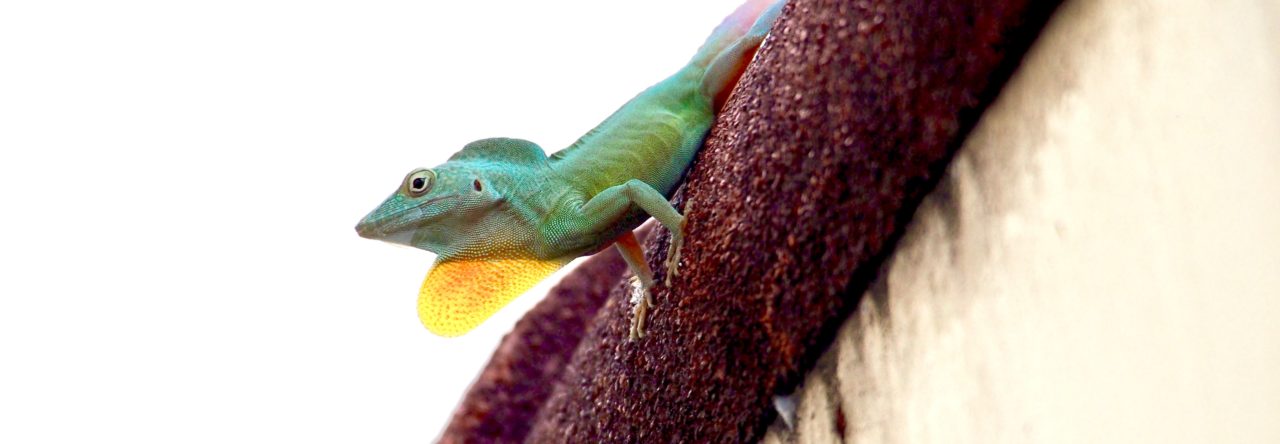
Anolis heterodermus. Photo by J. Losos.
Although many generic names have been proposed for species within the anole clade, traditionally only three other than Anolis were widely used: Chamaeleolis, Chamaelinorops and Phenacosaurus. Each of these clades—which at one time were thought to represent early, pre-Anolis derivations from the anoline line—are morphologically distinctive. The former two, Chamaeleolis and Chamaelinorops, need no introduction—they are oddball species that at first pass might not even be recognized as anoles, and that have received a modicum of scientific study. The third clade, Phenacosaurus, by contrast, has been mostly ignored. This is surprising, because at least some species are quite notable morphologically, with head casques, heterogeneous scalation, wild colors, and an all-over prehistoric appearance. Moreover, they live at remarkably high altitudes, at least by anole standards, and have a passing resemblance—some species more than others—to Caribbean twig anoles. Nonetheless, there is almost no literature on the natural history or evolution of these anoles.
Ken Miyata’s 1983 Journal of Herpetology paper is the one exception. In it, he describes the habitat use of A. heterodermus in areas near Bogotá, Colombia. His description paints the species as one that uses narrow perches on bushes and other vegetation, and that is especially plentiful in blackberry bushes. Combined with its short legs, heterogeneous body and head scalation and elongate and compressed body, reminiscent of twig anoles like A. valencienni, one might entertain the possibility that it is in functional terms a mainland twig anole.
A year and a half ago, we reported in AA on our studies of another phenacosaur, the much smaller A. orcesi from Ecuador. Our studies conclusively demonstrated that it is in all respects like a twig anole—behaviorally, it moves extremely slow; ecologically, it is found almost entirely on narrow surfaces; and morphologically, it is a Caribbean twig anole doppelgänger. But in one respect, A. orcesi was a disappointment—it looks just like any old anole, without the wildly prehistoric aspect for which the larger phenacosaurs are renowned. For this reason, it was time to examine another phenac, and what better choice could there be than A. heterodermus, the subject of Miyata’s study, supposedly common near Bogotá, and appropriately wild in appearance?
And so Rosario Castañeda, Anthony Herrel and I converged on Bogotá in late February for just this purpose, joined by Rafael Moreno, a graduate student at Universidad Nacional de Colombia, who has just completed his masters degree research on this species, with one fine paper out and more in the works. Our plan was simple: go to appropriate spots on the outskirts of Bogotá, locate lizards in the vegetation, watch them and record habitat use and behavior, then capture them and bring them back to the field lab to measure sprinting and biting capabilities and to examine their stomach contents.
Read More