Author: Jonathan Losos Page 81 of 133

Professor of Biology and Director of the Living Earth Collaborative at Washington University in Saint Louis. I've spent my entire professional career studying anoles and have discovered that the more I learn about anoles, the more I realize I don't know.

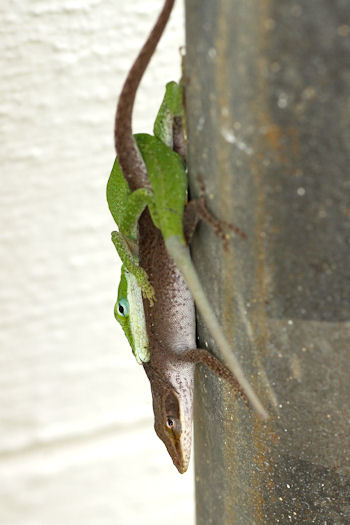
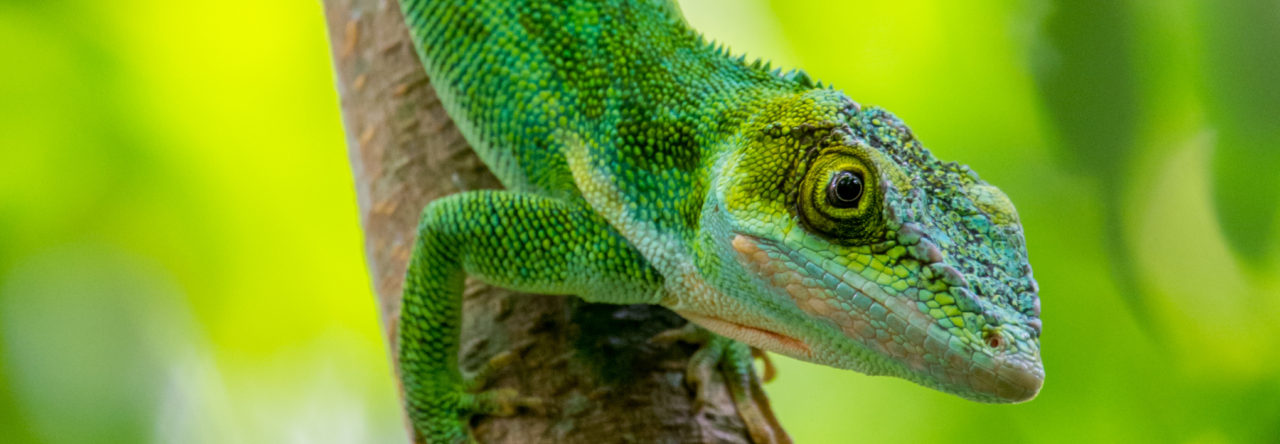
Anolis Fuscoauratus Displaying


Anolis fuscoauratus. Photo by Roberto Langstroth

AA reader Roberto Langstroth writes:

Perhaps Anole Annals readers would enjoy these shots of a displaying A. fuscoauratus on the Nassau Plateau of Suriname.  The second photo shows some interesting behavior, e.g., the tail curling and the tongue protrusion.  There were two individuals involved in vigorous displays…as the third blurry “artistic shot” shows…  They were on a vertical trunk of a large tree about 6 meters above ground on a steep slope on the plateau in March 2010.

More On Anole Tail Regeneration

From Daffodil’s Photo Blog

We’ve had a series of posts on rates of tail regeneration. Daffodil’s Photo Blog, which often features anoles, has just presented a photo tryptych illustrating tail regrowth in green anoles.

Diet Overlap Between Brown Anoles And A Native Lizard In Taiwan

Large prey taken by brown anoles (top two photos) and Swinhoe’s tree lizard (bottom two).

Starting in the 1970s, Caribbean anoles became a model system for studying community ecology, especially interspecific competition. Such studies generally focused only on anole species. Though seemingly chauvinistic, this anolocentrism is reasonable in many localities, where resource competition probably is primarily between anole species (although there was a boisterous debate in the 1980s on the extent to which anoles and insectivorous birds might compete).

However, this is not always the case. In Central and South America, for example, the much greater non-anole saurifauna than on Caribbean islands makes it likely that anoles may experience much greater resource competition with non-anole lizards, as well as other taxa. And the same may be true for anoles introduced to far-flung regions.

Take, for example, the brown anole in Taiwan, which occurs with the native Swinhoe’s tree lizard. Like brown anoles, the agamid is found on the ground and low on tree trunks, and thus might be considered a trunk-ground anole. Being only slightly larger than brown anoles, the tree lizard probably eats much the same food. Gerrut Norval posted a while back on the amazingly large prey that brown anoles and tree lizards eat in Taiwan, and now he and colleagues have published a paper documenting the extensive diet overlap between the species (Gerrut previously provided a post on the background to this study, including some interesting information and photographs on the research methods). Very likely they are strong competitors, although Norval et al. argue that the size discrepancy means that the effect is asymmetric. However, at least in some areas, brown anoles have much higher densities, meaning that their aggregate effect on tree lizards may be just as great as the reverse.

Brown anoles are most dense in hot, open areas, whereas the tree lizards reign supreme in shaded habitats, suggesting that environmental effects mediate the outcome of interspecific interactions between the two species. In addition, this difference indicates that reforestation efforts would be a good conservation move to stem the effect of the brown anole invasion.

Jumping Anole Video Goes Viral

httpv://www.youtube.com/watch?v=_bsusAavtOo&feature=youtu.be

Who wouldn’t want to see a lizard do a face plant? Apparently tens of thousands couldn’t pass this one up. It’s all part of Chi-Yun Kuo’s research in the Duncan Irschick Lab; Chi-Yun provided a first-hand account of the research when the paper was published last year.

Editor’s Correction: Chi-Yun’s paper is fabulous, but this video actually comes from Casey Gilman’s also wonderful research. See her original paper in the lab that produced this video and the recent field follow-up.

Anole Consumption By West Indian Snakes

Caicos Dwarf Boa (Tropidophis greenway) eating an Anolis scriptus. Photo by Matthew Niemiller.

Neotropical snake and Caribbean expert Bob Henderson writes: “In going over some prey data for a chapter on diet and foraging in species of Corallus and the dramatic dichotomy between West Indian and mainland Corallus, I came up with some numbers you might find interesting.

I recovered 970 vertebrate prey items from West Indian snakes. Of those, 559 (57.6%) were anoles. The next closest prey genus was Eleutherodactylus (129; 13.3%).

Among ground dwelling or largely ground-dwelling species (tropes, colubrids, dipsadids), anoles accounted for 54.1% of their prey. Among arboreal snakes (Corallus, Hispaniolan Epicrates, and Uromacer), anoles accounted for 64.1%.

I suspect there are very few West Indian macrostomatan snakes that do not include anoles in their diets at some time during their lives.”

Amazing Green Anole Battle In Hawaii

Don McLeish has photo-documented an amazing battle between two green anoles in his backyard. The fight went on for at least an hour, and when he checked in on the lizards at night, one was still breathing hard hours later. Check out the photos!

Conservation Status Of The World’s Reptiles

Over at The Lizard lab, Martin Whiting discusses a recent paper published in Biological Conservation on the conservation status of reptiles. Basically, a cast of thousands assessed a random sample of 16% of the world’s reptile species, categorizing them into the IUCN’s categories of conservation concern, which range from “least concerned” to “critically endangered” and, of course, “extinct.”

Martin nicely summarizes the paper in his post, but I’ll reprint his conclusion summary paragraph here: “59% of species were Least Concern, 5% were Near Threatened, 15% Threatened (Vulnerable, Endangered or Critically Endangered) and 21% were Data Deficient. To put this another way, one in five species are threatened with extinction and another one in five are data deficient. The paper identifies freshwater habitats, oceanic islands and tropical regions as containing the highest proportion of threatened species. Habitat loss and direct harvesting are two key threats to reptile populations and these are depicted in Figure 3 from the paper” (above).

Of course, from the AA perspective, the question is: what about anoles? The results were, to me at least, surprising. Of the 65 species surveyed, 29.3% were in one the three threatened categories, nearly twice as many as the global average! I would have guessed the opposite–most anoles seem to being doing reasonably well. But, then I rationalized, it must be the mainland anoles, because Caribbean anoles are generally doing fine. Again wrong! 11/28 (39%) Caribbean anoles are in these categories (including the only two “critically endangered species, A. juangundlachi (known from one specimen, if I recall correctly) and A. roosevelti), compared to 8/37 (22%) for mainland species. One non-surprise is that all 10 “data deficient” species are from the mainland; however, even when they are removed, the percentage threatened in the mainland (30%) is still less than in the Caribbean. At least for the Caribbean species, the biggest predictor seems to be range size, as all threatened species either have small distributions or occur on small islands. I am less familiar with some of the mainland species, but think the same may be true for those. I’ll append the list below.

One last note: the paper truly has an extraordinary number of authors who contributed to this massive compilation. One amusing consequence is that the list of authors’ affiliations at the start of the paper is three pages long!

Possible Cage For Lizard Field Experiments

IMG_1720On a recent trip to Toronto, eminent bee-man and pollination biologist James Thomson showed me his lab, including a cage used for bee pollination studies.  The cardboard box is a “box of bees” that can be bought commercially and the experiment involves training bees to go to containers with different colors. Despite being fascinated by the research, my mind couldn’t help but wandering to thinking about how useful such a contraption could be to set up in the field for ecological or behavioral anole studies. As you can see, the cage is big enough that it could house a number of anoles at natural densities, and the mesh lets sunlight and rain through. James kindly informed me that the cages can be purchased at Bioquip; the largest they stock is 6′ (h) x 6′ (w) x 12′ (l), but James told me that larger models can be custom-ordered, and that they are very hardy in the field. Someone should try this!

Anole Or Not Anole?

DSC_0010xTime for everyone’s favorite parlor game. Your AA correspondents are out in the field, and this turned up. So, which is it? And what species, exactly?

New Guide To The Reptiles And Amphibians Of Guyana

guyana

guyana2

Based on a long-standing program of field exploration initiated by the Smithsonian’s National Museum of Natural History and the University of Guyana, with further support from the American Museum of Natural History and the Royal Ontario Museum, a distinguished cast of authors, each with extensive experience in Guyana, has just published this enormous and useful monograph. Part of the abstract is appended below, but more importantly you may be wondering, just which anoles occur in Guyana? The answer is that there are at least five native species (auratus, fuscoauratus, ortonii, planiceps, and punctatus). They note, as well, that chrysolepis is reported to occur in Guyana as well, but all chrysolepis group specimens they examined turned out to be planiceps.

In addition, at least one Lesser Antillean species occurs in the cities of Georgetown and Kartabo. These invaders have been identified as both A. extremus from Barbados or A. aeneus from Grenada and the Grenadines, but the authors were unable to find any reliable morphological characters that could distinguish the two species, and thus could come to no conclusion about which species, or both, occur in several cities in Guyana, though they did note that Ernest Williams had identified many of the specimens in museums from Guyana as A. aeneus, as good a reason as any to attribute them to that species. The authors conclude “Clearly, the taxonomic status of Anolis aeneus versus Anolis extremus needs further investigation, both in areas where they occur in the West Indies and where they have been introduced on islands and the mainland of South America.”

Honorary anole friend Polychrus marmoratus also occurs in Guyana and is pictured above.

The first half of the two-page abstract:

Page 81 of 133

Powered by WordPress & Theme by Anders Norén