
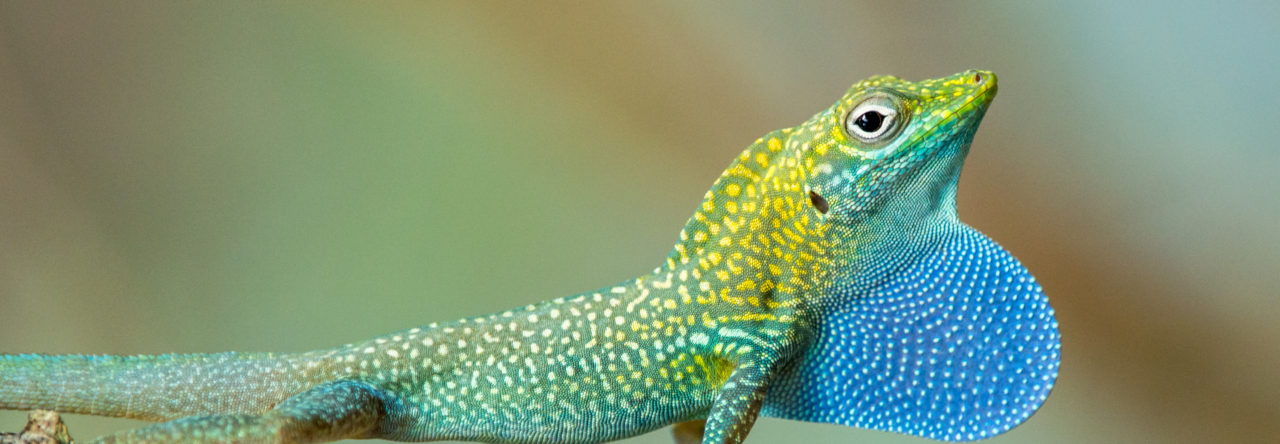
 Here’s something you don’t see every day. More on these guys soon.
Author: Jonathan Losos Page 79 of 133
Professor of Biology and Director of the Living Earth Collaborative at Washington University in Saint Louis. I've spent my entire professional career studying anoles and have discovered that the more I learn about anoles, the more I realize I don't know.

- Anolis annectens. Photo by J. Losos.

No flies on you guys–this remarkably obscure anole was quickly identified. So, what’s its claim to fame?
Well, we have to backtrack to Anolis onca for a minute. Faithful AA readers will recall that A. onca is the only anole lacking a subdigital toepad. For this reason, at one point it was placed in its own genus, Tropidodactylus. However, in 1974 Ernest Williams described a new species in Breviora based on a single specimen found in a jar of A. onca in the Field Museum in Chicago. At that time, Anolis was characterized by having expanded scales under phalanxes ii and iii of the toe, whereas Tropidodactylus, of course, had none (phalanxes are the bones in a toe–humans have three per finger, for example). What was remarkable was that the new specimen had expanded scales under phalanx ii, the Anolis condition, but only keeled scales under phalanx iii–it was intermediate between the two, hence the specific name annectens. Here’s an image from Williams’ paper and a photograph of an annectens toe.

From Williams (1974).

Anolis annectens foot. Note the lamellae under only one toe bone. Photo by J. Losos.
The term “retrograde” comes from Williams’ paper and refers to the idea that A. annectens and A. onca illustrate a morphocline in toepad reduction–halfway gone, then all the way gone. Incidentally, recent molecular studies confirm that the two species are sister taxa.
Amazingly enough, A. annectens occurs in the same general region as A. onca, near Lake Maracaibo in Venezuela. In 2007, Tito Barros and colleagues reported in Tropical Zoology on the collection of an additional 22 specimens of A. annectens, confirming that the one individual wasn’t a freak. They also provided information on coloration, geographic distribution (it still hasn’t been found in sympatry with A. onca) and some data on ecology.
Since we were in the area any way, we decided to go and look for them after collecting data on A. onca. By “we,” I mean Tito Barros, Gilson Rivas, several students of theirs, and Rosario Castañeda. Anthony Herrel was busy back at the field lab conducting performance trials (sprint speed, bite force), and I was on assignment finding discarded cardboard boxes to make a proper racetrack.
The weather was beastly hot, about 110 degrees Fahrenheit, with no wind. Here’s what Rosario had to say:

Read all about in Janson Jones’ latest anole post over on Dust tracks on the web and more on the ever dangerous broad-headed skinks at this recent post.

Better Janson than a brown anole
 Rob Heathcote posted this photo as a comment on Sean Giery’s post on bird predation on anoles, but the photo is so spectacular that we need to make sure everyone sees it.

Anolis tigrinus. Photo by Anthony Herrel
The last leg of our Little Known Mainland Anole Tour took us to the mountains above Caracas, in quest of Anolis tigrinus. A “mystery anole” photo of that species was put up on AA in December, and savvy readers quickly pegged it as a mainland species, noting it’s twig anole-like appearance. Moreover, the only publication on the natural history of this species, by Ugueto, Rivas, Barros, and Smith, suggested it was a twig anole as well. Given our previous work that had identified the twig anolishness of A. proboscis in Ecuador and A. (Phenacosaurus) heterodermus in Colombia (earlier in this trip), we’re beginning to see a trend: twig anoles seem to be the one kind of West Indian ecomorph that has evolved many times on the mainland (the A. pentaprion clade is another candidate).

Colonia Tovar
So, fresh from the beaches of Maracaibo, we headed to the mountains in quest of the tiger anole. A last minute change in plan led us to the little town of Colonia Tovar at about 7000 feet in elevation. We didn’t know what to expect from TC, but Wikipedia describes it as “Germany in the Caribbean.” Established by settlers from Baden (now part of Germany) in the 1850’s, the town gradually declined for a century, before reinventing itself as a kitschy tourist trap in the 1960s, and now it’s booming. And it was delightful. All of the buildings seemed straight out of Bavaria, there were brewhauses and wienerschnitzel (see photo at bottom of post), the waitresses wearing their fraulein get-ups.

The friendly locals in Colonia Tovar
We stayed at a delightful little hotel, Cabañas Heidelberg. And for no extra charge, we were able to go lizard hunting in the little patch of woods out back.

Those of you who noticed when the answer was briefly revealed, please don’t spill the beans. Very few AA readers, or anyone else, have seen this one!

A windy study site on the northwest coast of Venezuela.
All of us who study anoles in the Caribbean share a PR problem: people think we’re partying on the beach all day long. Now, it’s true that that’s exactly what some of my colleagues do (you know who you are, but I’m not naming names), but there’s a problem with this approach: anoles don’t live on the beach! And for that reason, anole researchers generally do not either, at least not during working hours.

The padless foot of Anolis onca. Photo by J. Losos.
As we all know, anoles are characterized by the possession of two characteristics, an extensible throat fan and expanded subdigital toepads. But there are exceptions. The Cuban A. vermiculatus and A. bartschi (two of the finest anoles you’ll ever come across) have no dewlap whatsoever. And one species, A. onca, entirely lacks toepads, not even a hint of subdigital lamellae.
Where am I going with this, you might wonder? The answer is simple. Where do you think A. onca lives? On the beach! Anolis onca is the only beach-dwelling anole, or so it’s said. And for that reason, our South American Little Known Anole Tour (SALKAT) moved from the chilly Andes of Colombia to the smoking hot sealevel of Maracaibo, Venezuela to see what’s up with this species.

Current exchange rate, 6.3 Bolivares (Bs) to the dollar.
 A few notes about Venezuela. Well, one mostly. It’s incredibly expensive. Who would pay $10 for a box of Froot Loops? Not even me. Or $9 for a can of Pringles? Ahem, well, it had been a good day. Rental cars cost more than $200/day, if you can find one (when we tried to get one at the Caracas Airport, the six rental car booths had, between them, two cars available). And hotel rooms are exorbitantly priced and also in scarce supply. We were told that the reason for that is that they were full of Cuban workers, sent over by the Castros to help their socialist brothers-in-arms. And, to be honest, the people we encountered–in the airport, at the hotel, etc.–often weren’t the friendliest.
One thing was cheap, though, gasoline. They practically give it away. At one point, we only had 1/4 tank of gas, so stopped at a service station. I went in and bought a can of soda for $2.50, then paid the bill for the gas, which came to $0.60.

Anolis onca. Photo by J. Losos.
Any way, back to A. onca.

That’s one beat up looking old dude, but apparently he’s still got it. Or does he? She seems to have one foot out the door.
We’ve been following the backyard anole antics reported in Daffodil’s Photo Blog for some time now, and Easter provided a heartwarming photo-story of an old guy who can still find some love. And this old guy seems like he’s seen some better days.

The saga continues. Last December, the Reptile Database, the online listing of all recognized reptile species, issued an update in which anoles were split into the eight genera proposed by Nicholson et al. Now, in the subsequent update released yesterday, they’ve done an about-face and changed all anoles back to Anolis. Here’s what they have to say:
“Anolis. After serious contemplation (and consultation with several experts) we changed the names of anoles back to Anolis. For some reasons see Poe et al. (2013) Zootaxa 3626 (2): 295–299.”
Interestingly, the very next item was this:
“Teiidae. The names of many teiids have changed following the suggestions of Harvey et al. (2012) Zootaxa 3459: 1–156. However, we are already getting complaints that this may not be tenable…”
So, seems like these issues may not necessarily be unique to anoles. The Reptile Database is a great resource for the herpetological community, but I don’t envy it the task of trying to decide when to change names and when not to. Moreover, since it has become so widely used, its decisions probably have an outsized impact on whether people adopt proposed changes or not.
In any case, for any readers who need to get up to speed, the Poe et al. paper referred to above was discussed several weeks ago, and the entire discussion thread on the proposed taxonomy of Nicholson et al. is probably best found by searching with the term “Nicholson” in the search bar to the right.
AA reader Ava writes: “Ironic that on Easter, I found myself on an egg hunt and found a green anole egg that I suspected had just been laid. She would have laid it last night. I put it in a cricket keeper (covered big holes), included the very soil the egg had been laid in and placed the keeper back in the main terrarium in the area where I had found it.
I read, afterward, that the position of the egg should not be disturbed. I fear I may have shifted it around in transfer. Have I blown it? Can one tell which end is up?
I live in Florida where the ‘takeover’ of the brown Bahamian anoles has been increasingly apparent. The ‘greenies’ as we call them have taken to the trees, but seem fewer every year. The browns are so aggressive. My hope is to ‘repopulate’ a certain mango tree where we used to see them. Pointless? Anyone?