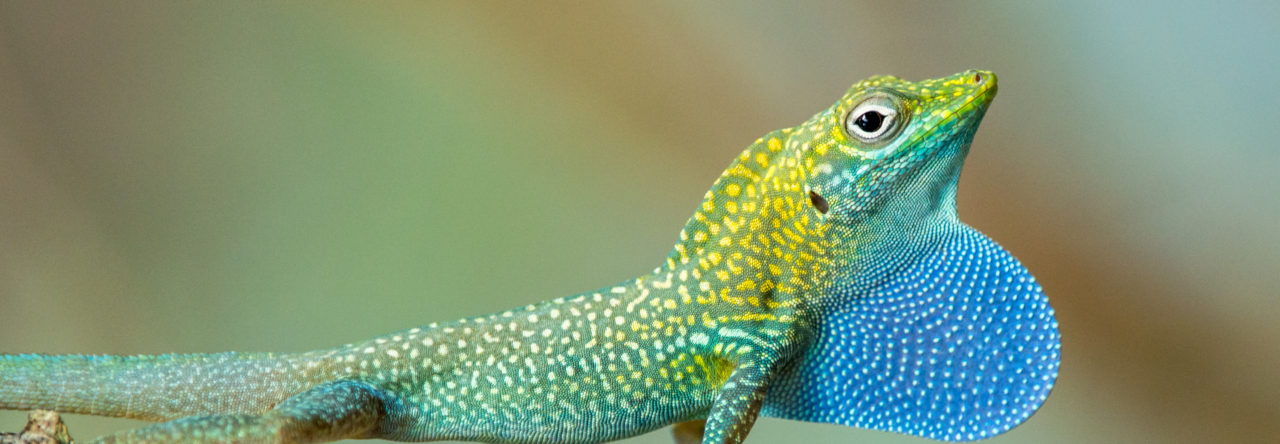

Anolis winstoni from https://commons.wikimedia.org/wiki/File:Anolis_oculatus_at_Coulibistrie-b01.jpg
Peter Mudde writes:
I am chairman of Lacerta, the Dutch Herpetological society. I also am a regular contributor to the magazine Lacerta. Lacerta recently made an “Anolis special.” We are preparing a printed English version and we have an internal discussion about the matter below.
In 1962 the late Skip Lazell, a regular contributor to Anole Annals described Anolis oculatus winstoni, stating: “This subspecies is named for Charles A. Winston, Manager of Woodford Hill Estate, and his family.” In recent years, the epithet “winstoni” has been changed to “winstonorum” as that would be he proper grammatical form if the subspecies was indeed named after Winston and his family (Michels and Bauer, 2004). This was critisized by Dubois (2007).
Now I am not familiar with the latest in zoological taxonomy, but I was under the impression that a name once given could not be corrected afterwards. That’s why the American alligator still misses a character in it’s scientific name.
Indeed, the combination Anolis occulatus winstonorum has emerged several times, mainly in non-scientific literature. Now my question is: how do those working with anole taxonomy refer to this subspecies? Your verdicts please.

- Mating Behavior of the Oaxacan Oak Anole - July 28, 2026
- Do Green Anoles Turn Brown when Mating and Does It Show They’re Happy? - July 11, 2026
- Blue Shed Skin of Green Anole - June 16, 2026
Dr Robert Sprackland
THE Code (ICZN) does indeed allow for emendation to correct spelling, case, number, or gender. Alligator mississippiensis DID get its second p via emendation. If the whole Winston family was to be honoured by patronym, the —orum suffix is appropriate.
Bigger question to many of us: are subspecies real?