
From the pages of Vanguard, the student newspaper of the University of North Georgia:
The Green Anole is Back in Georgia

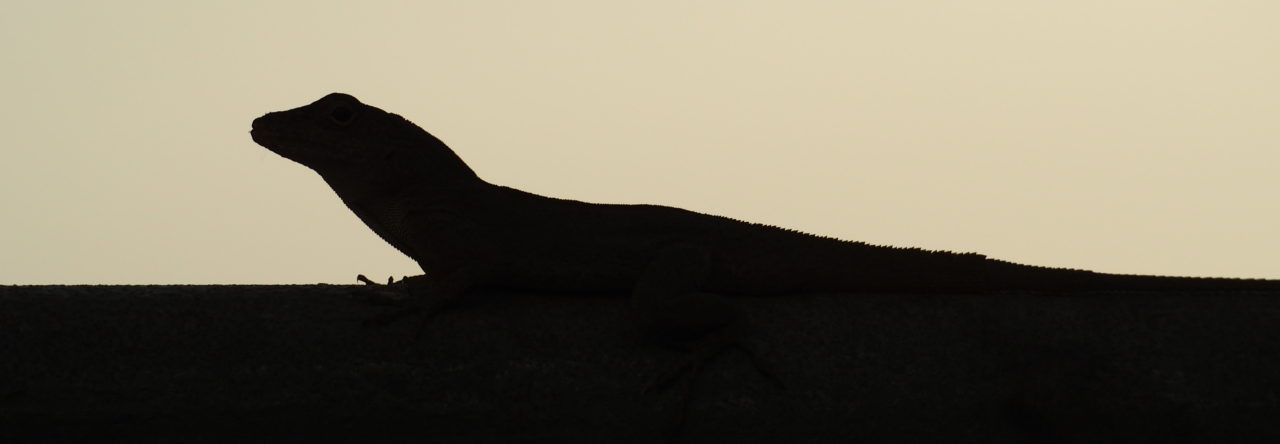
Despite being misunderstood, Green Anoles remain adaptable and present in North Georgia. Photo by Riley Hansen.
With spring weather on the rise, green anoles, a small lizard species native to the southern portion of the United States, are returning to Georgia in large numbers. Anolis Carolinensis is known as a “trunk-crown ecomorph,” meaning they can change colors from shades of brown and green depending on their temperature and stress level.
Lily Grace Smith, a UNG freshman with a concentration in sustainability, said, “I have experience with green anoles because they like to hide in my house a lot. I live near a creek in a forested area, so I come into contact with them frequently. They are seen as scary because they like to jump around a lot to try to escape, but if you hold them by softly holding right under their head, you can release them.

Lily Grace Smith, a holding a green anole she caught. Photo by Lily Grace Smith.
“I’m glad I’m seeing them around because they regulate the insect population and also keep their predators around,” Smith said. “I wish people would save them and, if possible, make tiny habitats for them (keeping leaf litter, brushes, vertical spaces for them to bask on).” – Lily Grace Smith, UNG Freshmen Environmental Spatial Analysis Major
With limited research on the specific predators impacting the green anole populations, researchers are studying specific instances of predation that have appeared due to the introduction of other non-native species such as carnivorous plants.
In a publication from Herpetological Review, authors Daniel A. Warner and Patrick Thompson of Auburn University said, “Although Interactions between these two species are probably rare, the native ranges of ‘A. carolinensis and D. muscipula overlap in areas of North Carolina and South Carolina, USA, suggesting that A. carolinensis is a potential source of nutrients for this carnivorous plant. In addition, the small size of the D. muscipula restricts prey to relatively small individuals, and its small native range restricts the impact of this predator to a limited area.”

Gallery • 6 Photos (you’ll have to go to the online article to see them all!). Green Anoles are often kept as pets in the South, and proper equipment and handling are vital for their survival. Photo by Riley Hansen.
“The characteristics of invasive species alone cannot explain the establishment of invasive populations,” Maya A. Jackson of Xavier University of Louisiana and Sonny S. Bleicher of Xavier University of Louisiana and Loyola University of New Orleans, in a study covering Behavioral Plasticity said, “Anoles, irrespective of species, appear to act more agonistically in urban zones. However, the two species of anoles vary greatly in their behaviors and reveal a more complex balancing act of ritualistic signaling.”
Despite these challenges, the green anoles’ adaptability and rapid evolution have assured their return to houses, schools and communities of the south this spring.

Leave a Reply