
Paper accepted, proofs corrected.
Next, the movie adaptation. But who will play Green Anole?
Paper accepted, proofs corrected.
Next, the movie adaptation. But who will play Green Anole?

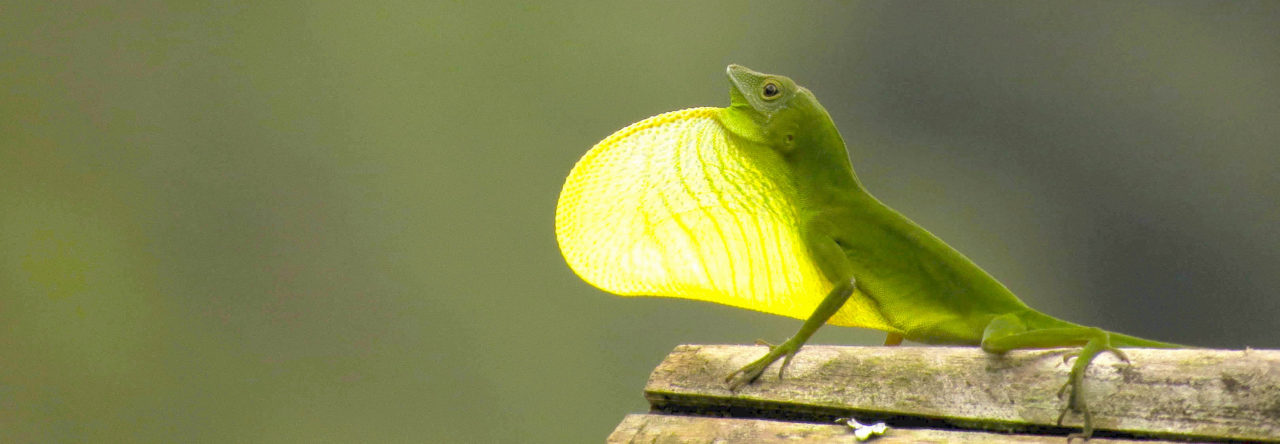
Barely even kissing cousins: A. aequatorialis on the left and A. fitchi (photo thanks to Chris Funk) on the right.
The new Castañeda and de Queiroz phylogeny of Dactyloa is an important advance in our understanding of anole phylogenetics. Prior to this paper, relationships among clades within Dactyloa had been little studied; indeed, the monophyly of Dactyloa was in question, with a viable alternative being that Dactyloa is a paraphyletic group from which the rest of Anolis sprang. Not only have Castañeda and de Queiroz convincingly laid this possibility to rest, but they have identified five strongly supported clades. As the previous AA post on this paper noted, these clades are geographically coherent, revealing five geographically distinct theaters of Dactyloa diversification.
The paper has important implications in several other respects:
1. Size evolution: Dactyloa is known for its giant anoles (officially defined by Lazell as an anole exceeding 100 mm in snout-vent length). Almost all giant Dactyloa belong to the latifrons clade, all members of which, save one, are giants.
2. Convergence: In a number of cases, species that were thought to be closely-related were found to occur in different clades. The most amazing of these are A. aequatorialis and A. fitchi (pictured above), so similar in appearance and ecology that they were thought to be sister taxa that replaced each other on opposite sides of the Andes. However, it turns out that they are not at all closely related and belong in different clades.
3. Evolutionary divergence: an underexplored aspect is the extent of evolutionary diversification within clades of Dactyloa. Though much remains to be learned, it is clear that diversification has been quite extensive, as a number of the clades contain an ecomorphological array of species. The Western clade, for example, contains species such as festae, peraccae, chloris, aequatorialis, and gemmosus, which are very distinct from each other morphologically and utilize different parts of the structural habitat. Collecting the necessary morphological, ecological and behavioral data to trace the pattern of Dactyloa radiation will be an exciting challenge in the coming years!
In sum, this paper importantly advances our understanding of anole evolution. If now we could only crack that Norops nut!

Phenacosaurus orcesi, Ecuador
Here is a shot recently taken during our first “Day in the Life of a Phenacosaur” video recording. We tracked this subadult male from 6 am to 6 pm!
 In the Dominican Republic, there are few anole hunting localities more famous than the Recodo Road, a road running along the Rio Bani just west of Bani (you can get some background on this locality from several previous blog posts 1, 2, 3). Anthony Geneva, Shea Lambert, and I arrived here on Sunday to continue our studies of speciation in the distichus species group. One feature of this road familiar to anyone who’s visited are the river crossings that are necessitated by the absence of bridges. With a 4×4, these crossings are a piece of cake when the water is low, but completely impossible when the water is high. After a recent tropical storm, both of the two required crossings are on the verge of uncrossability. We made it through the first one (see photos above), but have decided to hold off on attempting the second until the river settles a bit more. Note the beautiful Kapok (Ceiba) tree at the first crossing, which is one of the oldest and most beautiful native trees in the region (it’s also from a genus with rather remarkable transatlantic dispersal capabilities [Dick et al. 2007]). More soon on the lizards we’re seeing so far!

Unidentified anole by Miguel Landestoy from the Philadelphia Inquirer. Who can name that species (not Miguel!)?
Faye Flam’s Planet of the Apes column in today’s Philadelphia Inquirer is entitled “Is Life Inevitably or Chance? Lizards May Tell.” Turns out that anoles may hold the answer to some of life’s most profound questions.

Phylogenetic tree from Castañeda & de Queiroz's concatenated dataset (left), instability of relationships among five major clades resulting from analyses of mtDNA (top center) and nDNA (bottom center), Anolis (Phenacosaurus) heterderma from Juan Salvador Mendoza's Flickr (http://www.flickr.com/photos/ecoterror/page6/) (top right), and geographic distributions for major clades identified by Castañeda and de Queiroz (bottom right).
A few days ago, I discussed a paper that proposes assignment of anoles to a new family called Dactyloidae. Today, I want to call attention to another new paper about anole systematics and taxonomy that involves a clade beginning with ‘dactyl’: the Dactyloa clade of Anolis. The Dactyloa clade includes around 80 species of anoles found across southern Central America, northern South America, and the southern Lesser Antilles. Although most anole biologist believe that its best to continue recognizing the species in this clade as members of a unified Anolis, the Dactyloa clade does seem to represent one of the few genera proposed by Guyer and Savage that is largely monophyletic (albeit with the addition of species previously assigned to Phenacosaurus).
In a paper published in Molecular Phylogenetic and Evolution, Castañeda and de Queiroz generate new phylogenetic trees for this group based on DNA sequence data from three loci (two mitochondrial and one nuclear) sampled across 40 of 82 previously recognized species, two new species, and 12 outgroup taxa. Castañeda and de Queiroz’s analyses of concatenated and individual gene datasets using GARLI and MrBayes recover support for five well-supported and geographically cohesive clades within Dactyloa. Three of these clades closely match groups defined based on previously morphological and biogeographic analyses: Phenacosaurus, the roquet series, and the latifrons series. Two of the clades identified by Castañeda and de Queiroz were not diagnosed by previous morphological analyses, but do make sense biogeographically: one of these clades occurs across the eastern cordillera of the Colombian Andes and the Venezuelan Andes (the “eastern” clade of Dactyloa) and the second can be found across the western and central cordilleras of the Colombian Andes, the western slope of the Equadorian Andies and the Pacific lowlands of Panama, Colombia, and Ecuador (the “western” clade of Dactyloa). The monophyly of two clades previously identified by morphological analyses – the aequatorialis and punctatus series – is strongly rejected by the new molecular data, reaffirming problems that have long plagued taxonomic studies of mainland anoles based on morphological data. Relationships among the five well-supported and geographically-cohesive clades identified by Castañeda and de Queiroz are poorly supported and unstable among analyses, seemingly due to short basal branches. Although their results clearly indicate the need for taxonomic revision of Dactyloa, Castañeda and de Queiroz reasonably suggest that any such revisions should await more comprehensive species-level sampling is available.

Phenacosaurus orcesi. Photo by Melissa Woolley.
As I prepared for our current trip to Ecuador to study the natural history of Phenacosaurus orcesi, I feared that we would not find any lizards. After all, until recently, the species was known from only two specimens. What if we simply couldn’t find them?
These fears were assuaged when I reviewed the literature—scant as it is—on phenacosaur ecology. In the most comprehensive study, Miyata found 77 P. heterodermus individuals in blackberry bushes in five afternoons of observations at a site near Bogota. On seeing the previous AA post, Vic Hutchison also recalled finding P. heterodermus in blackberry bushes in Colombia. George Gorman mentioned to me that he collected phenacs in a suburb of Bogota in the summer on 1968, and he recalls that “it was a like Lesser Antillean experience…rather than a ‘mainland’ experience, in that the lizards were abundant, easily collected, and on fenceposts and hedges.” In addition, the original description of P. vanzolinii states that “the local people say that the ‘camaleon o camaleon’ is common in the fields of maize.”
From all of this information, I formed the hypothesis that finding phenacs would be easy, that we’d be awash with data and would finish so early that we could go traipsing off elsewhere in Ecuador. In other words, I set myself up for the Principle of Unsympathetic Magic to rear its ugly head, and it did so with a vengeance.
Watch Miguel Landestoy kiss Anolis darlingtoni! (at 1:39 on the video)

A time calibrated tree from Townsend et al. and photographs of Polychrus (from http://reptile-database.reptarium.cz/species.php?genus=Polychrus&species=gutturosus), Anolis, and Basiliscus (from http://scienceblogs.com/tetrapodzoology/2009/01/something_new_about_basilisks.php)..
For decades, anole have been assigned to Polychrotidae, a family or subfamily of Iguania whose core members have always included Anolis and Polychrus. In spite of the morphological similarities shared by these genera, molecular studies conducted over the past decade have consistently recovered a non-monophyletic Polychrotidae and have never recovered strong support for a sister relationship between Polychrus and Anolis. In recent Bayesian and maximum likelihood analyses of 29 loci sampled from 47 iguanians and 29 outgroup taxa, Townsend et al. (2011) drive the final nail in the coffin of the notion that Anolis and Polychrus are closely related and form a clade that should continue to be recognized as Polychrotidae. The sister-group relationship between Anolis and Polychrus is completely absent from the posterior distribution of trees generated from Townsend et al.’s 29-locus concatenated dataset and this relationship appears in only one or two of their 29 single-gene trees. As a result, Townsend et al. limit Polycrhotidae to Polychrus and resurrect the family name Dactyloidae for Anolis. Although they acknowledge that Dactyloidae is a less intuitive name for this clade than Anolidae, the latter is junior synonym of the former, having been coined by Cope (1864) some 20 years after Fitzinger (1843) recognized Dactyloidae. Students of squamate phylogenetic systematics should definitely check this paper out, Townsend et al.’s results concerning Polychrotidae are only one of their many interesting insights.

Image of Anolis darlingtoni from http://www.philly.com/philly/blogs/evolution/A-Long-Lost-Lizard-is-Found-in-Haiti.html
Last week, Blair Hedges led a team of scientists, journalists and naturalists on a helicopter tour of some of the most remote forested habitats remaining on Haiti’s Tiburon Peninsula. For anole enthusiasts, this expedition’s most remarkable find was the rediscovery of Anolis darlingtoni, an enigmatic species that hasn’t been seen since 1984. As reported by Faye Flam at Philly.com, expedition member Miguel Landestoy spotted a single animal sleeping around 2m up in a tree fern. This seems to have been the only darlingtoni recovered by the expedition, but full trip details are still filtering in.
Even with this rediscovery, Anolis darlingtoni remains the rarest anole on Hispaniola, and the one that is the most immediate danger of extinction. Luke Mahler and I went to a great deal of trouble to search for A. darlingtoni in remnant forests at the western end of the Tiburon Peninsula a few years ago and came up empty, so I know that finding this species is no easy feat. My congratulations to Blair, Miguel, and the rest of the team!
Powered by WordPress & Theme by Anders Norén