
 and who doesn’t?
http://dusttracks.com/2011/08/20/the-green-anole-is-the-hero-the-sweet-tea-is-the-salvation/
As the summer is ending and a new semester is beginning, your thoughts may have returned to teaching. I try to use a diversity of taxonomic groups in my lectures and labs, but of course, I find anoles to be useful examples for many topics in the classroom. In my Evolution course, taught each year to biology majors at Trinity University, I focus one laboratory module on anole evolution to teach my students to conduct phylogenetically-informed comparative analyses. Below, I’ll describe the approach I use in my course, and if you would like to see my materials, or adapt them for your own teaching, I’d be happy to share the lab handouts – just email me at michele.johnson[at]trinity.edu.
Many activities in my lecture and lab focus on creating and interpreting phylogenies, and one of my earliest lab sessions teaches students to use parsimony and similarity-based classification to build phylogenies from mammalian morphological traits.

Stages of limb development for A. sagrei
As lineages rapidly diversify, such as in the history of anoles, does their developmental-genetic architecture constrain the rate or direction of evolutionary change? In other words, could the processes controlling the production of variation, the variation that natural selection acts on, affect patterns of phenotypic evolution by generating some phenotypes more readily than others? While theoretical discussions like these have been prevalent for over a century, developmentally-based constraints were not formalized in the context of modern biology until the 1980’s, fueled by an influential paper by Maynard-Smith and colleagues and the re-synthesis of evolutionary and developmental biology. Since then evo-devologists have been testing the plausibility of developmental constraints by examining the developmental bases of traits that have independently evolved multiple times; phenotypes that have repeatedly evolved using the same mechanisms may be indicative of constraint (because the precise interpretation of these patterns and appropriate level of analysis are contentious I will leave further theoretical discussion of constraint to future conversations).
In a recent paper, for which I am the lead author, we set out to examine whether developmental constraints could have affected diversification of anole limb morphology.
I am irreparably fond of anoles, but I must admit that they are not the cuddliest of beasts. In fact, they can be downright unfriendly, especially with each other. The mere sight of another male sends anoles into spasms and, when not mating, males and females seem to barely tolerate each other, at best. It would seem that cuddling is best left to mammals and birds, but recent observations would indicate that even the ornery anole has a soft side.

Anolis shrevei mating pair cuddling in Valle Nuevo, Dominican Republic.
A post by Kat Wollenberg on this blog documented two Anolis etheridgei sleeping with their tails intertwined. A follow-up post by Melissa Woolley shows that Anolis gemmosus mating pairs sleep near each other, even if not touching.
But does an anole have to be asleep to show its softer side? In June 2011 I observed an Anolis shrevei mating pair in Valle Nuevo cuddle as they basked one afternoon. It is chilly at 2500 meters, even in the Dominican Republic. It had been a cold morning, and neither the sun nor the lizards had shown themselves until almost noon. But when the sun did peek out from behind the clouds, there was a mass exodus of anoles, which came out from under their rocks to take advantage of the day’s first rays. This little pair came out from under the same rock and sat together for close to an hour. They were touching each other, despite the fact that there seemed to be enough rock to go around. Whether this was coincidence or another mechanism of behavioral thermoregulation, the anoles of the chilly Cordillera Central know how to keep warm.

Invertebrates associated with Hispaniolan anoles. Scale bar in right panel is in millimeters.
The invertebrates in the image above were photographed yesterday in the Dominican Republic. Today’s trivia is related to these invertebrates and consists of three questions:
1. What are these invertebrates and how do they interact with anoles?
2. How many individuals are in the right panel (note: all of these individuals were associated with a single anole)?
3. How do these invertebrates factor into Dominican folklore?

Photo copyright R. Glor 2011.
Perhaps this is Anole Annals’ first NSFW post, but the mating event depicted in the photo above was such an exciting observation and photographic opportunity that I can’t help but share. Yesterday we discovered a new contact zone between two phenotypically and genetically distinct populations of Anolis distichus along the Rio Bani (this contact zone is along the river’s eastern bank rather than along its well-traversed western bank). Along a narrow zone of contact (~500 m), green bodied, orange dewlapped populations of A. d. ignigularis come into contact with gray-bodied, yellow dewlapped populations of A. d. ravitergum. While sampling this contact zone, we ran across the copulating pair pictured above. The fact that the male is predominantly gray and the female predominantly green may be an indication that this is a hybridization event between A. d. ravitergum and A. d. ignigularis; genetic analyses on tissue samples collected from the pair will soon provide the answer!
If it is a hybrid pair, its likely to be more successful than others reported recently on anole anoles (e.g., A. carolinensis and A. sagrei); although hybrids between A. d. ignigularis and A. d. ravitergum are rare in nature, our captive mating experiments have yielded hundreds of eggs and offspring from matings between A. d. ravitergum and A. d. ignigularis.

Though they are not as flashy as some of their West Indian relatives, Anolis scriptus, the Southern Bahamas Anole, is an ecologically important and interesting component of the herpetofauna of the distal end of the Bahamas Archipelago. Small and brown to brownish green, they seem to be rarely photographed or discussed, so I thought they deserved a post on Anole Annals.  These are individuals from the Turks and Caicos Islands- where they are ubiquitous on most emergent land- from the largest islands at over 290 square km to the smallest rocks with some vegetation. Interestingly, this species has been shown to modify its perch height in response to the presence of predators (more on predation in a later post). When curly-tailed lizards (Leiocephalus psammodromus) are around, the anoles are more arboreal (Smith 1994;1995). However, we have found this to be the case mostly on smaller islands, while on larger islands the anoles will still use the ground and lower tree trunks, even in close proximity to high densities of curly-tailed lizards.


Polychrus gutturosus flashing its stuff. Photo from http://www.bijagual.org/images_reptiles/reptiles_image_links/pages/polychrus_guttorosus_3_JPG.htm
One interesting implication of the recent finding that Anolis and Polychrus are not closely related concerns the evolution of the dewlap. The two genera were long thought to be close relatives in part because they both possess what appear to be similar dewlaps. The new phylogeny indicates that these structures are not indicative of common ancestry, but rather that the two clades have convergently evolved very similar structures.
Dewlap-like structures have, in fact, evolved repeatedly in iguanian lizards (the clade that contains iguanids [in the old, broad sense], agamids, and chameleons). Some of these dewlaps are different from that of anoles—such as the flap of iguanas and the triangular dewlap of Draco—but the dewlaps of the agamid genera Sitana and Otocryptis are dead ringers for those of anoles. In fact, one might argue that Sitana out-anoles anoles with its regal fan pictured below.
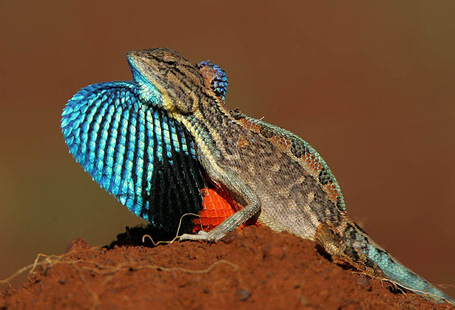
Sitana ponticeriana. Photo by Niranjan Sant from Lizards in an Evolutionary Tree

These stills are of an anole fight we saw yesterday along the Rio Bani. This fight happened on a rock between two male Anolis distichus ravitergum. On the left, the two males are facing off. In the middle, one male is charging and biting the other. On the right, the two are tumbling down the boulder. Shea Lambert recorded the video and plans to post a version with slow-motion and music sometime soon; it should be epic.
Powered by WordPress & Theme by Anders Norén
