
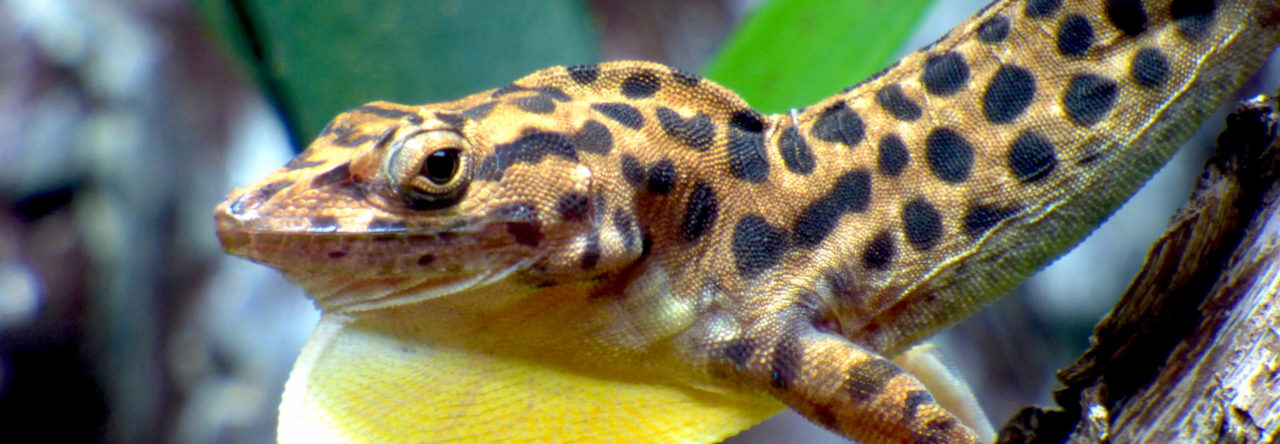
Non-native Anoles on Canouan in the Grenadines

Any reason to think these anoles, which arrived on Canouan in a container, presumably from Florida, are anything other than Anolis carolinensis?

Anoles Still Unbeaten

Anolis nebulosus displaying. From Jenssen (1970)

In a recent post, Rich Glor–he of little faith–claimed that the multi-splendored Sitana ponticeriana outdoes all of Anolis kind by unfurling its spectacular dewlap while standing on its hindlegs. However, Joe Macedonia set the record straight in a comment, pointing out that just such behavior was reported for A. nebulosus by Jenssen. Anyone else seen anything like this?

Anole murder mystery, Part II

In a recent post Miguel Landestoy shared a phenomenal photo of an unfortunate Anolis whitemani that met an untimely end in the dunes of Salinas, in the Dominican Republic. This got me thinking about odd anole deaths that I have seen in the field. Sometimes the cause of death is quite clear. Perhaps a limb has been torn off, or the body otherwise bears the marks of predation. On other occasions, however, how the anole met its fate appears more elusive.

Anoles Beaten at Their Own Game?

Both images from ganeshdhane's flickr page: http://www.flickr.com/photos/ganeshdhane/

Even though anoles aren’t the only lizards to have evolved dewlaps, their spectacular diversity of dewlap shapes and sizes certainly makes them leaders in the global arms race for dewlap dominance.  Nevertheless, I recently came across some photos of the spectacularly dewlapped-agamid Sitana ponticeriana doing something I don’t think anoles are capable of – displaying while standing on two hind limbs.  I’ve seen Australian agamids stand up for extended periods of time to display, dissipate heat, or scan the horizon, but I’ve never seen an anole do this for more than a few seconds while reaching for a new perch.  Sure, anoles can do lots of other stuff to get the message across – push-ups, full-ups, elaborate tail-wags, tongue protrusions, nuchal crest extensions, gapping, etc. – but I’m just not sure they’re built to stand.   My question to all the anoles lovers out there: has anybody ever seen one of our beloved creatures displaying while standing on its hind-limbs?

PS – Lots of other amazing photos of the dewlapped agamids are on Flickr

Measuring Bite Force In Anoles: The Video

The latest anole flick from Day’s Edge Productions. If you haven’t seen some of their previous work, try this one. And for an interview about this film with filmmaker and UCLA grad student Neil Losin, go here.

Anolis Cuvieri On The Prowl

Puerto Rican anole photographer extraordinaire, Father Alejandro Sanchez (you must see his webpage here) describes these photos of a female A. cuvieri: “In a karstic forest in north-western Puerto Rico, a female Puerto Rican giant anole (Anolis cuvieri) patrols its territory in search of prey. When doing so, members of this species usually move in a very deliberate way, reminiscent of chameleons to the point of moving their eyes independently as they scan the vegetation for food or danger.  Anolis cuvieri is usually very tame, and this individual hardly paid any attention to my movements or the camera’s flash. After I finished shooting, the lizard allowed me to stroke its tail for a few moments before jumping out of reach.” He also noted that “I saw a couple of A. cristatellus make themselves scarce as this female A. cuvieri approched.”

Anolis carolinensis in South Georgia

Anolis carolinensis, 15 September 2011. Residential Valdosta, Georgia

After living much of my life in the anole-saturated forests and neighborhoods of central Florida, somewhere beneath the Spanish Moss, I lived and worked in Anchorage, Alaska for four years. Other than the occasional wood frog, Rana sylvatica, my interactions with reptiles and amphibians were, of course, somewhat diminished… (Plenty of moose, though. Oh yes, plenty of moose. And dogs. Lots and lots of dogs.)

Anolis carolinensis, 02 August 2011. Residential Valdosta, Georgia.

This past summer I returned to the American southeast with my family — specifically to Valdosta, Georgia. Since returning, I’ve been struck by the density of Carolina green anoles and the lack of Cuban brown anoles, Anolis sagrei. In central Florida A. sagrei is ubiquitous these days. It’s hard to find a yard where they don’t dominate the trunk-ground area. In Valdosta, however, I have yet to positively identify a single Anolis sagrei (I’ve been told by locals they are here, but in isolated pockets). My little corner of south Georgia seems to be A. carolinensis territory in most every way, every day.

Indeed, I am seeing a strong and robust number of Carolina greens hanging out low to the ground, not just in the trunks and trunk-crowns. They’re on the bushes, they’re on the screens, they’re on the grass, and they’re even on the sidewalks and driveways. Low-riders, I call them — the Carolina greens riding the ground-level, juveniles and adults.

In a way, moving to Valdosta, Georgia feels a bit like time travel. It feels like central Florida circa the mid-1980s, minus the NASCAR fetish, back when I was a hairy little rugrat chasing green anoles through my Volusia county backyard while jamming Devo on my twelve-pound Sony cassette walkman. I’d nearly forgotten what Carolina greens are like without the presence of Cuban brown anoles and scattered Star Wars action figures in the grass… but what’s been most startling is the number of green anoles I’ve seen low-riding — basking on pavement, hanging out on concrete, scampering around fallen pine needles and leaves. Given their trunk-crown ecomorphology and the dominance of Cuban brown anoles in Florida, I wasn’t prepared to see so many Carolina greens surfing the ground. Is it a seasonal climate (heat) pattern? Not sure. Time will tell and I’ll keep watching.

It’s unlikely I’ll try to get these green anoles to bite my earlobes and wear them as jewelry like I did circa 1982 (the shame!), but I am enjoying this relative sense of time-travel. I also wonder when A. sagrei will make it up here in force — and push these greens back up into the trunk-crown, if ever.

~ janson

Anolis carolinensis, 31 August 2011. Grand Bay WMA; Valdosta, Georgia

Anole Annals Reaching A Wide Audience

For example, we’re proud to be the first “related link” on this post.

The Evolution of Female Pattern Polymorphism

In many species of anoles, females vary in their back patterning, some gaudily adorned with saddles, diamonds, or crosses, others sporting simple lines and speckles, some sad lasses with no markings at all. Although such female pattern polymorphism has long been noted and its adaptive significance studied (for example, here), no one has compiled a list of which species exhibit it and which don’t, much less examined patterns of FPP evolution.

Until now. In a very nice paper, Paemelaere et al. have surveyed the literature and recorded the presence or absence of of FPP in 179 anole species. They find a wide variety of interesting findings. First, there is phylogenetic signal: closely-related species tend to be similar in the presence or absence of FPP. Nonetheless, second, FPP has evolved and been lost many times—overall, at least 28 evolutionary transitions, with more gains than losses. The ancestral condition, incidentally, appears to be an absence of FPP. Third, there is great biogeographical heterogeneity (see figure above). FPP is far-and-away most common among mainland anoles, and is also reasonably common in the Lesser Antilles, but much less common in the Greater Antilles. Within the mainland anoles, it is particularly members of the Norops club that have FPP; much less among dactyloids. However, Norops also occurs on Cuba and Jamaica, and there they don’t exhibit much FPP.

One additional interesting pattern not remarked upon by Paemelaere is that among Greater Antillean species, FPP occurs primarily in trunk-ground anoles, having evolved at least three times independently on different islands (in three members of the sagrei clade on Cuba; A. cristatellus on Puerto Rico; and three members of the cybotes clade on Hispaniola).

Anole Artistry

Ann Melton’s Galloping Snail Studio in Georgia features beautiful and accurate natural sculptures in ceramic, stoneware and pewter including an anole pin, figurine, letter opener, jar and vase.  She describes her artistic journey as beginning with “…clay at an early age and over time developed a wide range of ceramic techniques.  I began formal ceramic studies in Manises, Spain.  At Mountain Empire Community College I participated in an intense two year Studio Potter program.  Then went on to graduate from Virginia Commonwealth University with a Bachelor of Fine Art.  For 10 years I designed for an international pewter company.  I now live on Melton Farm in Beachton, Georgia and work out of “Galloping Snail Studio” where I combine the two disciplines.  The resulting work is both functional and decorative which savor the uniqueness of the red hills region.” Her work can be purchased directly at her website or at sportingartisans.com


Page 274 of 305

Powered by WordPress & Theme by Anders Norén