
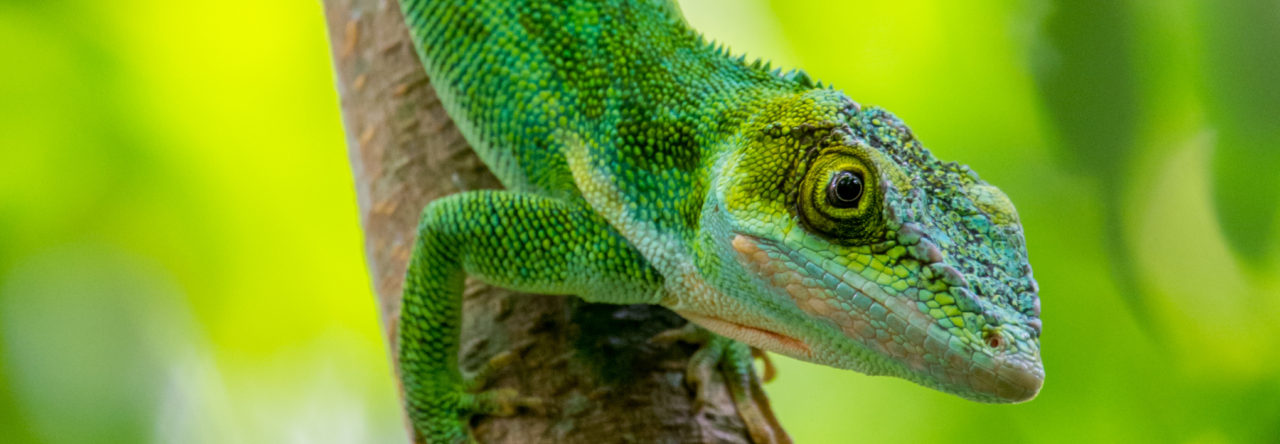

Anole morphology holds an important place in the recent history of evolutionary biology. For example, comparisons of morphology, behavior, and ecology among Anolis species led E. E. Williams to conceptualize ecomorphology (discussed here). The repeated Caribbean anole radiations are also of great importance for studies of convergence, parallelism, and constraint (e.g., here and here). Surprisingly, however, the vast majority of anole research has focused on postcranial characters; comparatively few studies have surveyed variation in head shape and its functional and ecological significance. While strong correlations between relative limb length and microhabitat have been the subject of much research, one cannot overlook the fact that variation in head shape may also have important ecological and evolutionary significance for this genus.
 Even a brief visual survey of the MCZ skeletal collection reveals an array of variation in anole head shape: from the robust skull of A. cybotes to the slender skull of A. dolichocephalus to the ornate skulls of Chamaeleolis (Here is a real challenge: Can anyone name the species in the picture?). Harmon et al. (2005) used three-dimensional geometric morphometrics for 21 anole species and concluded that anole heads primarily vary in relative length and depth. To further investigate which skeletal elements contribute to this variation and how many times anoles have independently converged on similar head shapes Sanger et al. recently analyzed skull shape variation among males of 106 Caribbean species (yes, Sanger, that’s me).

An A. distichus futiley searching for possible escape routes.

A cage within a cage

Most butterfly cages are easily collapsable (though not always, as this picture indicates), making them convenient for storage.

We have at least six butterfly cages (seen collapsed and stacked here).
When handling lizards in the lab, it’s important to minimize the chances of a crafty critter escaping. Collapsable “butterfly cages” are a convenient and thrifty way to ensure the security of your lizards during cage maintenance, egg checks, lizard-handling, and feeding. Before removing the egg laying cups to see if any eggs were laid, for example, we generally place the Kritter Keeper housing breeding animals into a butterfly cage to ensure that any animals springing out don’t get very far (this practice, of course, will prove unnecessary once our room is entirely converted to new custom cages). In addition to their many uses in the lizard colony, we also use butterfly cages extensively in the field as temporary housing or to sort animals sampled throughout the course of a day. The cages we use are only around $20 each and they’re well worth the investment for any lizard lab.
As an evolutionary biomechanist that is half in the Losos lab, I naturally dabbled in studying anoles during my first semester. I never presented my research, and have since moved on to other animals, but I thought you might like to see what I found.
Thom’s work on head shape shows a great amount of variation in the jaw length and width among anoles, and we wondered if the shape had an effect on jaw function. I was looking for differences in feeding behavior between the short-snouted Anolis sagrei and the pointy-snouted Anolis carolinensis. I placed a cricket on a leash, put it on a wooden perch inside a plexiglas container, put the lizard on the perch at the other end, and filmed the result.
Here are some videos of one sagrei attack:
sagrei- Front view
And here is a video of a carolinensis:
carolinensis- Side view
Based on my limited dataset, it looks like the sagrei keep their heads low on the perch while they make an attack-dash consisting of 1 chomp. They hold the prey in their mouths for a while before they begin chewing. Carolinensis get very close to the prey, pause, raise their heads up, and stab their jaws downwards without moving their hind legs.
By the way, if you need ideas on how to study anole biomechanics, I’d love to chat!
As is customary at year’s end, Anole Annals looks back on a banner year. 396 posts (and counting); 111,432 page loads; 64,843 visits. And what better time to reminisce about our finest moments? So, let’s vote for Post of the Year. Below are the six most viewed posts. Vote for one, or suggest your own in the Comments section.
A Highly Anecdotal Account of a Most Remarkable Anole
Dead for a Day – Long Live the Lizard Man, Eric Pianka
How the Green Anole Was Selected To Be The First Reptile Genome Sequenced
Is An Anole Smarter Than a Fifth Grader?
Society for the Study of Evolution Announces Changes to the Name of Its Journal

Rows of new cages being assimilated into the Glor Lab.

A recently completed cage ready for occupants. Note feeding hatch at top of cages.
The past six months have seen some radical changes to the lizard breeding cages used in the Glor Lab’s lizard room. Because our space is very limited we needed new space-saving cages to accommodate a growing lizard population and to conduct additional breeding experiments. Construction of new cages also afforded an opportunity to improve upon some of the problems with our old breeding cages, which were just the typical Kritter Keeper cages available at your local pet store. Dan Scantlebury led our efforts to design new cages that improved security, eased access for feeding and other tasks, and minimized the space each cage takes up.
The new cages are composed of custom cut plexiglass and feature a front opening door secured with a magnetic latch. Front opening doors are helpful because most anoles tend to shoot up and out of Kritter Keepers when you pull the lid off; in the new cages they tend to run to the back of the cage and escape less frequently. On top, the new cages have a screen lid as well as a mini-hatch that can be opened at feeding time to supply crickets or other food items. Where we once had five Kritter Keepers we can now have eight custom cages with similar internal volumes (due to the fact that new cages are taller and deeper than the Kritter Keepers). Complete details on how to make these cages will be included in a post by Dan sometime after he gets back from his current field trip.

 A holiday quiz- can anyone ID this species? Found in the twilight zone of a cave in a small stream (hint) entering the main cave stream. Isla Bastimentos, Bocas del Toro Province, Panama. Apologies for the picture, one needs a good reason before hand to bring a nice camera into wet and muddy caves.
Has this species been reported from the BDT Archipelago?
Here’s another highlight from the collection of videos that the Glor Lab recorded during an expedition in the summer of 2010 (see our previously posted videos of a fight, color change, and mating). This video is an interaction between a male Anolis distichus and a caterpillar. This interaction left one of the participants with a good meal and the other, well, let’s just say he’s a part of the circle of life.
 Anole Annals is proud to bring you its newly produced 2012 calendar. Featuring photographs of 13 different anole species taken by world-renowned wildlife photographers and biologists, the calendar is the perfect holiday gift. Moreover, today happens to be 1/2 price Calendar Monday, so order immediately!

From Falk et al., 2011.
The Gates Foundation today announced a multi-billion dollar initiative to eradicate malaria from all lizardkind. Through a combination of heightened prophylactic use, development of genetically modified lacertilians, and enhanced mosquitivory, the Foundation hopes to eliminate this scourge, which afflicts millions of saurians throughout the world.
Well, maybe some day. But a recent paper on Anolis malaria set my mind a-wandering. Most people, likely the Gates Foundation included, are unaware that malaria is a disease not just of humans, but of many other species as well, including lizards. When I first learned that lizards got malaria, I thought it was just a curiosity, not of particular importance. However, I’ve come to realize that I was very wrong in a number of respects.
First, malaria in some cases can have substantial physiological effects on lizards (though this has yet to be demonstrated in anoles).