Anole Visual Ecology, Sans Vision

A riddle: What has four legs, eagle eyes, and can change colors?

Anoles are extremely visual animals, with vision being the primary sensory mechanism through which they perceive their surroundings. Accordingly, their vision is excellent, at least during the daytime. (“Eagle eyes” might be a bit misleading. A more accurate phrase might be “bifoveate retinae conferring excellent visual acuity and depth perception”). The amount of daytime light available for vision depends largely on the vegetative structure in the microhabitat. Indeed, many Anolis species occupy a distinct “photic habitat” due to sun/shade preferences. Variation in photic habitat provides a treasure trove of testable hypotheses for the visual ecologist. Is anole vision adapted to particular light environments? Is dewlap color selected for detectability in a given light environment? And so on.

Two very different photic habitats. (Photographed at approximately the same time of day, same cloud cover).

I totally dig visual ecology, but I’m using it as bait to draw your attention to a closely related (but under-studied) relationship between the light habitat and physiology/behavior. Anoles, like all other animals, use light in ways that do not require visual images at all. These so-called “non-visual” responses to light are used for things like the dilation and constriction of the pupils, the control of circadian rhythms, and seasonal responses to daylength. Non-visual photoreception is processed in the brain through different pathways than those involved in the formation of images, so these responses to light can occur even if the animal is visually blind.

Interesting stuff, but here’s where habitat enters the picture. Non-visual responses to light are irradiance-dependent, meaning that whether or not there is a response, and what the response entails, depends on how much light there is. Bright light, for example, is a wake-up signal to the sleeping lizard, whereas dim light (e.g., moonlight) is less effective in eliciting arousal. However, “bright” and “dim” are relative measures, thus one might expect that the sensitivity of non-visual photoreception would be “tuned” to the overall light levels in the microhabitat. After all, light that seems dim in an open, unshaded habitat might correspond to the brightest midday light available in closed canopy forest. A mismatch between non-visual photosensitivity and habitat irradiance would impair non-visual photoreceptive “performance,” and could even lead to the misinterpretation of photic cues.

In a recent paper published in Journal of Comparative Physiology A, we showed that a non-visual behavioral response to light (the photic induction of locomotor activity) is correlated with habitat irradiance using four species of Puerto Rican anoles (A. cristatellus, A. gundlachi, A. pulchellus, A. krugi). Most diurnal animals respond to light by increasing their activity level. The best way to demonstrate this is to give light when the animal is inactive, i.e., at night. We developed a special device to continuously detect and record anole locomotor activity (walking, running, jumping, etc.) for weeks on end.

Transparent enclosures with a very sensitive movement detector were used to continuously record locomotor behavior.

We quantified baseline activity levels during the day and night, then measured the increase in activity in response to light given at night. Species occupying relatively more shaded habitats were more sensitive to the effects of light (light induced more locomotor activity) as compared to closely related, ecomorphologically identical species occupying more brightly illuminated habitats. The differences were most pronounced at irradiance levels similar to natural twilight levels. This jives well with the notion that dawn is nature’s alarm clock, and that photosensitivity should be tuned to take advantage of morning light, whatever irradiance that may be in a given environment.

Still, there are a few gaps that need to be filled in to complete the story. (You’ll have to read the paper to find out what they are). Non-visual photoecology is still in its infancy, and the main challenge is to develop approaches to explore the links between the environment, non-visual photoreception, and fitness. If anyone’s interested in pursuing variations on this theme, I know a good post-doc for hire.

Species Richness Patterns in Caribbean (and Mainland) Anolis IV

This is the last post (for a while, anyways) about species richness patterns in anoles. Unlike the previous papers and discussions (found here, here, and here), Algar and Losos (2010) zoom out from the Caribbean and take aim at the entire Anolis radiation. 

Islands are often species depauperate relative to mainland settings, likely because their small size makes them difficult to colonize and those species that do make it are more susceptible to extinction. Yet, islands also house many iconic evolutionary examples of adaptive radiation. Algar and Losos (2010) point out that this discrepancy stems mainly from the role that in situ evolutionary diversification plays in these two scenarios. In their paper, Algar and Losos, using anoles of course, explore how in situ diversification on islands affects the relationship between island and mainland species richness.

Anolis (Embryos) Snag Another Cover!

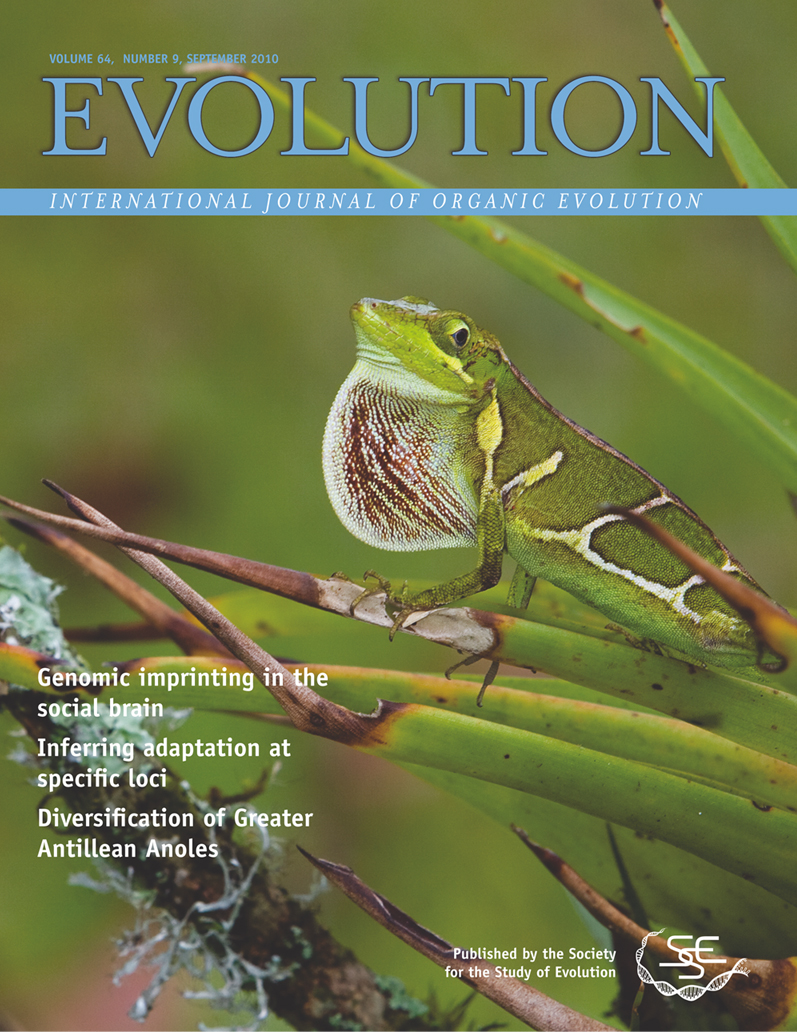
Many editors have recently come to acknowledge that an anole on a book or journal cover generates much enthusiasm from the community (here, here, here, here, here, here and here– I hope that I didn’t miss any). The trend continues in the February issue of Proceedings of the Royal Society. In this issue Sanger et al. describe the developmental bases of limb length convergence among trunk-ground and trunk-crown habitat specialists (previously described on Anole Annals). It should be noted that the only thing that can  possibly trump the beauty and eloquence of an anole in its native environment are developmental series of anole embryos (see here for further proof)

Chromosome Evolution in Anoles: A Study Waiting to Happen

Anole karyotypes from Gorman and Atkins, Herpetologica, 1968.

George Gorman, who pioneered the use of molecular tools to study anole phylogenetics from the late 1960’s to the early 1980’s, asks:

“Why not examine karyotypes of Dactyloa?”

He says:

“In the 1960’s and ‘70’s, before the DNA revolution,  the systematic examination of karyotypes of reptilian taxa mushroomed, and, to some extent helped orient our thinking about relationships among various clades.  This was certainly the case within Anolis at various hierarchical levels,  from species determination to definition of distinct species groups.  To my knowledge, there has been very little added to our knowledge about karyotypes of mainland Anolis that Etheridge placed in the latifrons series of Alpha Anolis,  now frequently referred to as the Dactyloa clade.  (if these are long-lost terms, Etheridge’s Beta anoles are the Norops section; all other lineages are within his “Alpha” section).

Background

There is a very pervasive, either primitive or convergently arrived at, karyotype among the Sauria…consisting of 12 metacentric macrochromosomes, and 24 microchromosomes. This karyotype may be found in many families and in all species of many genera within families. This was also the known published karyotype of A. carolinensis….the only anole that had been examined until about 1965.

Here’s a brief summary of what followed:

Happy Anole New Year

Better late than never.

Winter Anoles: Thermoregulating in the Cold

Braving the elements in Charleson.

We all think of anoles as warm weather, tropical beasties, but of course, that’s not entirely the case. Many live at quite high elevations and are active at cool temperatures. For example, this past summer we saw A. orcesi active (as active as it gets) when temperatures were 20 C and below.

In addition, anoles get relatively far north into temperate areas of the United States. One might think that they’d just go to sleep in the winter and not come back out til the spring warmth, but that’s not the case. Faithful contributor Marc Tollis discusses one recent observation over on his own blog, Anolis Tollis.

Species Richness Patterns in Caribbean Anolis III

Lineage accumulation curves (Fig. 2, Rabosky and Glor 2010) showing that Hispaniola (blue), Jamaica (purple), and Puerto Rico (orange) have reached speciation-extinction equilibrium. Cuba (red) is still gaining species.


Losos, J.B., and D. Schluter. 2000. Analysis of an evolutionary species-area relationship. Nature 408: 847-850.

Rabosky, D.L, and R.E. Glor. 2010. Equilibrium speciation dynamics in a model adaptive radiation of island lizards. Proc. Nat. Acad. Sci. 107: 22178-22183.

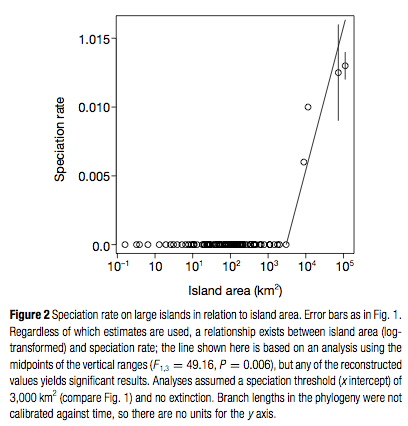
Losos and Schluter (2000) return to Caribbean anoles to test three hypotheses about the species-area relationship: (1) that there is an area threshold above which speciation surpasses immigration as a source of new species; (2) above the threshold size, speciation events per unit time should increase with island area; and (3) the slope of the species-area relationship should become steeper above the area threshold. Qualitatively similar to Losos (1996), this paper was novel in that a newly available, nearly complete, mt-DNA phylogeny allowed Losos and Schluter to reconstruct immigration and speciation events and to model whether species number has reached speciation-extinction equilibrium.

Anolis cristatellus, and Life’s Unexpected Twists and Turns

Read all about it here.

Vacation in Vieques, Complete with Anoles

Frigid temperatures in Boston are making me long for the warm waters of Vieques, PR and the time I was there in October.  Truth be told, I work for Jonathan Losos in a mostly administrative role, but even that has turned me into an avid lizard hunter when on vacation in the tropics.  I even set a goal for myself – to find and photograph all three species of anoles on the island – except for the one no one has seen in almost 100 years.  I trusted that if several professionals have not been able to find A. roosevelti, than my chances were slim (although, I did keep my eyes out for large lizards falling out of trees, just in case).  To my absolute delight, the other three species,  A. cristatellus, A. pulchellus, and A. stratulus could all be seen running around the manicured garden that surrounded the house I was staying in.   We named one “King” and watched him move from palm tree to palm tree, displaying to the other anoles in the vicinity.  (I’ve observed many anoles in Ecuador, but had never seen an anole move its tail back and forth before as a display – adorable!)

I watched a spirited courtship between a male and female A. pulchellus in ferns, and spent far too much time trying to get a shot of A. stratulus – particularly one that could always be seen on the wall of the pool house, but would promptly run through the door when I pulled out my camera.

There was even an A. stratulus running around without a front hand.  He seemed to move about just fine, though, both through the house and around the vegetation outside.  I was proud of my non-biologist friend that worried about him missing “so many sticky toes”.    Also entertaining was a fight between two juveniles – unfortunately shot with my cheap telephoto lens, so the quality is poor, but it’s still entertaining: video

Looking forward to a week in the Bahamas in May – another vacation, but I’m sure it too will be filled with anoles.

Species Richness Patterns in Caribbean Anolis II

Losos, J.B. 1996. Ecological and evolutionary determinants of the species-area relation in Caribbean anoline lizards. Philosophical Transactions of the Royal Society of London B 351: 847-854.

As alluded to previously,  MacArthur and Wilson (1967) did consider evolutionary processes when they developed their Theory of Island Biogeography. Specifically, in situ evolutionary diversification (i.e. speciation) may contribute substantially to the species diversity of an island and should be considered in any general attempt to model species-area relationships on islands. Building on Rand’s 1969 paper studying the ecological determinants of species richness in Caribbean anoles, Losos (1996) incorporates an evolutionary perspective into the Caribbean Anolis species-area story.

Page 259 of 305

Powered by WordPress & Theme by Anders Norén