Rare(ish) Puerto Rican Anoles

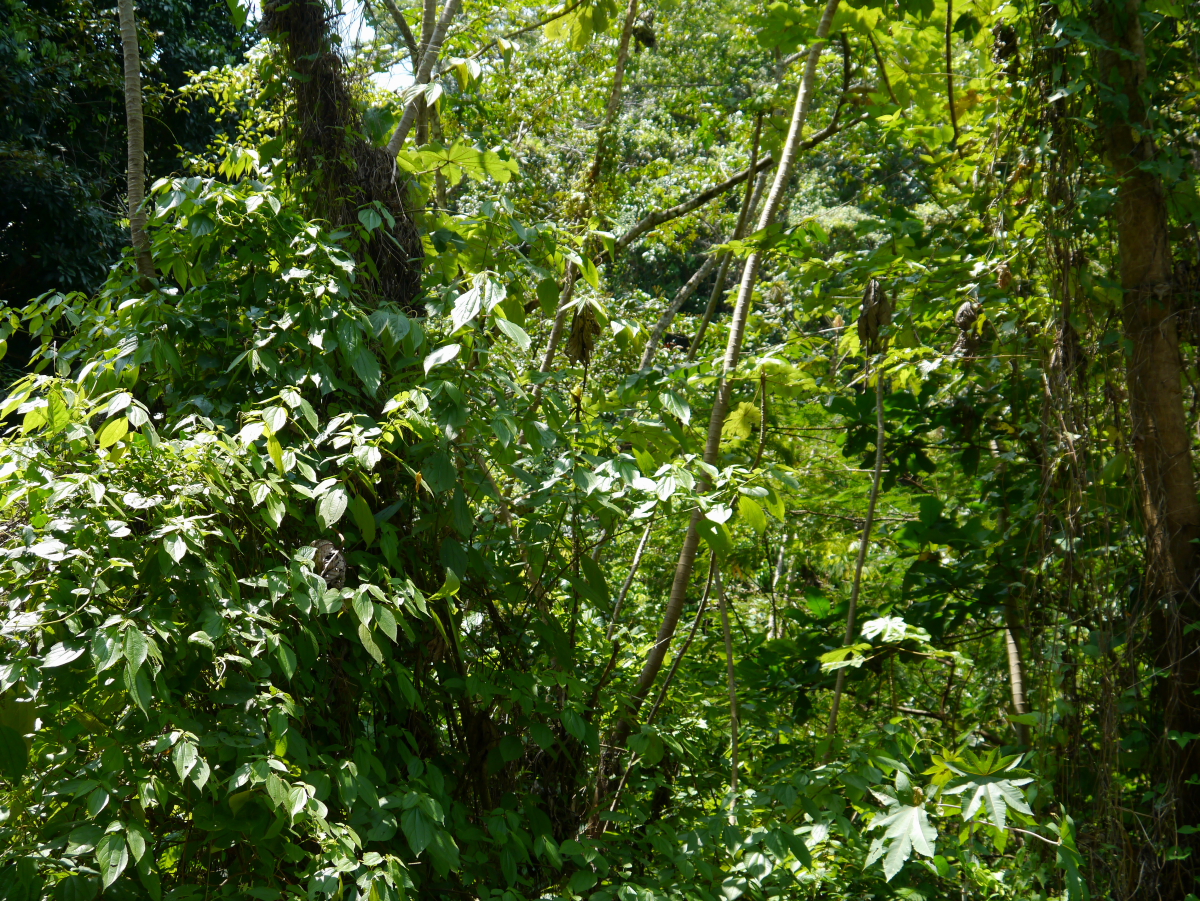
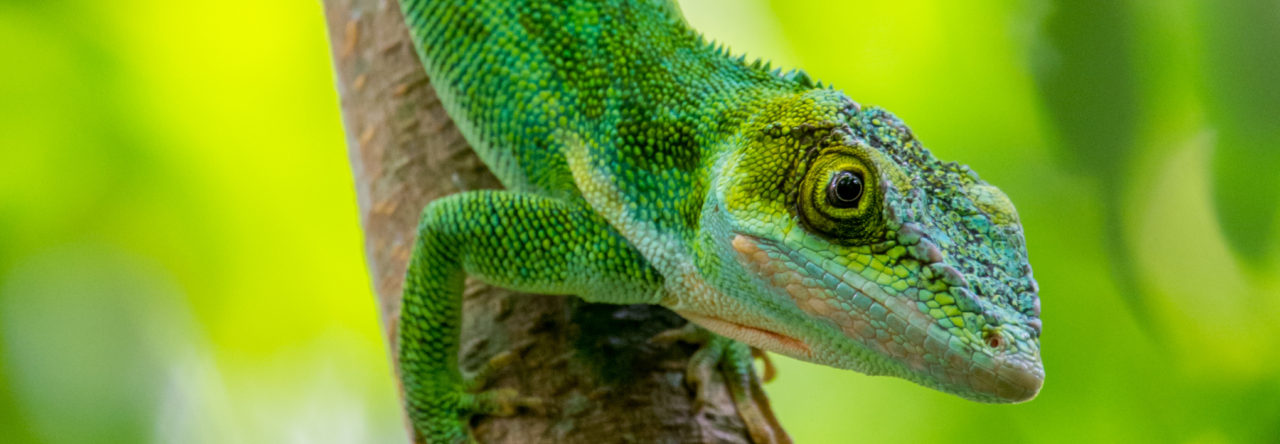
Another Revell Lab (Liam, Kristin, Graham) trip to Puerto Rico this spring, and another series of encounters with the diminutive Anolis occultus and the spectacular Anolis cuvieri. Both of these species can be quite challenging to find, but we have had some good success in several locations in the Puerto Rican karst region.  In January, we observed many individuals of both species


And managed to get a few in-hand for pictures


We also found a juvenile cuvieri, which has a gray coloration and an ontogenetic shift to green as they age:

Unless they happen to be one of the brown morph adults,

Why Study Locomotion And In Particular The Leaping Ability Of Anoles?: Comparing The Jumping Mechanics of Humans, Lemurs, And Anoles

httpv://www.youtube.com/watch?v=r33UMVk1o5s&feature=email

As a scientist in life sciences, I have always tried to highlight the existence of laws. It seems to me that all science should be predictive. Once we are interested in locomotion, the first idea that comes to mind is the following: are there any laws of locomotion that transcend forms, species? Is it possible to predict locomotion of any species to the knowledge of environmental constraints it faces (Legreneur et al., 2012)?

I am not a herpetologist. Over 15 years I have worked on humans, and especially high-level athletes and the elderly. I demonstrated in humans that the trajectory of any point controlled by the central nervous system was still as linear as possible. This point is either the fingertip during a pointing or grasping task, or the body center of mass during locomotion, e.g. during the takeoff phase of a jump. Since most joints move in rotation, and that the controlled point displaces through a linear path, it is necessary to dephase the rotating joints to transform the rotation kinematic energy into linear energy. Finally, for transmiting force from the body to the substrate, for example from the hip to the ground during the jump, the joints move in a proximal-to-distal manner, i.e. the extension of the hip precedes the ones of the knee and the ankle.

To demonstrate that these laws observed in humans were applicable to all terrestrial tetrapods, I am interested in two phylogenetically very distant arboreal jumpers, i.e. a prosimian, Microcebus murinus, and a squamate, Anolis sp. I reproduced with these two species the same experiments that I conducted on humans, i.e. leap up to maximum and submaximal heights. Thus I demonstrate that the coordination observed during take-off in maximal leaping were identical in humans, Microcebus and Anolis (Legreneur et al., 2010; Legreneur et al., 2011; Legreneur et al., 2012).

Carl Hiaasen, Anolologist?

For those of you who enjoy reading literature of the non-Anolis variety in your limited spare time, allow me to recommend the work of author and journalist Carl Hiaasen for a shot of anole-spiked satire. Hiaasen’s extensive fiction and non-fiction works (which are reminiscent of Edward Abbey and Christopher Moore, to name a few) have captured the elusive charm and absurdity of the people and wildlife of Florida, and should be required reading for anyone who has been or is thinking of traveling there.

Although none of Hiaasen’s novels have focused on anoles, they make frequent cameo appearances in his work. For example, in his most recent young adult novel “Chomp,” one of the precocious main characters, Tuna, “captured a brilliant green anole lizard and helped Wahoo memorize its scientific name, Anolis carolinensis, which was a mouthful.” In another book, “Nature Girl,” a frustrated private investigator follows a sleazy telemarketer and his girlfriend into the everglades, where they have been lured by the phony promise of a luxurious ecotour. The PI is intent on capturing evidence of the telemarketer’s infidelity, but instead captures extensive footage of A. carolinensis engaged in “adult” behaviors.

Apparently, Hiaasen’s interest in anoles extends beyond their supporting role in his fiction. At a recent Q&A session with publishers at Random House, Hiaasen drew gasps from the audience when he described noosing A. equestris in Coral Gables and prying their mouths off his bloodied fingers using a quarter, and later being knocked off a ladder when the same species leapt off an outdoor light fixture and onto his face, again drawing blood. Hiaasen also described a childhood and adolescence (still in progress, according to the 59-year-old author) spent chasing lizards and other herps with his friends, his children, and later his grandchildren. Clearly Hiaasen deserves the honorary title of “anolologist.”

Perhaps anoles will figure more prominently in his next book? Personally, I’ll be crossing my fingers until then.

Fighting Hawaiian Anoles

Reader Louise Butler from the Big Island writes: “I am attaching two photos. One is a battle royale on the outerside of my kitchen window. Two anole-like dudes (?) duking it out, each grasping the other’s jaw. They remained this way, occasionally changing position but never letting go, for several minutes. Most amazing was that my indoor anole hardly noticed them and he was on the inside of the very same screen! Look at the difference in size.

I’ve never before, or since seen Anolis this big.

The second photo depicts the gold-dust day gecko’s most favored way of proliferation. They love the car. I’ve seen several emerging from the innards of my neighbor’s car after one of his trips to Kona from our location on the eastern tip of the Big Island.”

So, readers, what do you think about the size of those Hawaiians? And let’s not forget that geckos are not the only ones that use that means of transportation.

January Field Course On Tropical Biology In Puerto Rico

Anole biologist and phylogenetic comparative methods wizard Liam Revell has shamelessly used a photo of Anolis evermanni just so we would advertise his three-week field biology course in Puerto Rico to be held next January. And you know what? It worked: the field-based course in tropical biology – focusing on ecology, evolution, and conservation biology – will be offered for the first time in January 2013 during the UMass Boston winter session (and hopefully annually thereafter). More info here.


Another New Book for Comparative Biologists

The University of Chicago Press has recently published another outstanding new book for comparative biologists.  Charles Nunn‘s The Comparative Approach in Evolutionary Anthropology and Biology provides insightful reviews of methods for ancestral character reconstruction, phylogenetic tests for character correlation, phylogenetic diversification analyses, and many other topics.  Nunn’s book seems well-suited to a broad range of readers.  It seems tractable for novices (the second chapter explains what a phylogenetic tree is), and those with math anxiety won’t be deterred by dense discussions of mathematical or computational algorithms.  At the same time, seasoned comparative biologists will likely appreciated Nunn’s fairly comprehensive coverage of alternative methods and their relative strengths and weaknesses.  Although most of Nunn’s examples are from anthropology, the general lessons in this book are likely to be of interest to many anole biologists and the examples from anthropology are often insightful and thought provoking.  To top it all off, the book is accompanied by really nice webpage called AnthroTree that features tutorials and worked examples.

A Morning Of Territorial Confrontations

As I photographed an A. carolinensis displaying high on a tree trunk, an A. sagrei popped out about 5 feet below and countered with a display. Before he could advance on the green anole male above, another male A. sagrei advanced to challenge. The two A. sagrei got in each other’s faces, but did not actually lock in combat. Suddenly the first A. sagrei broke off and advanced up the tree to confront the male green anole. There was a lot of counter displaying but not as fierce as just performed by the two brown anoles. Eventually the green male retreated further up the trunk, stopped to display once before disappearing around the other side.

New Edition of Paradis’s Book on Phylogenetics in R

Springer recently published a new and dramatically expanded version of Pardis’s book Analysis of Phylogenetics and Evolution with R.  This book is a great way to teach yourself some of the amazing techniques available for phylogeneticists and comparative biologists via the R statistical computing environment. With 386 pages, the new edition is nearly twice as large as the previous version (211 pages).  Countless new methods are covered, and many problems with the previous edition are remedied.  In spite of the expansion and improvements, the sticker price is actually lower on the new edition ($65) than it was on the old edition ($75).  You can pick up a copy for around $50 at places like Amazon.com.  This book should be considered required reading for anyone doing modern phylogenetic and comparative analyses.  If you need anoles to inspire an interest in learning R, I’ll be posting shortly on some R tutorials that use anoles as case studies.

Island Lizards Need Your Help

This isn’t strictly anole-related, but I think many faithful readers of Anole Annals will be interested in this fascinating project:

 UCLA anole biologist and film-maker extraordinarie Neil Losin (whose films about anole research we’ve featured before) is teaming up with University of Miami’s Nathan Dappen, who just earned his Ph.D. studying the Ibiza Wall Lizard, a threatened species that’s only found on the Mediterranean islands of Ibiza and Formentera. They are working on a book: Symbol: Wall Lizards of the Pityusic Archipelago. Both Losin and Dappen are both professional photographers as well as biologists (e.g., here); they want to bring together science and photography in the very first book about these lizards with the goal of captivating the two million tourists that visit these islands every year.

Ibiza Wall Lizards appear in art, sculpture, and even tattoos on people’s bodies, but despite their iconic status, few tourists or locals know much about them, and there’s no place to learn more about this fascinating species. Ibiza Wall Lizards may have the greatest color diversity of any reptile – they range from green, to blue, to orange, to black! The only rival I can think of are Martin Whiting’s flat lizards from South Africa. They’re also play an important ecological role as plant pollinators and seed dispersers, so they’re crucial to the health of this island ecosystem (check out their award-winning short video on these lizards). The Symbol will bring the folklore, biology, and conservation of these lizards to everyone through spectacular photos and easy-to-read text. The book will be available in four languages – Spanish, English, German and Italian – the four most commonly spoken languages of the islands. It will be a perfect souvenir for tourists, and a wonderful gift to the locals.

Losin and Dappen need your help to get the project off the ground! They are raising money for the book on Kickstarter, a popular crowd-funding platform (for those of you unaware of Kickstarter and similar websites, the idea is that people post projects in need of funding and people donate whatever they want; if the goal is reached in the time period allotted, usually several weeks, credit cards are charged and the project is funded; otherwise, no donations are taken). By donating to this project, you can help make lizards an ambassador for nature on these islands and change the way people think about Ibiza’s reptilian icon forever. Plus, contributors earn cool rewards, like acknowledgement in the book, limited edition photographs, and signed copies of the book itself.

Check out Losin and Dappen’s Kickstarter campaign here. All contributions are secure (billed through Amazon’s payment system) and your credit card won’t be charged unless Losin and Dappen reach their funding goal.

Thanks for taking the time to check out this important project!


Full Morphometric Database For Anolis sagrei And Anolis Carolinensis


Most studies that describe anole locomotion are based on the analysis of kinematic and dynamic data. One of the challenges in biomechanics is to deduce from these data the interarticular forces and moments produced during locomotion. Indeed, evaluation of these dynamic data can inform us about the force production and absorption mechanisms that are crucial in movements for which the musculoskeletal system is in high demand, e.g. running, jumping or landing. These movements are essential in the fitness of individuals in arboreal environment during predator avoidance or prey attack and need to develop very high force levels by the musculoskeletal system, and especially by the hindlimbs during takeoff and forelimbs during landing.

To evaluate these dynamic constraints, the most usual procedure is to use a mathematical method called “inverse dynamics.” It consists in deducing the interarticular forces and moments for the knowledge of the ground reaction force, the linear and angular accelerations of the different segments, and their morphometric characteristics. However, there was no morphometric database to date in anoles.

That’s why we conducted a study to characterize the centers of gravity, moments of inertia, masses and lengths of major segments in Anolis carolinensis and Anolis sagrei (Legreneur et al., 2012). To do this,

Page 250 of 305

Powered by WordPress & Theme by Anders Norén