For years I’ve been perplexed by the definition of native because it seems to vary greatly (almost as confusing as the definition of species itself – there are “species” that vary only through geography). Is native a time dependant variable? Does it refer to a pre-Columbian period? (Of course even the term “Native American” is nebulous at best – Kennewick Man).
The reason I bring up this question is that it seems logical to me that Anolis carolinensis originated in the Caribbean, specifically in Cuba. Based on the present day currents through the Florida Straights my guess would be somewhere in western Cuba. If western Cuba is indeed the point of origin, the most likely seed species would be Anolis porcatus. Possibly over hundreds of thousands of years including an ice age, carolinensis adapted to cooler and cooler temperatures and eventually established itself throughout the southeastern United States.
Thom, Sanger, Michele Johnson, and I have been working on a paper on juvenile morphology and behavior in an anole community in Barahona, Dominican Republic. Our only problem is that A. brevirostris juveniles move so fast, we didn’t get any photos while we observed them.
So…does anyone have a photo of an A. brevirostris juvenile? If so, you will of course receive credit for your photo in addition to truckloads of good karma!

Fighting carolinensis. Photo from https://twitter.com/#!/tsansmerci/status/183640654881095681/photo/1
Wowie zowie! Check that out. The top carolinensis is holding the other one in mid-air by its jaws. No wonder they have such big heads (female carolinensis heads are much smaller) and such powerful toepads.
Previously we reported on the efforts to raise money to produce a book on endangered lacertid lizards. The fund-raising is going well, thanks to many AA readers and others. Here’s the latest:
First of all, THANK YOU to all of our backers! The big news is that we reached our Kickstarter goal yesterday, and that means one thing: We’re going to Spain!
We couldn’t have done it without every one of you. By the end of yesterday, our 199 backers had pledged a total of $15,268 — an average pledge of over $76. We’ve been overwhelmed by the generosity of our friends, family, and lots of folks we’ve never even met before!
Now that we’ve reached our “do or die” goal, we get to put all the money we’ve raised into our book, The Symbol: Wall Lizards of the Pityusic Archipelago. But that doesn’t mean we can’t make this project even better! We’ve still got 10 days left before our Kickstarter campaign is over. The initial $15,000 we’ve raised will get us to Ibiza and Formentera for 1 month of photography, allow us to lay out the book, and help us print a small initial press run for sale on the islands.
So what’s next?
We’re photographers, and that means we love to see our pictures printed — that’s why we first envisioned this project as a book! But we also realize that the world of reading is changing, and not everyone wants to carry a book around with them. So we want to develop The Symbol into an iPad app available in Apple’s App Store. Along with the basic book, we will add slideshows and short videos into this “app-book,” creating a true multimedia experience.
Building the app will cost us about another $5000. With 10 days to go, we think we can make this happen! Here’s what we can do to make it worth your while:
1) When we reach $17,500: For new and existing backers at the $25 level or above (and existing backers who increase their pledge to $25 or more), we’ll give you a beautiful PDF edition of The Symbol to read on any computer or mobile device. We’ll also make the PDF edition of the book freely availableto Ibiza and Formentera’s primary schools.
2) When we reach $20,000: We will develop the iPad edition of The Symbol: Wall Lizards of the Pityusic Archipelago — an interactive e-book enhanced with additional images and video clips. We will also donate a hard copy of The Symbol to every primary school on Ibiza and Formentera.
So what can you do?
If you’re a backer who has pledged less than $25, increase your pledge to $25 or more to get the PDF edition of The Symbol when we reach $17,500! And help us get the word out! I know every one of our backers has a few friends who would love to support this project. Use email and social media to share the link to our campaign. Tell your friends that you made a pledge, and that they should too!
Thanks again for your incredible generosity! Once our expedition begins, we’ll be posting images and videos from the field regularly. Expect these e-updates to begin when we leave for Spain in mid-June. We’ll see you then!
All the best,
Neil Losin, Nate Dappen, and Valentin Perez-Mellado

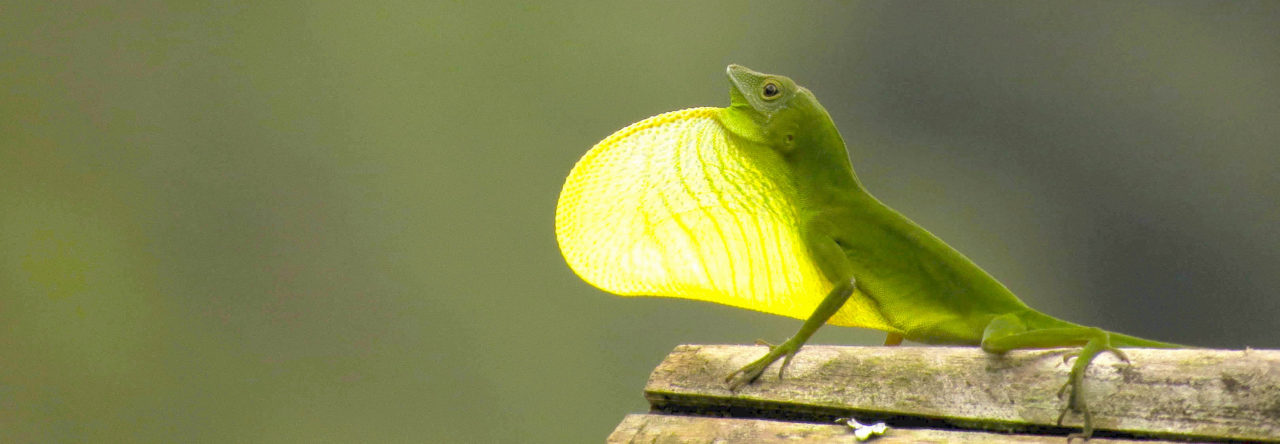
Otocryptis wiegmanni. Photo by Akila De Silva from http://lazy-lizard-tales.blogspot.com/2012/01/year-of-dragon-amazing-agamids.html
A while back we had a post discussing the many times lizards have evolved dewlaps, and more recently our mystery lizard was a most anole-like agamid lizard, Sitana ponceriana. Above is a close relative of Sitana, Otocryptis wiegmanni, doing its best anole imitation. Really, someone needs to do a comparative anatomical study of all these dewlaps to see how similar they are in construction–I’m guessing pretty similar!
The photo comes from a cool website, The Lazy Lizard’s Tales, and this particular post is chockful of cool looking agamids
The Anolis carolinensis – A. sagrei interaction in the SE United States has been discussed on quite a few occasions on this site (see [1], [2], [3], [4], [5], [6] and others). Anolis carolinensis is the only anole native to the US but A. sagrei has invaded much of the former’s range by inhabiting nearly all of Florida, some of southern Georgia, and parts of Louisiana and Texas. The Anolis community has focused a great deal of attention asking: what is the ecological, behavioral, and evolutionary effect of A. sagrei on A. carolinensis.
A new paper by Jessica Edwards and Simon Lailvaux of the University of New Orleans, “Display behavior and habitat use in single and mixed populations of Anolis carolinensis and Anolis sagrei lizards,” explores this interaction even further.
In a comment a few months ago I promised a review of alternatives to the beloved but discontinued long-backordered, Cabela’s Telescopic Panfish pole. As of Monday, Cabela’s claims that the panfish poles we have grown to love will be available again on May 6th. With any luck they will be back to stay and the review that follows will be moot, but after being fooled by two previous restock dates that came and went, we set out to evaluate alternatives. Read on for a review of each.
If you’ve read papers published over the last few years on Anolis diversification, you’ve likely noticed a common pattern: the papers present sophisticated analyses of macroevolutionary patterns that were conducted in R (for instance: 1, 2, and see this teaser for the promise of R with GIS data). If you’ve contemplated how to introduce yourself to R and get over the initial hurdles of writing code for your own research, opportunity is-a-knock’n.

Co-organizer Luke Harmon invites you to apply to the 2012 Workshop on Comparative Methods in R today!
Over the last few years, Michael Alfaro and Luke Harmon have organized a wonderful workshop on macroevolutionary methods in the R programming language for statistical computing. They’ve just released the application for this year’s course. I had the privilege of attending last year and found it to be an enriching experience on several fronts.
This young Anolis equestris was enjoying the recent bloom of a royal palm here in south Florida. After the freeze in 2010 there was a sharp decline in Anolis equestris (kill rate perhaps as high as 80%). The Iguana iguana population declined by 95% or more (so much for the “invasive invasion”). What has resulted from this die-off is that now I see many more of these young A. equestris. This particular specimen most likely hatched out last spring, there is also a smaller sized batch that must have hatched out in the fall. This staggered series of young animals is something I had not observed previously. Adult Anolis equestris (particularly the males) are notorious cannibals and young equestris are much slower and less agile than A. sagrei, A. porcatus, and A. distichus which often elude the sprinting attacks of equestris.
There have been a number of citations of equestris eating birds and small rodents. Anolis equestris are opportunistic predators and will undoubtedly take fledglings if possible. I have seen mocking birds chase equestris from trees because they see them as threats, however, their fabled predatory exploits have been largely exaggerated. For nearly forty years I have made numerous field observations of A. equestris in south Florida. What I have found is that they spend their time much like their smaller anolis counterparts snapping up small arthropods. In fact, a fair proportion of their food intake isn’t even animal matter;

Brown anole from Dust Tracks on the Web
Darwin famously pointed out that a surfeit of cats could lead to an abundance of flowers. Janson Jones has transplanted that way of thinking to our favorite study organism, arguing that a population burst in green anoles in Florida is due to an influx of little dogs, whose ceaseless yapping and running amok has knocked brown anoles off their game, allowing the greens to proliferate. Read all about it here.
Animals and/or insects have a very weird yet amazing relationship with each other. Most of the time, a species will be wiped out without the other. When we think of our dogs, we often think about getting them the best life they can have, and we end up buying stuff from www.treehousepuppies.com or from our local pet shops. But nature does not operate that way, instead, it lets the animals and insects fend for themselves with the help of others.
And here’s what Darwin had to say:
Humble bees alone visit red clover, as other bees cannot reach the nectar. It has been suggested that moths may fertilise the clovers; but I doubt whether they could do so in the case of the red clover, from their weight not being sufficient to depress the wing petals.
Hence we may infer as highly probable that, if the whole genus of humble-bees became extinct or very rare in England, the heartsease and red clover would become very rare, or wholly disappear. The number of humble-bees in any district depends in a great measure upon the number of field-mice, which destroy their combs and nests; and Colonel Newman, who has long attended to the habits of humble-bees, believes that “more than two-thirds of them are thus destroyed all over England.”
Now the number of mice is largely dependent, as every one knows, on the number of cats; and Colonel Newman says, “Near villages and small towns I have found the nests of humble-bees more numerous than elsewhere, which I attribute to the number of cats that destroy the mice.” Hence it is quite credible that the presence of a feline animal in large numbers in a district might determine, through the intervention first of mice and then of bees, the frequency of certain flowers in that district!

