
The Anoles of San Andres And Providencia

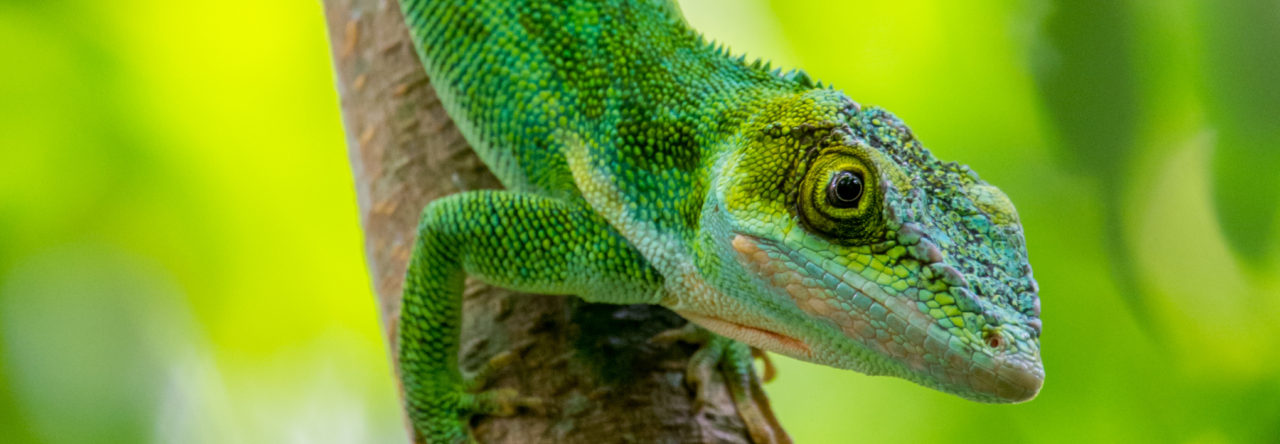
Anolis concolor from mangroves on San Andres island. Photo by Lee Fitzgerald

ResearchBlogging.orgAlmost all Caribbean anoles are descendants from a single colonizing species, whose descendants now occupy all of the Greater Antilles, the Lesser Antilles south through Dominica, and many other islands. Almost all of the remaining species are members of the roquet clade, occupying the southern Lesser Antilles and descended from a South American colonist. As we all know, these species have been extensively studied.

But colonization of Caribbean islands has occurred more than just these two times. Some other islands have been colonized by different colonists. None of these invasions has led to much in the way of evolutionary radiation and these species–in each case the only anole on the islands they occupy–have been little studied. We’ve previously discussed one such colonization, A. lineatus on Aruba and Curaçao. In addition, islands in the Pacific (yes, the Pacific!) have twice been colonized, leading to A. agassizi on little known Malpelo and A. townsendi on Cocos Island (incidentally, the island said to have beeen the inspiration for Isla Nublar in Jurassic Park).

And, finally, there are the presumed sister taxa, A. pinchoti and A. concolor, on the Colombian islands of Providencia and San Andrés. A smidgeon of research has been conducted previously on their ecology, and now a new paper in the South American Journal of Herpetology has examined their morphology. Calderón-Espinosa and Barragán Forero measured museum specimens of these species and compared them to published data on a variety of other Caribbean anoles. They found that neither species is a good match for any of the Greater Antillean ecomorphs, but that they are most similar to trunk-ground or trunk-crown anoles. By comparison, anoles of the Lesser Antilles are also most similar to these two ecomorphs. Anolis concolor attains an intermediate body size, similar to Lesser Antillean species that occupy islands on which they are no other anole species. By contrast, A. pinchoti is smaller and more similar to the smaller Lesser Antillean species on two-species islands.

Anoles are renowned for their convergent evolution. Further comparison of the many cases in which anoles have colonized relatively small islands should prove interesting.

M. L. Calderón-Espinosa and A. Barragán Forero (2011). Morphological Diversification in Solitary Endemic Anoles: Anolis concolor and Anolis pinchoti from San Andrés and Providence Islands, Colombia South American Journal of Herpetology

What Could Be Greener Than An Anole Reusable Lunch Bag?

Lunchskins are reuseable sandwich bags. Great idea? Or a green, scaly mess?

How Will Global Warming Affect Lizards? A Detailed Physiological Study On Puerto Rican Anoles

Anolis cristatellus from mesic habitats. Photo by Manuel Leal.

For obvious reasons, there is great concern about how species will cope with climate change–as the world gets hotter, will species be able to survive? Many studies have taken a macroscopic view, examining the geographic distribution of a species to divine what its temperature tolerances are and then projecting where it will be able to occur in the future. Although such approaches are useful as a first pass, direct study of the physiology of species is a much more informative way of determining how a species will be affected. An excellent example of just this approach was published recently by Gunderson and Leal in Functional Ecology (pdf here).

Mesic and xeric habitats. Photos courtesy Alex Gunderson (left) and Manuel Leal (right)

The authors studied the Puerto Rican crested anole, A. cristatellus, which occurs throughout Puerto Rico and the Virgin Islands. They focused on comparing populations living in cooler, wetter (mesic) habitats versus those living in hotter, drier (xeric) places. They found that in the field, mesic populations had an average body temperature of  about 29 C, whereas xeric populations averaged 32.5 C. However, using copper models as described in previous posts, the authors determined that a lizard randomly placed in a mesic habitat would have a temperature of about 29 C, whereas the random xeric lizard would be 33.5. In other words, the lizards are not thermoregulating in the mesic forest (lizards and randomly placed copper models have the same temperature), but they are actively altering their habitat use in the xeric areas to use cooler spots and thus keep their temperature lower than if they were sitting in random spots. In support of this conclusion, the mesic lizards were in the sun about as much as expected, but the xeric lizards were in the sun less often than predicted.

Anoles at The World Congress of Herpetology

In the herpetology community (i.e., reptile and amphibian aficionados), The World Congress of Herpetology (WCH) is a big deal. In essence, it is a very large scientific conference, held every 3-5 years, uniting local herpetology societies from around the world.

“I wouldn’t miss WCH for anything!”– J.B. Losos

As the WCH mission statement says, “the objectives of the Congress are to promote international interest, collaboration and co-operation in herpetology”; in laymen’s terms means we herpetologists get together to talk about our research in formal meeting rooms, as well as informally in the pub over a beer or two.

This year the 7th World Herp Congress will be held in Vancouver (8-14 August 2012). [Incidentally, a small typing error in google brought me to the 11th World Harp Congress, happening just a few weeks earlier in the same place!]

There will be 15 presentations and 8 posters focussing on our beloved anoles! Including presentations from some of your favourite Anole Annals contributors. A run down of the anole content is after the fold.

Reptile Beer And Wine Bottles As Collectibles: Alexis Harrison Wins Award For Essay

The Philip Hofer Prize for Collecting Books or Art “is awarded each year to a Harvard student whose collection of books or works of art best exemplifies the traditions of breadth, coherence, and imagination represented by Philip Hofer, A.B. ’21, L.H.D. ’67, founder and first Curator of the Department of Printing and Graphic Arts in the Houghton Library and Secretary of the Fogg Art Museum.”

One might think that the award always goes to magnificent collections of rare books or fine art, but apparently not so, as the second place award this year went to anole biologist Alexis Harrison, who established and curates the Collection of Herpetological Beer and Wine Bottles pictured above. Note that each specimen is tagged and catalogued, and the exhibits are arranged in systematic order. Moreover, the public exhibit rotates regularly, and most recently featured the Fisher Collection, on loan from San Diego, CA.

Get a range of bottle labelers https://www.greatengineering.com/ and pursue your passion of collecting and curating bottles in an orderly fashion.

Of course, the question on everyone’s mind: are there anole bottles? The answer is yes, but regrettably few. The best exemplar is a species–best guest: porcatus group–featured on Cerveza Lagarto from Cuba.

Also, even more regrettably, we must acknowledge that the collection has spawned a competing, mammal-themed collection exhibited in the next cabinet over. Lacking anoles or saurians of any kind, the collection is obviously substandard, but it does have its moments.

Anoles In Your Backyard

Nathan Dappen and Neil Losin of Day’s Edge Productions include anoles once again in their latest video. Enjoy!

Two-Tailed Lizards: How’d That Happen?

You never know where you'll find a two-tailed lizard in the Bahamas

Two-tailed–or occasionally even three-tailed–lizards are not all that uncommon. The way it usually happens is easy to explain. Most lizards can lose their tails and regrow a new one.  The way they do this is that in the middle of each vertebra in the tail is a zone of weakness (called a “breakage plane”), pre-made to easily fracture. At the same point, the muscles are arranged to pull apart, and the blood vessels to easily split and clamp down, losing little blood. When this happen, the signal goes out–don’t ask me how–and new tail construction begins.

But occasionally it doesn’t quite work like this. The tail is only partially broken, and doesn’t come off, but enough is broken that new tail growth begins. The result: two tails, the old, still attached one, and the newly grown one.

Now, one more point: new tails do not regrow the original vertebrae, made of bone. Rather, they grow as one long, cartilaginous rod. So, one can easily tell the new tail from the old one.

In any case, that’s how I understood things. When we caught the beauty pictured above, I thought “let’s x-ray the tail to illustrate how this happens for our viewing audience back home.” And boy was I surprised. Take a close look–both tails are composed of cartilage–no bones there.

Now, you’re probably thinking: “Big whoop. It lost its tail, regrew it, then partially broke the regenerated tail, leading to the production of a second one.” Well, you’re probably right, but it’s not supposed to happen that way. Regenerated tails do not have breakage planes and other adaptations for detachment. They’re not supposed to be lost and regrown. Can anyone explain to me what’s going on here?

Curly Tail Lizards Eating Brown Anoles: Coming Soon To A Theater Near You (If You Live In Florida)

BK. Photo by John Rahn

Previous posts (1, 2, 3) have discussed the effect of Curly-tailed lizards (Leiocephalus carinatus) on brown anoles in the Bahamas and elsewhere. To summarize briefly, the effect is this: curly-tails eat brown anoles. Lots of them. The survivors move up into bushes to get away.

Such slaughter may seem of academic interest when it occurs in far-flung Caribbean ports, but soon–already!–Florida denizens can see the carnage up close and personal. The reason: curly-tails have been introduced to the east coast of Florida and seem to be spreading fairly rapidly.

This is all preamble to a series of photographs that AA reader John Rahn has sent in. John lives in Hobe Sound, Florida  (on the coast, north of Miami and West Palm Beach) and enjoys watching and photographing lizards on his back patio. He commented that “I love watching their antics. They are actually quite interesting and are great subjects to practice shooting (photographing).There’s another on my patio (editor’s note: “another” refers to  the A. distichus  he mentioned, along with a photo, in a comment), a girl with great markings and a red head, and this big boy.”

Paper Cut-Out Anoles


These are kind of cool. More here. Anyone got a pattern?

On The Complete Lack Of Discretion Anoles Exhibit While Having Sex

I think it’s time we had a talk. How do I put this? There’s going to come a time in your life where you start to notice, you know, things around you that maybe you didn’t notice before. You might not fully understand it, it can be confusing, and, well, I just want to make sure you’re prepared. What am I trying to say? Well, er, I’ll just say it. Anole sex. That’s right. That magical event when a male anole and his old lady get together to make sweet love. There have been a some posts recently on the morphology of the male’s one-twig-per-berry genitalia, anole copulation, and Isabella Rossellini. I thought I’d throw my hat into the ring focusing on the behaviors anoles exhibit while copulating, accompanied by a video of mating A. stratulus, a species of Puerto Rican trunk-crown anole.

The video starts out with the male displaying with bobs and dewlap, and moving a lot, appearing agitated. From what I’ve seen in Puerto Rico and the Bahamas, this is classic male anole hallelujah-I-think-I-might-get-lucky behavior. When the camera moves to the female and the male approaches her, you see her adopt a receptive posture. The male does a couple of push-ups, then bites her neck and the act begins.

During copulation both the male and the female bob, and the male displays his dewlap. Displaying during mating is common in anoles, and from the video you can see that these displays, and especially the dewlap, are pretty conspicuous. Which leads me to wonder why in the world they do it? This is brazen behavior. I saw lizard cuckoos and crown giant anoles (A. cuvieri) at this site on a daily basis, and I doubt either of these predators would pass up on a two-for-one meal if they saw it. Displaying seems to greatly increase the risk of an already compromising and thus dangerous pastime. Is it just a correlated response to the excited physiological state that likely accompanies copulation? Are the males and females communicating with each other? Good old-fashioned exhibitionism? David Crews has published some interesting work on anole display and female receptivity, but I’ve never seen anything that explicitly addresses the topic of display during the act of mating.

Page 238 of 305

Powered by WordPress & Theme by Anders Norén