
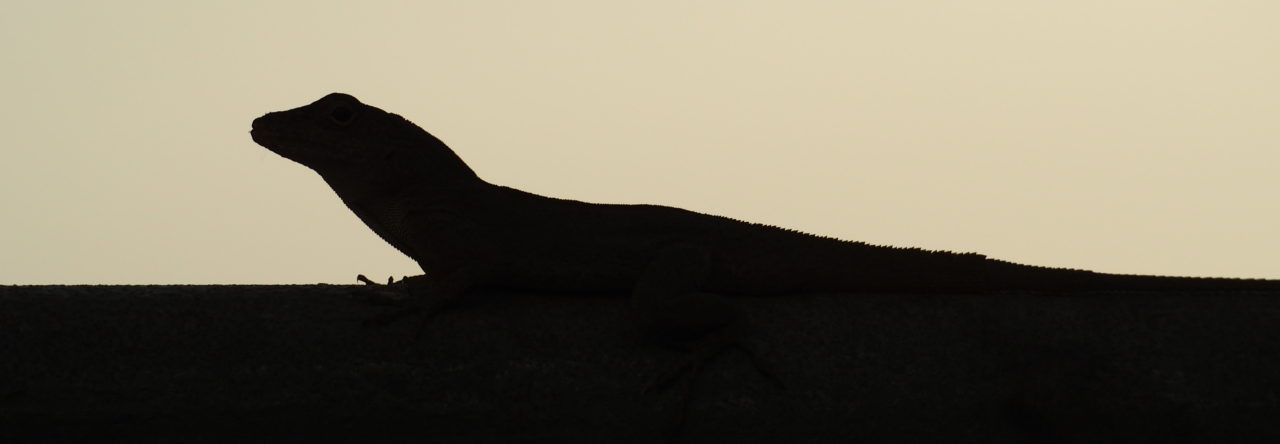
While conducting field work in the Dominican Republic, we recently took a morning off to go for a hike to a nearby waterfall, the beautiful Salto de Jimenoa. I was surprised to find several educational signs about the forest posted along the trail, covering topics including land use history, geology, and, most importantly, flora and fauna. Nestled in a paragraph about reptiles and amphibians, it noted the following (in Spanish, English, French, and German, no less!): “The amphibians are represented by lizards and frogs… A good observer can see lizards of the Anolis species jumping from the trees or walking on the ground and birds can be appreciated.” While some of the biology might not have translated very well, it was good to see anoles getting the shout-out they deserve!
This post serves as a lighthearted response to Jonathan’s earlier announcement and as an advertisement – perhaps endorsement – for some of the upcoming anole talks at Evolution 2012.
In his post Jonathan highlights recent comments by David Hembry that describe the blossoming of anoles into “field model organisms,” the ecological parallel of chicks, mice, and Drosophila which have long histories in laboratory studies. While the importance of anoles for Evolutionary Ecology is almost without question, I think that this stops short of describing the present and undeniable future of anole research. From my perspective, the roots of Anolis research are strong and wide, but its flower(s) has not yet fully blossomed.

Day’s Edge Production in full swing
The guys at Day’s Edge Productions keep on chugging along. Their latest offering is the first video report from their Italian island lizard project, studying the incredible variation of wall lizards found on tiny Spanish islands. What makes this video worth checking out for anolistas is the incredible abundance and audacity of the lizards, which crawl right over the actors as the camera rolls. Anyone ever seen anoles that daring?
Last year was a banner year for anoles. As Xavier@evolutionistX tweeted at the end of the Norman, OK Evolution meetings: “The star of #evol11: Anolis lizards. They won both Fisher’s and Dobzhansky awards, would like to invite them to a celebrity party @NYC.” And who could blame him? The prestigious Dobzhansky and Fisher Awards both went to workers studying anoles, as did three of the four Young Investigators Prizes. And there were a slew of other excellent anole talks (reported on these pages last year; start at this post and work backwards, or search on “Evolution Meetings”). David Hembry summarized the meeting well on Nothing in Biology Makes Sense: “I confess, I didn’t go to the Evolution meetings for three years. I missed Minnesota in 2008 due to fieldwork, Idaho in 2009 due to illness, and Portland in 2010 due to the EAPSI. When I “returned” in 2011 in Norman, it was like everybody had switched to working on anoles and sticklebacks!” (see the rest of David’s insightful observations on this point below).
But can anoles do it again in this year’s meeting , slated to begin on Friday in Ottawa? You can rely on Anole Annals to be on hand to provide the play-by-play coverage from the spectacle of the opening ceremonies to the climactic closing mixer. And fear not: though not the grand slam of last year, anoles again will bring home some medal.
Here are the talks. Unfortunately, authors are not listed, but you can get all program information at the meeting’s program mobile app website:
For many years, the South American lizard genus Polychrus has been considered the closest extant outgroup to Anolis. In light of this phylogenetic position, the authors of a new report on the life history of Polychrus acutirostris note that “a comprehensive understanding of Polychrus might help clarify possible ecological factors related to the radiation of anoline lizards as well as to infer the existence of niche conservatism or dietary shifts related to the origin of this large lizard radiation” (Garda et al. 2012).
Members of Polychrus are superficially similar to Anolis, and are mostly medium sized arboreal and diurnal lizards. However, Polychrus also differs from Anolis in both conspicuous (e.g., lack of toepads) and somewhat less conspicuous ways (e.g., its tendency to produce single clutches of multiple eggs, versus multiple one egg clutches in Anolis). In their report, Garda et al. (2012) compare populations of Polychrus acutirostris found in two different Brazilian habitats to test whether size of eggs and clutch size, reproductive seasonality, diet, and size of reproductive adults varies among populations in the manner predicted by life history theory. Although recent work makes Polychrus‘s position as the outgroup to Anolis less certain than it once was (Schulte et al. 2003, Townsend et al. 2011, and this previous AA post), we still have much to learn from the type of comparative studies that Garda et al. have implemented.
Photo by Avery Locklear at http://travel.nationalgeographic.com/travel/traveler-magazine/photo-contest/2012/entries/141546/view/. From the National Geographic Traveler 2012 photo contest.
Like they always say, it’s important to take time to smell the bananas.
Avery Locklear provides the back-story: “I saw the banana flower from a distance and approached it. Then I found the anole resting on it, sitting content. I stood there for a few minutes as it continued to explore the banana flower.
I have so many memories of anoles from when I was younger. I always called them chameleons until several years ago, I looked them up and found more information about them. My grandmother, who lives in Florida, would sometimes find them in the house and would catch them so she could set them free. I always liked to have a look at them before she let them go.
I have lots of photos of them as they are everywhere in Florida.”
Almost all Caribbean anoles are descendants from a single colonizing species, whose descendants now occupy all of the Greater Antilles, the Lesser Antilles south through Dominica, and many other islands. Almost all of the remaining species are members of the roquet clade, occupying the southern Lesser Antilles and descended from a South American colonist. As we all know, these species have been extensively studied.
But colonization of Caribbean islands has occurred more than just these two times. Some other islands have been colonized by different colonists. None of these invasions has led to much in the way of evolutionary radiation and these species–in each case the only anole on the islands they occupy–have been little studied. We’ve previously discussed one such colonization, A. lineatus on Aruba and Curaçao. In addition, islands in the Pacific (yes, the Pacific!) have twice been colonized, leading to A. agassizi on little known Malpelo and A. townsendi on Cocos Island (incidentally, the island said to have beeen the inspiration for Isla Nublar in Jurassic Park).
And, finally, there are the presumed sister taxa, A. pinchoti and A. concolor, on the Colombian islands of Providencia and San Andrés. A smidgeon of research has been conducted previously on their ecology, and now a new paper in the South American Journal of Herpetology has examined their morphology. Calderón-Espinosa and Barragán Forero measured museum specimens of these species and compared them to published data on a variety of other Caribbean anoles. They found that neither species is a good match for any of the Greater Antillean ecomorphs, but that they are most similar to trunk-ground or trunk-crown anoles. By comparison, anoles of the Lesser Antilles are also most similar to these two ecomorphs. Anolis concolor attains an intermediate body size, similar to Lesser Antillean species that occupy islands on which they are no other anole species. By contrast, A. pinchoti is smaller and more similar to the smaller Lesser Antillean species on two-species islands.
Anoles are renowned for their convergent evolution. Further comparison of the many cases in which anoles have colonized relatively small islands should prove interesting.
M. L. Calderón-Espinosa and A. Barragán Forero (2011). Morphological Diversification in Solitary Endemic Anoles: Anolis concolor and Anolis pinchoti from San Andrés and Providence Islands, Colombia South American Journal of Herpetology
Lunchskins are reuseable sandwich bags. Great idea? Or a green, scaly mess?
For obvious reasons, there is great concern about how species will cope with climate change–as the world gets hotter, will species be able to survive? Many studies have taken a macroscopic view, examining the geographic distribution of a species to divine what its temperature tolerances are and then projecting where it will be able to occur in the future. Although such approaches are useful as a first pass, direct study of the physiology of species is a much more informative way of determining how a species will be affected. An excellent example of just this approach was published recently by Gunderson and Leal in Functional Ecology (pdf here).
The authors studied the Puerto Rican crested anole, A. cristatellus, which occurs throughout Puerto Rico and the Virgin Islands. They focused on comparing populations living in cooler, wetter (mesic) habitats versus those living in hotter, drier (xeric) places. They found that in the field, mesic populations had an average body temperature of about 29 C, whereas xeric populations averaged 32.5 C. However, using copper models as described in previous posts, the authors determined that a lizard randomly placed in a mesic habitat would have a temperature of about 29 C, whereas the random xeric lizard would be 33.5. In other words, the lizards are not thermoregulating in the mesic forest (lizards and randomly placed copper models have the same temperature), but they are actively altering their habitat use in the xeric areas to use cooler spots and thus keep their temperature lower than if they were sitting in random spots. In support of this conclusion, the mesic lizards were in the sun about as much as expected, but the xeric lizards were in the sun less often than predicted.
In the herpetology community (i.e., reptile and amphibian aficionados), The World Congress of Herpetology (WCH) is a big deal. In essence, it is a very large scientific conference, held every 3-5 years, uniting local herpetology societies from around the world.
“I wouldn’t miss WCH for anything!”– J.B. Losos
As the WCH mission statement says, “the objectives of the Congress are to promote international interest, collaboration and co-operation in herpetology”; in laymen’s terms means we herpetologists get together to talk about our research in formal meeting rooms, as well as informally in the pub over a beer or two.
This year the 7th World Herp Congress will be held in Vancouver (8-14 August 2012). [Incidentally, a small typing error in google brought me to the 11th World Harp Congress, happening just a few weeks earlier in the same place!]
There will be 15 presentations and 8 posters focussing on our beloved anoles! Including presentations from some of your favourite Anole Annals contributors. A run down of the anole content is after the fold.


