
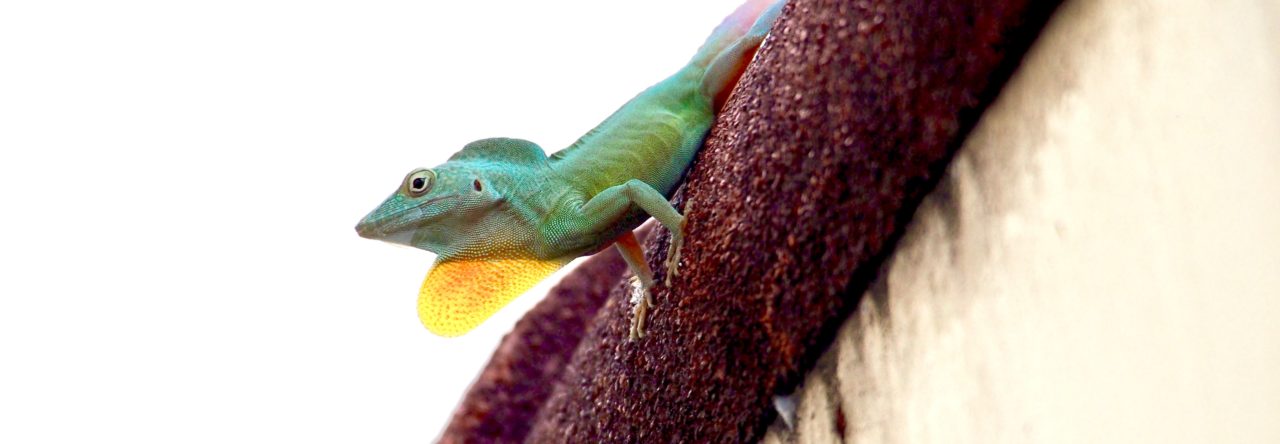

Battling green anoles. Photo from http://dmcleish.com/Maui2009/AnoleFight/DSC_0278.jpg
 Both theory and empirical examples from many types of organisms indicate that animals alter their fighting behavior based on the outcome of previous fights. That is, if an animal won its previous fight, it is likely to win its next one, whereas previous losers are likely to keep on losing. In a new paper in Ethology, Garcia et al. examine whether such winner and loser effects occur in the green anole, A. carolinensis.
To create winners and losers independent of their innate fighting ability, the investigators first staged encounters in which one lizard was 40% larger than the other. Because size is a very good predictor of encounter outcome, they used this method to create animals which had won or lost their first encounter. Indeed, most of the larger animals won in these matches. Then, in the second round, they placed individuals of the same size together, one of which had won its previous encounter and the other that had lost.
Results did not support the hypothesis: probability of winning was not affected by previous experience: winners in the first round were no more likely to triumph in the second round than were first round losers. However, there was one interesting finding: losers that had put up a good fight in Round 1 were likely to win Round 2, whereas those who hadn’t continued to lose. Two possible explanations are either: 1) that the feisty losers were intrinsically more aggressive and couldn’t overcome the size disadvantage in Round 1, but when paired against similar-sized animals, were able to use their aggressiveness to overpower their opponent; or, second, that this is an example of a variation of the “loser effect,” only that it is not the outcome of the fight, but the quality of it, that matters. Losers who put up a good fight might still feel emboldened and thus do well in the future, whereas losers that lose badly may continue to lose in the future.
Mark J. Garcia, Laura Paiva, Michelle Lennox, Boopathy Sivaraman, Stephanie C. Wong, & Ryan L. Earley (2012). Assessment Strategies and the Effects of Fighting Experience on Future Contest Performance in the Green Anole (Anolis carolinensis) Ethology, 118, 821-834 DOI: 10.1111/j.1439-0310.2012.02072.x

 It’s been a good couple of years for studying lizard smarts. Last year, Manuel Leal


