Observations On Two Colombian Endemic Anoles

Juan Salvador Mendoza

Fundación Kamajorú para la conservación y educación ambiental  Barranquilla, Colombia.

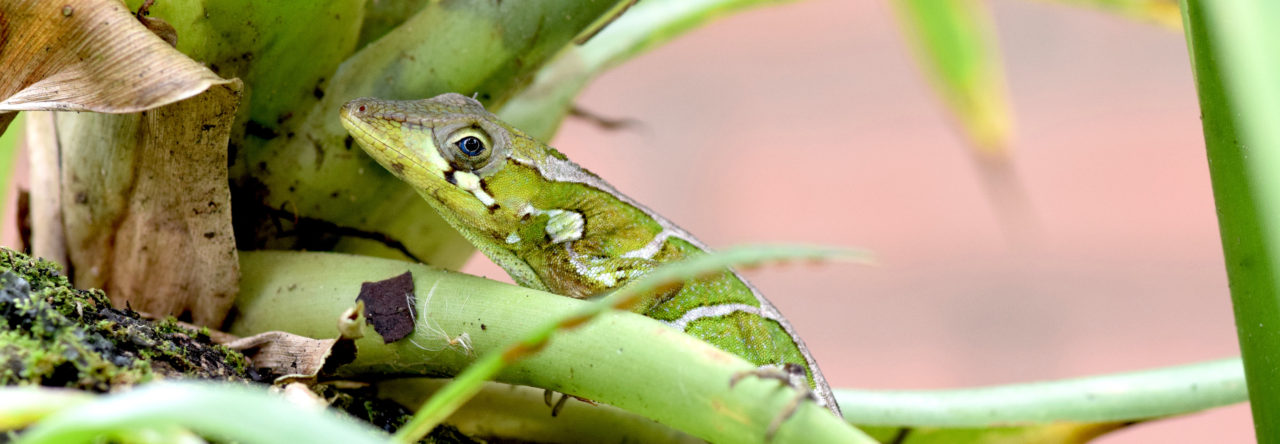
Detail of Anolis concolor, San Andres Islas, Colombia; Juan Salvador Mendoza, July 2012.

Anoles (genus Anolis sensu old taxonomy) are one of the most diverse neo-tropical vertebrate groups with more than 200 species. In continental Colombia more than 60 anole species have been registered, including 30 which are endemic (Sanchez et al. 1995).  Three more endemic species are known from the insular portion of San Andres and Providencia in the Atlantic Ocean and Malpelo in the Pacific (Sanchez et al. 1995).  One of this insular species is A. concolor (Cope, 1836) a relatively medium-sized anole (60-80 mm SVL) that inhabits mangroves and dry forests in the islands of San Andres and Providencia; on the latter island, this species is sympatric with a A. pinchoti which is endemic only to the island of Providencia. In the Pacific, the representative species is A. agassizi from Malpelo Island.

A.concolor. Male, Jardin Botanico, Universidad Nacional, sede Caribe;

A.concolor. Male, Jardin Botanico, Universidad Nacional, sede Caribe; San Andres Islas, Colombia. Juan Salvador Mendoza 2012

Anolis concolor is a very agile lizard that may use the ground, tree trunks and branches to forage and display courtship and territorial behavior. I observed and photographed several individuals in the “Jardin Botanico, Universidad Nacional de Colombia;” this garden holds more than two hectares of the natural vegetation of the island, tropical dry forest.  This lizard can be found in the borders of roads on top of secondary vegetation and can be also found in conserved remnants of mangroves and dry forest. In San Andres this species shares its habitat with a gecko species (Aristelliger georgensis) that may be also found even during the day time in the tree trunks. This is the only anole species in San Andres Island and can be very abundant; I counted 35 individuals in a 1 km forest trail.

Green Anoles Banned In Japan

We’ve had a lot of discussion on AA about invasive anoles. Although some in Hawaii seem hot and bothered about them, only in two places–both in Asia–are governmental entities actually trying to do something about it. And, unfortunately, both such efforts seem to be having a devastating effect on the native fauna. Gerrut Norval has reported on such efforts in Taiwan and how they are leading to the massacre of many native agamid lizards. Now, thanks to sharp-eyed AA reader, anole researcher and—as a fallback career option–ichthyologist, Bruce Collette, we learn of anole control efforts on the Japanese island of Okinawajima.

The current issue of Biological Magazine of Okinawa has just published a paper by Ishikawa et al. on efforts to control introduced A. carolinensis by trapping them in glue traps. Unfortunately, as they note, this trapping has succeeded in capturing–and presumably killing–many times more native geckos than green anoles. The journal is in Japanese and if any of our Japanese readers could provide a synopsis, we’d be very appreciative. However, the abstract is in English and is appended below, along with a photo from the paper of sticky-trapped anoles.

Great White Anole

from fpczoner on Instagram: http://instagram.com/p/RTRKOfpDAs/

Election Coming Down To The Wire; Vote Now

This lovely photo of A. capito taken by Gabe Gartner is one of the contestants in this year’s contest.

As we enter the last weekend, it’s neck-and-neck, with recent polls showing the race tightening. 500 votes are in–cast yours for the Anole Photo Contest. Voting ends at the witching hour on Halloween (October 31).

Here We Go Again: Hurricane Sandy Headed Straight Toward Abaco

AA veterans will recall that we have a recurring interest in hurricanes, especially those that go over Marsh Harbour, Great Abaco, Bahamas, the site of a series of long-running anole experiments. Previous posts have documented how such hurricanes have prematurely terminated several experiments, and some may recall that last year, Hurricane Irene passed right over the islands. Miraculously, the hurricane hit at low tide and in just the right direction such that waves did not wash over many of the islands, and thus the experiment was not destroyed.

But this time, it doesn’t look so good. According to the latest projections, it looks like Sandy’s eye is going to pass pretty close, about 20 miles east of Marsh Harbour, at about 8 AM tomorrow morning eastern time. Barometer Bob is calling for winds up to 70 mph in the Abacos. And that’s just after high tide, and it is a particularly high high tide. Passing to the east would produce less storm surge than coming straight on from south, but it still sounds like bad news. Hang in there, little lizards, and good luck to all the denizens–human, saurian, and other–of the Bahamas.

Friday morning update: it’s right over Abaco:

The Empire Strikes Back: Revenge Of The Brown Anole

Brown anole eating a curly tail lizard. Photo by Joseph Wasilewski.

We’ve had a number of posts concerning predation by curly tail lizards on brown anoles, in the BahamasFlorida, Cuba and elsewhere. Now comes a report from near Miami that the brownies aren’t just sitting back and taking it. Rather, they’re rounding up vigilante posses to track down and consume baby curlies, hitting the predator’s population where it’s vulnerable. Ok, perhaps that’s a stretch, but in a recent note in Herpetological Review, Krysko and Wasilewski publish the first report of Anolis sagrei preying on Leiocephalus carinatus, revealing that the ecological interactions between the two species are more complicated than previously thought: we already knew that curlies prey on brown anoles and that the two species also compete for some of the same insect prey (making this an example of the phenomenon of intra-guild predation),  but this study raises the possibility that the interaction–and its likely ecological and evolutionary consequences–could be substantially more complicated. One might think that because of the massive size advantage of the curly-tails, the effects must mostly be one-way; however, the massive population size differential between the two species means that brown anoles, in theory, could greatly affect curly tail populations as well. Although the effects of curly tails on brown anoles have been studied, the opposite experiment has not been done. Of course, previous work on tiny Bahamian islands indicates that curly tails substantially reduce brown anole populations, but maybe dynamics are different in larger and more complicated ecosystems. Personally, I wouldn’t bet on it, but who knows?

More On Anolis Proboscis

Earlier in the year, we reported on a pair of papers describing the enigmatic and little known Ecuadorian horned anole, Anolis proboscis. Now, the Tropical Herping website has put up an information page on this species which comprehensively summarizes what we know and, as a bonus, reports unpublished observations that the species has been located at a number of new localities, bringing to 12 the total sites from which the species has been reported.

Blue Knight Anole: What Is It?

Reader Thomas McLellan writes in: “I recently found this photo online (Editor’s note, April 20, 2013: the photo won’t reproduce here, but if you click on the link, you can see it) & was hoping someone might have info on what this is. Is it a color phase of Anolis equestris or something else? (This photo was apparently taken at the Detroit Zoo.) Any ID info about them? Can anyone help?”

And I’d be remiss not to mention our old post on blue knight anoles, which oddly enough, is one of our most frequently viewed posts. Lots of people get to it by searching for “blue beauty.” Am I missing something here? Are they looking for blue knight anoles, or something else?

p.s. Shortly after this post was written, I received the photos below from Amber Carney, a zookeeper in Miami, by way of Yoel Stuart, who asks if this pattern and coloration is unusual. Thoughts, anyone?

The Effect Of Previous Fight Outcome On the Probability Of Winning The Next Fight In Green Anoles

Battling green anoles. Photo from http://dmcleish.com/Maui2009/AnoleFight/DSC_0278.jpg

ResearchBlogging.orgBoth theory and empirical examples from many types of organisms indicate that animals alter their fighting behavior based on the outcome of previous fights. That is, if an animal won its previous fight, it is likely to win its next one, whereas previous losers are likely to keep on losing. In a new paper in Ethology, Garcia et al. examine whether such winner and loser effects occur in the green anole, A. carolinensis.

To create winners and losers independent of their innate fighting ability, the investigators first staged encounters in which one lizard was 40% larger than the other. Because size is a very good predictor of encounter outcome, they used this method to create animals which had won or lost their first encounter. Indeed, most of the larger animals won in these matches. Then, in the second round, they placed individuals of the same size together, one of which had won its previous encounter and the other that had lost.

Results did not support the hypothesis: probability of winning was not affected by previous experience: winners in the first round were no more likely to triumph in the second round than were first round losers. However, there was one interesting finding: losers that had put up a good fight in Round 1 were likely to win Round 2, whereas those who hadn’t continued to lose. Two possible explanations are either: 1) that the feisty losers were intrinsically more aggressive and couldn’t overcome the size disadvantage in Round 1, but when paired against similar-sized animals, were able to use their aggressiveness to overpower their opponent; or, second, that this is an example of a variation of the “loser effect,” only that it is not the outcome of the fight, but the quality of it, that matters. Losers who put up a good fight might still feel emboldened and thus do well in the future, whereas losers that lose badly may continue to lose in the future.
Mark J. Garcia, Laura Paiva, Michelle Lennox, Boopathy Sivaraman, Stephanie C. Wong, & Ryan L. Earley (2012). Assessment Strategies and the Effects of Fighting Experience on Future Contest Performance in the Green Anole (Anolis carolinensis) Ethology, 118, 821-834 DOI: 10.1111/j.1439-0310.2012.02072.x

Happy Reptile Awareness Day

Turns out today is Reptile Awareness Day. The reptile channel has some suggestions of things to do to in honor of the day and Audubon has put their Reptile and Amphibian Field Guide iOS app on sale for $0.99.  So is anybody doing anything special to celebrate?

Page 222 of 305

Powered by WordPress & Theme by Anders Norén