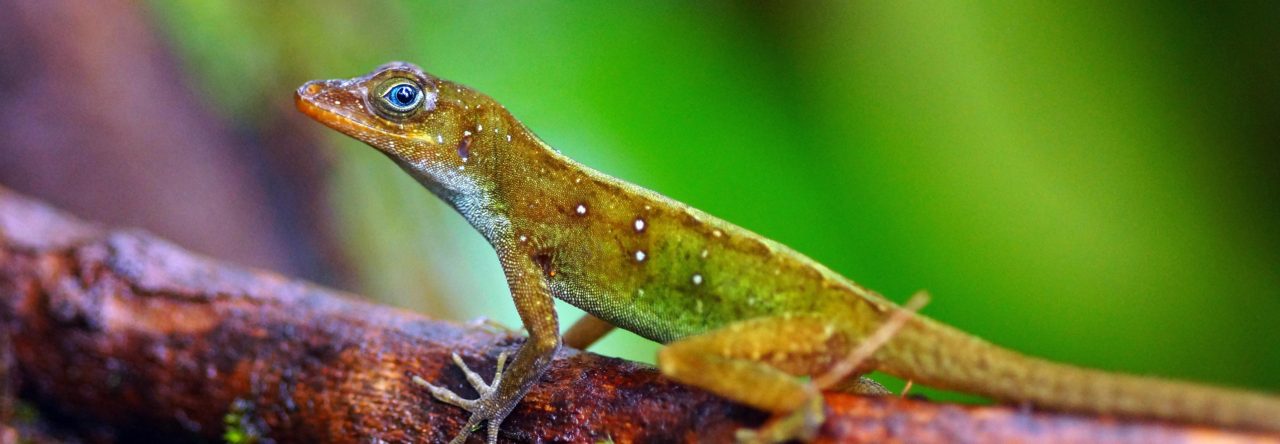
How’s this for a nifty anole decal? A gift from AA contributor and photographer extraordinaire Joe Burgess, the window dressing is the handiwork of Floridian Gary Swenk, who has this to say about himself and his unusual trade: “I am a retired law enforcement officer now doing vinyl graphics from home. I attached a catalog that I use and I also can convert pics, images etc. to vector graphics for making the decals. Black and white or pics with good contrast work best (not all pics, images are able to convert but it is easy for me to test them). I have a lot of different colors available. They can be made in many sizes ( 3″ up to 11″ is a good size). I can customize a graphic with names etc., using numerous fonts. Price is based upon size and single colors would run $2 to $5 for the sizes mentioned plus actual shipping cost which would be minimal. My cell is 904-540-3879.” And his emai is customdecals4u@yahoo.com.
Long time AA readers will recall that every year, a team of researchers go to the Marsh Harbour, Abaco, Bahamas to study how curly-tailed lizards affect brown anoles and, in turn, how the presence of brown anoles affect the rest of the ecosystem on tiny islands. This research, initiated by Tom Schoener and Dave Spiller in the 1980s, has been long-lasting and has produced many interesting discoveries about anoles, ecology and evolution.
But in the last few years, the research has been bedeviled by hurricanes. In 1998 and then again in 2004, studies on the effects of curly-tails on brown anoles were terminated prematurely by hurricanes. We did learn a lot about how hurricanes affect ecosystems, including lizards, but it wasn’t so helpful with regard to understanding how brown anoles evolve in response to predation pressure. After waiting several years for the islands and lizard populations to recover, we re-initiated the experiment again in 2008. At the same time, we started a second experiment by introducing a single pair of lizards to each of seven islands, creating a replicated experiment on the effects of founder events on evolutionary adaptation.
Both experiments were moving along nicely when—what else?—another hurricane hit, Irene in 2011. As everyone recalls, Irene was a big one, and we feared the worst, but by good fortune, its effects were less than catastrophic because it hit at low tide—minimizing the extent of the storm surge—and from a direction that tended to minimize the storm surge on the particular islands we were studying. The result was that some—though not all—island populations were hit hard, but very few were demolished. In fact, I speculated that studying the effect of a population bottleneck on populations created by founder events might be particularly interesting, because some theories suggest that it takes multiple population crashes to lead to great evolutionary changes.
Hurricane Irene ripping its way through the Bahamas. Abaco is the island to the right of the arrow labelled “Freeport.”
So along comes 2012 and… another direct hit on our islands, this time by the infamous Hurricane Sandy. Although initially quite large, by the time Sandy hit Abaco, its wind speeds were less than Irene, giving us hope. But, on the other hand, Sandy slowed to a crawl, meaning that it remained over Abaco for a long time, not just at low tide, and also from a more threatening direction than Irene’s. All dangerous portents.
Thus, with great trepidation, we returned to Abaco earlier this month, anxious to learn how our island buddies had fared. A trip to Abaco last December—admittedly, not the best anole time, even in the Bahamas—had indicated that a number of the lowest lying islands seemed lizardless. And our visit confirmed that finding. The seven islands in our founder effect study are all small and low-lying, and the lizard populations on five of them were wiped out (one of them had a female last December, but she’s apparently gone). One of the remaining islands contains but three anoles—a male and two females—and it will be interesting to observe the effect of this population bottleneck. That population—like all in this experiment—was founded by two individuals and quickly grew in size. Will it rebound again, and just as quickly?
What’s going on inside their heads? The four anole species of South Bimini, The Bahamas.
Whenever I stand in the forest on South Bimini in the Bahamas, I’m always struck by the similarity of these anoles to those I’ve worked with elsewhere in the Greater Antilles. Yes, that’s the whole idea behind the ecomorph concept, but as many have pointed out recently, habitat use and morphological convergence are only part of the story. Along with the classic divergence and convergence in body size and shape, the ecomorphs also show intriguing convergence in sexual size dimorphism and social behavior. It’s this latter aspect of the Caribbean anoles that interests me. How has this convergence in behavior, though it’s not perfect, happened? Have the proximate mechanisms that are responsible for anole behavior evolved in the same way on the various islands in the various ecomorphs? From a larger perspective we are asking, how do neuroendocrine systems evolve? That’s what my students and I are trying to figure out, and that’s why we’re in the Bahamas right now.
A few years back, Matt Lovern and I started a project examining circulating steroid hormone levels in four anole assemblages (The Bahamas, Puerto Rico, Dominican Republic, and Jamaica). Based on a plethora of work in a variety of vertebrate species and their testosterone-behavior relationships, we predicted that we would find consistent intra-island differences among ecomorphs in testosterone (and corticosterone), with the ever-charismatic trunk-ground anoles showing the highest levels. Boy, were we in for a surprise. We did find species differences, and we even found consistent ecomorph differences, but not like we expected. Unlike the mainland green anole (Anolis carolinensis) and the introduced brown anole (Anolis sagrei) on the mainland (yes, the apparent difference in testosterone levels between mainland and Caribbean brown anoles is probably a separate, interesting story!), trunk-ground anoles in the Caribbean have very low baseline testosterone levels. Twig anoles, on the other hand, are super-juiced with testosterone. I won’t give the whole story away, as we are working on getting it published, but the take-home message is that hormones are only part of the story, and testosterone likely plays very different roles in the behavior of the various species and ecomorphs. While this may not sound surprising to some, in some ways it is, because typically people only focus on circulating hormone levels to explain behavior, and testosterone levels tend to be pretty good predictors at a large scale. Although many proclaim that it’s not the hormones but the receptors, nobody has examined hormone receptor distributions in target tissues across a large number of closely related species. Again, that’s what we’re trying to do here in the Bahamas (and elsewhere).
We’ve been spending our time here on Bimini collecting brains for analysis of several potential regulators of social behavior in multiple brain regions known to be important in anole aggression and courtship behavior. My student Allison, who is here with me now, got some funding to spend the rest of the summer back in Minnesota sectioning and staining brains from the four ecomorphs here on Bimini. We’ve also been conducting “GnRH challenges” on these species to determine whether the baseline levels of testosterone that we’ve measured are as high as they can go. That is, when we physiologically stimulate the hypothalamus-pituitary-gonad axis to produce more testosterone, is it capable of doing so, and are there differences among species in that response? I’ll be spending the rest of my summer running those samples to find out. This will complement the social challenges that Matt Lovern and I conducted in the Dominican Republic last year on Anolis cybotes and Anolis coelestinus, examining whether social challenges result in increased testosterone. Stay tuned to see what we find!

Imagine my surprise to stumble onto a farm that specializes on goatsmilk soap named Anole Nook Farm. I contacted the proprietor, Hannah Shumaker, who kindly explained:
“I named my farm/business after counting 27 anoles sunning themselves on the front of my house one morning. I’ve since moved, and while my current farm is not quite as much of an anole haven as the first, I still see them regularly. I’m a North Carolina native and have always been fond of the little fellows. I’m still keeping an eye out for the elusive blue anole.
My business is locally/sustainably grown soaps. I use the goatsmilk from my farm and locally grown ingredients in my soaps. Right now that’s sheep or beef tallow, rapeseed oil, honey, and local botanical additives. Here are links to a little page about my business and my poorly maintained facebook page.
That’s me and my anole connection, in a nutshell. Anoles are awesome!”
If a juvenile anole has a dewlap since birth, there must be a reason for it, but what is it? Juvenile hispaniolan crown giants do have them and here is a video of one using it. This Anolis ricordii was only 52.10 mm in SVL and was showing his stuff while a colleague was taking photos of it. We placed it in the tree and left it for about 10 minutes without disturbing it, after which it started dewlapping and bobbing the head. At one point, the dewlap was fully extended, but by the time I got my “pocket” camera ready, this was all it gave.
httpv://www.youtube.com/watch?v=PZLAvF84Ob4
Later on, another individual, which was somewhat smaller, was found on the ground on a rainy day. There must be intraspecific spatial niche partitioning, when your parents are higher up and could eat you, it must be safer to stay away. Would a dewlap also be useful mainly for “pushing” away potential competitors/predators, as A. cybotes?

Found this nice explanation of anole color change on twitter. It’s from the website of Elizabeth Nixon, a professional artist, who says that it was made in Photoshop in 40 hours. Very nicely done!
Here at AA, we’re a bit obsessed with lizards with things on their noses, technically called “rostral appendages,” and sometimes, depending on shape, “horns.” A lot of this interest comes Anolis proboscis, the horned anole of Ecuador, about which we’ve written much before.
Almost as cool as horned anoles (really, that’s an unfair standard) is the Sri Lankan lizard genus Ceratophora, which contains three species with rostral (or nasal) appendages, and two other species that are appendage-less. In a recent paper in Journal of Zoology, Johnston et al. discuss the evolution of these appendages. It’s long been debated whether the appendages evolved independently in each species or once in the ancestral Ceratophora, followed by loss in the two nasally-naked species. By combining analyses of phylogeny (which produces somewhat inconclusive reconstructions of ancestral phenotype), morphology and allometry, the authors conclude that the appendages most likely evolved independently in each of the three species. Moreover, they suggest the blob-like appendage of C. tennenti (bottom photo) may have evolved for crypsis, but the more horn-like appendages of the other two species probably resulted from sexual selection.
While on the topic of nasal horns, I decided to see if there are any new photos of the other horned anole, A. phyllorhinus, on the web, and indeed there are. See below. The natural history of this species, which likely evolved its horn independently of A. proboscis, awaits further study.

from http://ipt.olhares.com/data/big/506/5069364.jpg

- from http://www.reptarium.cz/content/photo_rd_05/Anolis-phyllorhinus-03000033975_01.jpg
httpv://www.youtube.com/watch?v=QsOmFYVhS9g
The Northern House Gecko (Hemidactylus flaviviridis) is a widespread species found in human-modified habitats throughout northern and eastern India. This is probably the most common house-dwelling gecko in Kolkata, the eastern capital of India. This species is primarily insectivorous and often observed to hunt on various insects like ants, mosquitoes or cockroaches. As an altered behavior, it is also not very uncommon to find this species extending it’s food items to available edible human food products! However, there have not been many reported incidents where Northern House Geckos specialized on a certain type of human food.
The video clips here show an individual gecko that ‘waits’ for biscuits everyday almost at the same time in the evening at my home in Kolkata. This individual shows extraordinary ‘pet’ behavior and sometimes eats from my hand. This has been happening since 2011 until very recently.Sometimes the gecko goes missing for a couple of months, but reappears again when we find it waiting for a biscuit near the TV-table, its usual refuge. Though not marked,I assume it to be the same individual as it has very distinctive behavior.
Hi everyone.
Do any of you have a PDF of the following article, which you can e-mail to me please?
Valderrama Puente, M.J. 1977. Algunos datos sobre el ciclo reproductivo en Anolis sagrei. In Cuarta Jornada Científica Estudiantil. Havana (Facultad de Biología, Universidad de La Habana).
Thanks.
httpv://www.youtube.com/watch?v=R-y5r5kj87M
After an early afternoon rain in western Cordillera Central of the Dominican Republic, a swarm of “flying ants” emerged from a nest on ground, most of them gathering at top of this antenna pole, attracting the attention of the neighboring community of anoles. Approximately a “platoon” of 2 dozen of A. chlorocyanus started climbing up the 7-8 meter tall pole, a few A. cybotes stayed low, and at least one A. distichus joined the feast. The lizards came from two small wooden buildings and used the wire (seen near top, at right side) and roof-to-nearest bushes jumps to access the pole. Many more came and went. Certainly, there were several males, and dewlap displays were made once in a while, but there was no time (or no real need?) for a fight this time. Some male chlorocyanus live very close to each other in those buildings (along with several females), and show notorious scars over their faces.
Editor’s Note: Here’s another video that Miguel mentioned in a comment (below):
httpv://www.youtube.com/watch?v=2dxAqySnAVM