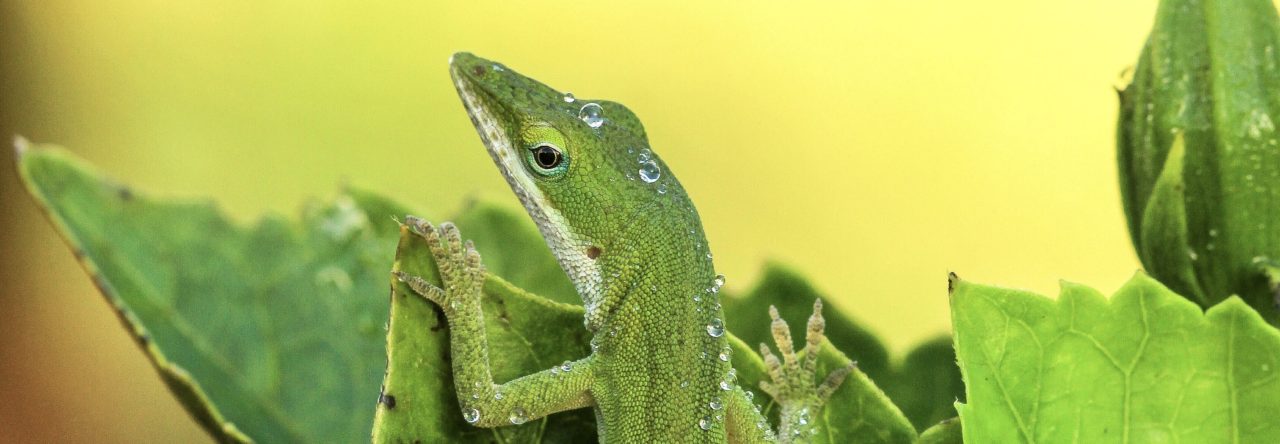
Newspaper Article on Brown Anoles Affecting Green Anoles Gets It Right

Battling anoles. Image Credits: Ken King // Dixie Native


The St. Augustine Record published a very nice article two weeks ago discussing the invasion of brown anoles, A. sagrei, and how they’ve affected green anoles. But instead of the usual alarmist hysteria–green anoles being pushed to extinction–this article pretty much gets it right!

“…the invasion of the brown anoles have chased the natives into the treetops. The brown anoles, having few enemies, have taken over the former habitat of the greens, forcing them into new territories and farther from our sight.”

That’s right–the green anoles aren’t going extinct, they’re just shifting their habitat use to get away from the browns. The only quibble I would have is that this is not really “a new territory” because not only have green anoles in Florida been using high perches all along, but that’s what their ancestors in Cuba, who’ve always lived with brown anoles, have always done.  Green anoles experienced what’s called “ecological release” when they got to Florida and found it brown anole-less; now they’re simply returning to their ancestral niche.

For more on this topic, see previous AA posts [e.g., 1, 2, 3].

A Doubly Regenerated Tail and Other Morphological Oddities

I’m doing fieldwork with Anolis sagrei in Gainesville, FL, this summer. We now have about 125 lizards  measured and marked, and have come across a number of interesting morphological oddities in these lizards. Most interesting so far is this doubly regenerated tail, i.e. there appear to be two spots at which the tail has regenerated, which means a regenerated tail must have broken and regenerated again.

A doubly regenerated tail in a male Anolis sagrei in Gainesville, FL.

A doubly regenerated tail in a male Anolis sagrei in Gainesville, FL.

Approximately three minutes before we noticed this tail, my field assistant Christian Perez asked me if double regenerations were possible, and I confidently said “no.” As Jonathan Losos puts it in Lizards in an Evolutionary Tree, “when a tail regenerates, the new portion of is made of a rod of cartilage and thus lacks the intravertebral breakage planes that enable an unregenerated tail to autotomize.” So how did this double regeneration happen? Anyone seen this before?

The next oddity is this male with a mysteriously shortened upper jaw:

A shortened upper jaw in a male Anolis sagrei in Gainesville, FL.

A shortened upper jaw in a male Anolis sagrei in Gainesville, FL.

Third, we have a partially discoloured dewlap:


A discoloured dewlap in Gainesville, FL

A discoloured dewlap in Gainesville, FL

And finally, here’s an addition to our collection (1, 2) of multiply tailed lizards:

A double tail in an Anolis sagrei in Gainesville, FL.

A double tail in an Anolis sagrei in Gainesville, FL.


Which Puerto Rican Anoles Are These?

A few weeks ago I had the opportunity to visit Puerto Rico for the first time, albeit briefly. Fortunately, a lot of anoles can be found even on a brief visit. With the help of caribherp.org and other references, I could identify most of them. I was hoping to get some help from the knowledgable readers of Anole Annals on the rest. I suspect they are mostly all juvenile Anolis cristatellus cristatellus, but the appearances are varied enough that I couldn’t be sure. Any ID help is greatly appreciated!

Small brown anole at Cueva Maria de la Cruz, Puerto Rico

Unidentified Anole #1:  Cueva María de la Cruz

This small brown anole and a couple of similar-looking buddies were dashing about on a large tree trunk at the edge of a grassy clearing at Cueva María de la Cruz. This small cave is in northeast Puerto Rico, near the coast, north of the western edge of El Yunque National Forest. I saw adult Anolis cristatellus cristatellus in smaller trees nearby, so it seems likely that this is a juvenile, though its pattern looked non-standard to me.

Do Communities of Introduced Anoles Differ from Natural Communities?

Anolis cristatellus awakened on a leaf. Photo credit: Tom Kennedy, University of New Mexico.

Anolis cristatellus, native to Puerto Rico but introduced to a number of areas, awakened on a leaf. Photo credit: Tom Kennedy, University of New Mexico.

Human-mediated species invasions are excellent real-time experiments to assess community assembly. These recent invasions are considered accurate analogues of ancient colonizations, which contribute to today’s natural species communities. Whether this is a correct assumption, however, had until now not been sufficiently tested.

A new paper by Steven Poe available online in the American Naturalist examines this point. His results are very exciting for many people working on anoles, and everyone interested in species invasions and community assembly. Therefore, I present a summary of his findings here.

Previous studies have shown that recently naturalized species are morphologically similar to ancient colonizers, indicating that processes shaping biotic communities could be the same in both situations. However, the unnatural (i.e., human-mediated) mode of dispersal responsible for assembling modern communities and the frequent establishment of animals in urban areas may result in unique species combinations that are not normally present in nature. Poe examined this proposition by comparing natural and nonnative two-species communities of anoles based on morphology and phylogenetic structure.

The results show that the morphological differences among the species in natural communities are not significantly lower or higher than those in naturalized species pairs. Furthermore, the anole species in natural and nonnative communities are morphologically indistinguishable; they have unusually high colonization scores and all morphological trait comparisons of species from naturalized communities versus natural communities are nonsignificant.

Please Help Us Make the Sungazer the National Lizard of South Africa

Cordylus giganteus

South Africa has various national wildlife symbols:

National animal – the springbok (Antidorcas marsupialis)

National bird – the blue crane (Anthropoides paradisia)

National fish – the galjoen (Dichistius capensis)

National flower – the king protea (Protea cynaroides)

National tree – real yellowwood (Podocarpus latifolius)

Now, I would like to appeal to Anole Annals readers to help get the sungazer, Smaug giganteus (formerly Cordylus giganteus), formally recognized as South Africa’s national lizard by the Department of Arts and Culture. This would promote the conservation of this species, but by using it as an umbrella species, the conservation of their grassland habitats would also benefit various other organisms. It will only take a few minutes of your time. Just visit and sign the petition at: https://secure.avaaz.org/en/petition/Department_of_Arts_and_Culture_Make_Sungazers_South_Africas_national_lizard/.

The Swinhoe’s tree lizard (Japalura swinhonis) is a common endemic lizard species in Taiwan.

The Swinhoe’s tree lizard (Japalura swinhonis) is a common endemic lizard species in Taiwan.

Wouldn’t it be great if we could get a national lizard nominated for every country?

I nominate the Swinhoe’s tree lizard (Japalura swinhonis) for Taiwan.

Which anoles would you nominate for which countries?

The Battle over Anole Classification Ignores the War

Should Anolis be split into several genera, and why is this is the wrong question? The battle over anole classification is not about splitting Anolis into several genera; it is about changing the content of a well-understood taxon, by pointing the name Anolis to a different branch or node of the tree. The war, then, is about the failure to connect taxonomy to phylogeny in an evolutionarily meaningful way, which is that taxon names should be associated with evolutionary lineages (clades) and not with ranks. If one accepts this, then it is rarely necessary to change the association of a name with its taxon, as proposed by Nicholson et al. (2012) in the case of Anolis.

Below I respond to several misconceptions about taxonomy, some with reference to anoles. I am not claiming that Nicholson et al. (2012) espouse these explicitly, but they are germane to anole taxonomy.

Misconception 1. Taxonomic stability is ignorance. Put another way, stability in taxonomy is not necessary, or even desirable. In contrast, I argue that stability should be a basic characteristic of taxonomy.

Taxonomies become unstable when the association between a name and its taxon changes, i.e., when the name points to a different taxon. However, stability does not mean that taxonomies do not change at all. Stable taxonomies can change, that is, improve, by adding more information about hierarchy. That is, as new nodes are discovered, names are progressively applied to those nodes. The existing associations between names and taxa need not change.

Misconception 2. Taxonomies are primarily for systematists. Unfortunately, some systematists view taxonomy as a personal sandbox. Rather, taxonomies are reference systems that are fundamentally important to the community of non-systematists. If not conservative, taxonomies are confusing for those who need stable reference lists. Witness the controversy about Bufo, Rana, etc.

Misconception 3. Some people don’t like change.  Two types of change are at issue: (a) change in taxonomy, and (b) change in the practice of taxonomy. We who prefer a conservative taxonomy that maintains name-taxon stability are considered old-fashioned. Those who prefer taxonomy that breaks name-taxon stability, as has been proposed for anoles, are often considered progressive (see Misconception 1), under the assumption that any change is progress.

Ironically, a stable, “conservative” taxonomy requires a radical change in mindset about how taxonomy is done. Simply put, one maintains the association between name and clade, and applies new names when as needed to newly uncovered taxa. This approach reflects a growing understanding of the relationship between taxonomy and phylogeny. de Queiroz (1988) called attention more than 20 years ago to the failure of taxonomists to integrate taxonomy into the Darwinian Revolution.

A focus on ranks—arguing that eight genera of anoles are preferable to one—is inherently non-evolutionary. Thus, those who prefer to split a ranked taxon into several of equal rank are the resistors of change.

Misconception 4. Changes in stability between name and taxon are inevitable, especially in cases of paraphyly. De-stabilizing changes are not inevitable, and only result if one places primacy on rank-based taxonomy rather than taxonomy based on ancestor-descendant (evolutionary) relationships. N. B., I am not advocating that ranks should not be used, only that the emphasis on ranks is the cause of the controversy.

Elimination of paraphyly was the battle-cry of early cladists, but in reality the arguments about paraphyly were a distraction from the real issue. The Reptilia-Aves controversy was fundamentally about ranks, not paraphyly. Should Reptilia and Aves both be ranked as classes? If yes, then Reptilia is paraphyletic, because paraphyly follows from the use of ranks. The solution to the controversy was acknowledgement that Aves is nested within Reptilia, giving primacy of phylogeny over ranks. As Neil Shubin articulated, we all have an Inner Fish.

Paraphyly has consistently been a motivation for dismantling Anolis beginning with Guyer and Savage (1986). However, that the genus Norops (for example) is nested within the genus Anolis does not require splitting Anolis into several genera. One simple solution is to treat Norops as a subgenus within Anolis. The name of the species sagrei can then be written as Anolis (Norops) sagrei. The elegance of this is that Norops and Anolis, as nested taxon names, continue to refer to their traditional clades.

A second, more general solution is to use multiple levels of unranked clade names as done by Castañeda and de Queiroz (2013). They recognized as formal unranked taxa the clade Dactyloa; and within Dactyloa, clade Megaloa for the latifrons series, and clade Phenacosaurus for the heterodermus series. Because these are expicitly used as unranked names, they are not regulated by the International Code of Zoological Nomenclature (the Code).

As Cannatella and de Queiroz (1989:68) responded to Guyer and Savage (1986): “A phylogenetic taxonomy could have been effected by reorganizing sections, subsections, and series within Anolis, without generic level re-arrangements.”

Misconception 5. Subgenera are not used much in herpetology. Even if this were true, it is not a reason to reject the use of subgenera. Regardless, the data don’t support this claim; the use of subgenera is rising. They are a very useful tool, but have constraints imposed by the Code (these can be easily fixed).

Misconception 6. The most recent classification must be used as the standard. To recognize this fallacy one need only read the first Principle of the Code, which embraces taxonomic freedom. A common question from the community-at-large is, Which classification is the “correct” one? The answer is of course that there is no “correct” classification, and taxonomists who claim this do a disservice to the general community.

It is, in fact, time for a new classification of anoles, but one that truly integrates evolutionary principles with taxonomy, reflecting progress and not just change.

Acknowledgements. This essay is strongly influenced by Kevin de Queiroz, who articulated many of these ideas >25 years ago. David Wake engaged in helpful discussions.

References

Cannatella, D. C., and K. de Queiroz. 1989. Phylogenetic systematics of the anoles: is a new taxonomy warranted? Syst. Zool. 38:57-69.

de Queiroz, K. 1988. Systematics and the Darwinian revolution. Phil. Sci. 55:238-259.

del Rosario Castañeda, M., and K. de Queiroz. 2013. Phylogeny of the Dactyloa clade of Anolis lizards: New insights from combining morphological and molecular data. Bull. Mus. Comp. Zool. 160:345-398.

Guyer, C., and J. M. Savage. 1986. Cladistic relationships among anoles (Sauria: Iguanidae). Syst. Zool. 35:509-531.

Nicholson, K. E., Crother, B. I., Guyer, C., and J. M. Savage. 2012. It is time for a new classification of anoles (Squamata: Dactyloidae). Zootaxa 3477:1–108.

Evolutionary Taxonomy Meets Phylogenetic Systematics: Maybe 8 Genera Isn’t Enough for Anoles

There’s an old saying, “life imitates art.”

The last few days have seen renewed discussion of the proposal to split Anolis into multiple genera. In their most recent paper, Nicholson et al. (2014) explain why they want to split up Anolis: “Starting with Savage (1973), we have made clear our conclusion that the beta section of Williams (1976) deserves generic status (Norops).” The reason, as they explain in the preceding paragraph: “Anyone who has caused a squamate’s tail to separate from its body, and has read Etheridge’s paper, understands immediately why we conclude that the beta condition within anoles is as important to understanding the diversity of that group as the toe lamellae of anoles is to understanding the evolution of Dactyloidae.” In other words, the caudal vertebral structure of Norops, “a derived condition of the caudal vertebrae unique among squamates,” is so notable and distinctive that Norops needs to be recognized as a genus to call attention to and emphasize this evolutionary transition.

This approach follows the rationale of Ernst Mayr’s Evolutionary Systematics Classification system, whose goal was to highlight major evolutionary transitions. This approach has generally fallen out of favor, however, because it often led to the recognition of paraphyletic groups, such as “reptiles,” when birds are elevated due to their evolutionary significance.

Nicholson et al. (2014) solve this problem, however, by recognizing the clade they consider important, Norops, but then recognizing as many other clades as necessary to render all clades monophyletic: “Therefore, the seven additional genera that we propose as replacements for the alpha section represent the minimum number of genera needed to eliminate the problem of the previous taxonomy” once Norops is elevated to generic status. Evolutionary classification meets phylogenetic systematics!

Surely if one clade of anoles is going to be recognized at the generic level because it has a funky tail, then Chamaeleolis deserves to be a genus as well.

Nicholson et al., however, are not the first to take this approach in revising anole classification. Just last year, another paper considering anole classification came to exactly the same conclusion. Dimedawter et al. (2013), writing in Nature Herpetology, propose: “This approach is implemented readily enough and entails nothing more than identifying evolutionarily important clades, recognizing them at the appropriate taxonomic level, and then revising the remaining taxonomy to ensure that all taxa are monophyletic.” Taking the approach to its logical extreme, they then illustrate it using Anolis. However, rather than Norops, Dimedawter et al. start with Chamaeleolis and Chamaelinorops, two clades so distinctive that the authors contend they should be recognized at the generic level, as they once were.

No toepads? That’s got to be its own genus.

But what constitutes evolutionary significance is in the eye of the beholder. Dimedawter et al. survey anoles and note a number of other clades that seem distinctive enough to warrant generic recognition. Among these are the padless anole of Venezuela (Tropidactylus); twig giants and dwarves of South America (Phenacosaurus); the aquatic anole of Hispaniola (A. eugenegrahami); Xiphocercus, the medium twig anole of Jamaica; Deiroptyx as originally constituted (vermiculatus and bartschi); among others. All of these anoles are cool and distinctive in their own way, and so it seems reasonable to recognize them as distinct genera. In sum, they identify 11 clades worthy of generic level designation. To maintain monophyly of all anole clades, that requires recognizing 34 more clades, for a total of 45 anole genera.

Dimedawter et al. then go one step further. Agreeing with Nicholson et al. (2012), they argue that phylogenies should be informative of phylogenetic relationships. However, they fault Nicholson et al. for not going far enough—after all, their proposal does not provide insight on the relationships among the 150 Norops, or even among the six Chamaeleolis in their own system. So, they propose a new approach, Maximally Informative Phylogenetic Clustering (MIPC), which allows one to always know the sister taxon of a species from the classification. Applying this approach to anoles, they propose the recognition of 133 anole genera.

Exciting times for anole classification!

Dewlap Plus Tail-wagging in Anolis cristatellus wileyae

Anolis cristatellus wileyae on St. Thomas wagging its tail as it shows its dewlap.

Crack that whip!

This proud Anolis cristatellus wileyae had snuck into the Butterfly Farm a few minutes’ walk from the cruise port in St. Thomas, U.S.V.I. So had a few dozen of its conspecifics, but this was the only one showing off its pretty two-toned dewlap while lashing its tail back and forth dramatically. Perhaps this is a common behavior, but it’s not one that I had seen before. Do other anole species also do this kind of double-showoff?

If It Ain’t Broke, Don’t Fix It: Why Splitting Anolis Is a Bad Idea

Nicholson et al. (2014) provide two reasons that Anolis should be divided into eight genera. The first is simply that this is what modern systematists do, breaking up big groups into little groups. But this is not really a very compelling argument in its own right. As your mother used to tell you, “just because everyone else is jumping into a lake doesn’t mean you should, too.”

Their second reason is more specific. They argue that more finely divided groups are essential for understanding patterns of evolution and diversity:

“When new monophyletic structure is revealed in groups for which such structure was previously unrecognizable, taxonomy should change to incorporate that new information. This process does reveal constructs inherent to the natural world and, therefore, forces us to change the way we train future generations of biologists, design future comparative analyses, and interpret new data.”

But let’s take apart this argument. First, have Nicholson et al. revealed “new monophyletic structure” that was “previously unrecognizable”? The authors themselves point out that these groups have been found in all recent systematic studies and, indeed, the community has been well aware of them. One only needs to go back to Jackman et al. (1999) to see recognition of 17 clades, and discussion of these clades has continued ever since. Nicholson et al. would have readers believe that we thought that Anolis was one big, unstructured group of 400 species, but that is a very incorrect portrayal of the widespread understanding of anole phylogeny.

More importantly, second, has our understanding of anole evolution and diversity suffered because we have considered anoles as one genus instead of eight? This is a pretty hard argument to make. For a quarter of a century, work on anoles has been an exemplar of how to incorporate phylogenetic information into studies of evolutionary diversity. For example, anoles are now known as a model case of convergent evolution—it’s not like we’ve failed to recognize that convergence just because they’re all called “Anolis.” It’s striking in this regard that the sole paper cited by Nicholson et al. (2014) to support their contention that a single genus is problematic is nearly 30 years old! Thirty years of copious anole research shows that recognition of a single, large genus has not hindered anole research in the slightest.

Indeed, it is thought-provoking to compare the contributions made by research on anoles in the Caribbean and on the mainland. Workers on Caribbean anoles almost without exception adhere to the single genus framework, and work on Caribbean anoles has been extensive and is now well-known by the community at large. In contrast, mainland anole researchers are more divided, some favoring a single genus, others favoring multiple genera. It would be hard to compare the quantity and impact of work on Caribbean and mainland anoles and argue that recognizing multiple genera has accelerated research.

Finally, we might take a step back and ask: Is it still the case that big monophyletic groups must be broken up into little monophyletic groups to foster evolutionary research? This viewpoint may have been correct in the 1980’s when the cladistics revolution occurred, but is it really true, in this day and age, that researchers look to taxonomy to derive their evolutionary thinking? I would suggest that this is no longer true: with the huge explosion of phylogenetic thinking, modern researchers no longer look at taxonomic classifications to identify evolutionary groups; rather, they go straight to the phylogenies themselves. To see that this is true, pick up any journal and look at the evolutionary analyses. No one is basing their research on taxonomies; they are basing them on the phylogenies themselves, regardless of the binomial names appended to the terminal taxa. The argument that splitting up clades ever more finely to enhance research is old-fashioned, a hold over from the days when phylogenetic thinking was uncommon and many recognized groups were not monophyletic.

Still, Nicholson et al. are correct: it is the trend to ever more finely split up clades into smaller genera. Why should anoles be different? The answer is that there is an enormous, half-century of literature on these lizards that extends far beyond the fields of herpetology and systematics. Researchers in areas as disparate as physiology, cell biology, development and functional morphology, as well as evolution, ecology, and behavior, have conducted important work on anoles. And this work has been published using the name “Anolis.”

Nicholson et al. (2014) don’t even address the point raised by Poe and many others, that such name changes are more than disruptive, but truly damaging to scholarly research. In the herpetology course I teach, students are given a number of assignments that require them to go into the literature. And they have great trouble tracking down information on species whose names have changed. That’s not even accurate–usually they are simply unaware that there is a literature on a species under its former name. It would be nice to think that they would consult online resources that provide lists of the different names a species has had, but the students usually aren’t savvy enough (even though they are instructed to do so). In this regard, molecular biologists, physiologists and ethologists are no better than undergrads. If they read a paper on Anolis cristatellus from 1983, they will not know to connect that paper to a species now known as Ctenonotus cristatellus. Proponents of name changes tend to brush this under the rug, saying that people are adaptable and will cope, but this view is unrealistic.

Some day, all scholarly resources will be digital and species names will be automatically hyperlinked to their previous identities, but we are a long way from that point. And until that day, there are real costs to changing names, particularly for well-known groups with a long history of research. Given that research on Anolis is vibrant and phylogenetically informed, there is nothing to be gained and a lot to be lost by division into multiple genera.

Are the Data Sufficient to Split Anolis into Eight Genera?

Yesterday, I summarized the points made in Nicholson et al.’s recent Zootaxa rebuttal. To me, there are two main issues stemming from this paper. I’ll discuss the first today and the second tomorrow.

The first question is whether the eight proposed genera are monophyletic. There has been much criticism on this point in our pages and this was a central point in Poe’s critique. Nicholson et al.’s response strongly lays out their contention that all studies in recent times have found evidence for the same eight groups. They claim that there are very few species whose position is uncertain, not enough to worry about.

At this point, I personally don’t think it’s worth expending more effort arguing back-and-forth on this matter. Both sides have made their points. In a few years, we’ll have a lot more data on anole systematics and we’ll find out who’s right. If Nicholson et al. are correct that only a few species are in play (i.e., moved from one of their genera to another, as they have already done with A. christophei), then they’ll be vindicated. If they’re wrong and there are major upheavals to their preferred phylogeny, then their proposal will be seen as premature and misguided.

I don’t see the point in arguing this one any further.

Page 162 of 305

Powered by WordPress & Theme by Anders Norén