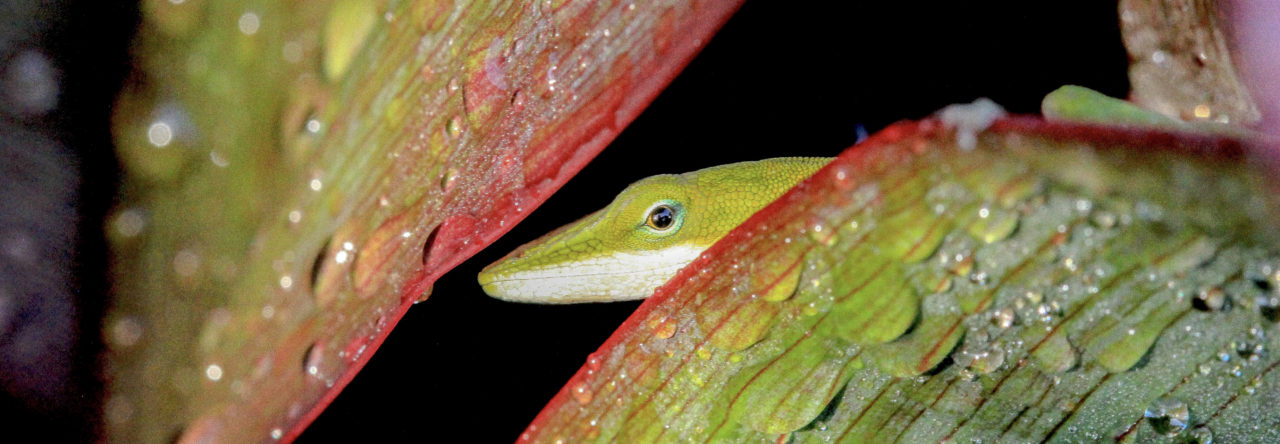
Photo by Bob Trivers
Bob Trivers is renowned as one of the most important theorists in the history of evolutionary biology. Less well known, however, is undoubtedly his most important work, on the mating behavior of Anolis lizards. Seriously, his 1976 Evolution paper showing size-assortative mating in the beautiful A. garmani of Jamaica was an important demonstration of sexual selection back in the days before its prevalence was widely appreciated, and his book chapter in the Ernest Williams festschrift on A. valencienni is also a classic*. (note: most of Trivers’ papers can be found on his website)
Bob is currently back in Jamaica and is keeping an eye on the green guanas, as they’re called. He reports:
“Here is the largest male on my property copulating for 34 minutes—impervious to my camera—with a long, slender—dare I say?—attractive female but here is the kicker, two hours earlier he had copulated with another female and so far as I can tell, he used his left hemipenis on the first and the right one on the second.”
Several days later, the same fellow was up to it again: “didn’t think i could get any closer to the monster male, did you? Watched the whole courtship from a distance of several trees and 20 yards; she stayed posing the whole time—beautiful sight—with her whole body off the substrate except the tip of her tail raised in a captivating arc; she never moved once as he traversed the distance dewlap-ing and head-bobbing—she head bobbing sometimes as well.”

Photo by Bob Trivers
Note that the big fella’ has switched sides again, using his left hemipenis this time.
And on the subject of hempenial switching, here’s a summary of what we know about that, from Lizards in an Evolutionary Tree (footnote 174, p.137):
Anoles (at least A. carolinensis and A. sagrei, the only species so studied) alternate the use of hemipenes. Each hemipenis is connected to its own testis. If prevented from using one hemipenis (by placing tape over one side of the cloaca), the male transfers significantly fewer sperm when it continually reuses the same hemipenis (Tokarz, 1988; Tokarz and Slowinski, 1990).”
* Hicks, R.A., and R.L. Trivers. 1983. The social behavior of Anolis valencienni. Pp. 570–595 in A.G.J. Rhodin and K. Miyata, Eds., Advances in Herpetology and Evolutionary Biology: Essays in Honor of Ernest E. Williams. Museum of Comparative Zoology, Harvard University: Cambridge, MA.