
Category: Notes from the Field Page 12 of 22

Field Work in Puerto Rico and a First Lizard Bite

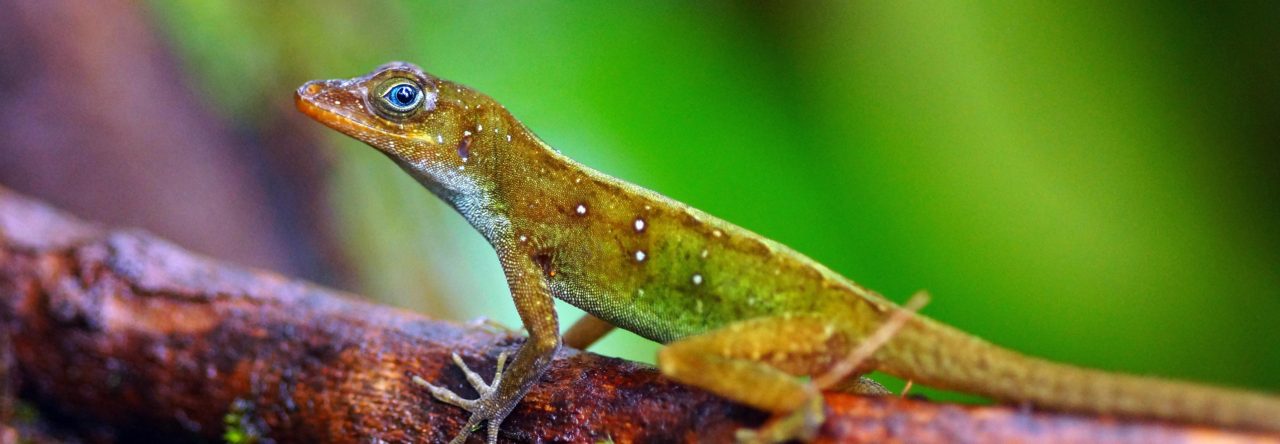
Anolis evermanni in Bosque San Patricio, San Juan.

I’m presently in the field in Puerto Rico working with my (first, brave) doctoral student, Kristin Winchell, along with two undergraduate assistants (Zack & Sofia). Although Kristin has been with me to Puerto Rico once previously (in January), this expedition is the first trip of Kristin’s doctoral research, which will focus on urban ecology and adaptation in anoles. In this trip she is collecting phenotypic, habitat use, and activity temperature (ambient and internal) data for Anolis cristatellus in urban and forested sites in the three major municipalities of Puerto Rico: San Juan, Mayagüez, and Ponce. For example, our forested field locality in San Juan is the diminutive but verdant state forest Bosque San Patricio. San Patricio is a small forest of no more than about 70 acres nestled well within the sprawling San Juan metropolitan area. In spite of this status as an island of green amidst concrete, at least three species of anoles can be found there (including Anolis evermanni, pictured above), along with Ameiva, the Puerto Rican racer (I found two), and (according to accounts) the endangered Puerto Rican boa.

My role in this expedition is mostly in a supporting capacity. In addition, I am visiting colleagues, scouting sites, looking for boas, and preparing for the tropical biology field course that I will be co-instructing with herpetologist Alberto Puente here in January. In fact, while Kristin & her crew finish up in San Juan, I have proceeded ahead to Mayagüez with my wife, Emily, and our two year old daughter, Cecilia, both of whom joined us on the island a couple of days ago. This leads me to the the second part of my post title. No doubt Zack & Sofia, who have never worked on anoles before, suffered their first anole bites (and perhaps inumerable additional bites) on this trip. It’s part of the job! However, it was to my considerable surprise when Cecilia suffered her first Anolis bite as well. Before you call Child & Family Services, this was a total accident, not some cruel rite of passage.

What happened was as follows.

Battle of the Diurnal, Arboreal Exotics in Florida (the Anole Loses)

Herpetological Review has yet to make its content available on-line, so this is a cell phone camera image of the figure from the Krysko et al. report. (The original image was also taken with a cell phone, making this perhaps the first cell phone photo of a cell phone photo to appear on Anole Annals.)

Krysko et al. report in the March 2012 issue of Herpetological Review on a new element of Florida’s food-web: one species of diurnal, arboreal, and non-indigenous lizard eating another species of diurnal, arboreal, and non-indigenous lizard.  Anole lovers will not be pleased to learn that this event involved a Madagascan day gecko (Phelsuma grandis) eating a bark anole (A. distichus) on Ramrod Key in Florida.  Krysko et al. note that this it he first report of a non-indigenous gecko consuming a non-indigenous anole.  This interaction ups the ante on the gecko/anole dynamics in Florida and Hawaii that have been reported previously here on Anole Annals and elsewhere.

Editor’s Update: Here’s a non-cell phone version of the same, courtesy of Ken Krysko.

Photo by Kenney Krysko

What Effect Did Hurricane Irene Have On Lizard Populations? We Now Know The Answer

Back to Abaco

Well, the 2012 Abaco Expedition is over. For almost a year, we’ve been wondering what effect Hurricane Irene had on our lizard populations. Now we know.

A little background: initially, we feared the worst. Hurricanes had destroyed several previous experiments. The culprit was not the high winds, but the high water, which put our tiny, lowlying islands underwater for up to six hours, drowning or sweeping away all lizardkind. But then word trickled in that this time, maybe things weren’t so bad. The storm had come at the best time possible–absolute low tide–and from a direction that minimized the amount of storm surge that could build up in the protected areas where most of our islands occurred. Maybe things weren’t so bad.

So, back we came to Abaco several weeks ago to find out. We have two experiments going on. The primary study focuses on the effect of anole-eating curly-tailed lizards. What effects do the curlies have on the population size and behavior of the brown anole, A. sagrei? And, in turn, how do these changes trickle down to lower levels of the food web? These studies occur on islands up to 300 square meters in area (that’s less than 1/2 the area enclosed by the bases in a baseball infield).

Seaweed in a bush, showing the high water mark of Hurricane Irene

The result of the hurricane: mixed. Several islands lie in a very exposed position, and their populations were decimated, to less than 10 individuals on both. In case there’s any doubt about the culprit for this crash, the dried seaweed strung high in the bushes is clear evidence of the highwater mark of the storm. On most other islands, those not so exposed to the storm’s onslaught, A. sagrei populations are higher, even those with the curly-tailed lizards. It seems that it was a overall a good year for lizards, except for those islands exposed to the hurricane’s wrath.

Our founder effect experiment occurred on seven tiny–and very low-lying–islands. These islands were wiped lizard-free by the last hurricanes to pass through the region, Frances and Jeanne in 2004. We re-inoculated the islands with brown anoles in 2005, placing one male and one female on each island. As I reported previously, the genetic and phenotypic mark of these founder events were still evident four years later.

Given past history and the diminutive size of the islands, we were not optimistic. But here, too, the results were mixed. Three islands were almost exterminated: down to two adults (and, encouragingly, one recent hatchling) on one island, and 4-5 on two others. But as with the bigger islands, the results here, too, were mixed, as one population increased from 25 to 49 and several others held steady with large populations.

These results lead to an interesting situation. All populations were established by a founding event, but now only several of them have experienced a subsequent population bottleneck. How will that effect patterns of divergence among the island populations? And let’s not forget that those who have postulated the importance of founder effects for species divergence and even speciation suggested that it was serial founder events/bottlenecks that were particularly likely to lead to important changes. Who knows? Maybe next year we’ll return to find a couple of newly evolved species.

On the Art of Noosing

Fast moving grass-bush anoles were good noosing practice.

Ten days into my first field work experience, and I’m loving it. I am in Puerto Rico with Travis Ingram, and we are studying the interactions between Anolis gundlachi and Anolis cristatellus, which requires us to catch lots of anoles. I had never noosed anoles before, but I figured I could get the hang of it pretty quickly. Little did I know the challenges and adventures that were in store…

Enclosing Anoles In Puerto Rico

I’ve recently arrived at El Verde Field Station in Puerto Rico for my first real field season working with anoles. My main goal is to carry out enclosure experiments looking at the different components (resource competition and predation) of the interactions between anole species. I’ll post more about the research later, but for now I want to give a rundown of the enclosures I’ll be using.

Into Every Life A Little Rain Must Fall: Worst Day In Bahamas Lizard Catching History

Into every life, a little rain must fall…but sometimes not enough. Our Bahamian brown anoles are delicate little flowers. Too cold and rainy, and they don’t come out. But too hot and dry, they also hunker down. Too windy–nap time. Like the three bears (or was it the little blonde girl?), it has to be just right.

And that put us in a bind. As our trip to the Bahamas wound down, we were running out of time, and as we got to our boat launch site, the weather didn’t look good.

Storm a-comin'

Waiting for the storm? Or Godot?

All we could do is wait for the storm to arrive. No point going out–it was too cold for the lizards to be active. And finally, the storm arrived, and we took cover in the only shelter available.

How Good Are Lizards At Detecting Motion?

Lizard Motion Detection Gizmo. Read all about it at http://chipojolab.blogspot.com/2012/05/motion-detection.html

We all know that anoles have a keen sense of vision. But how much does an insect have to move to draw a lizard’s attention? And do species vary in their sensory abilities? Dave Steinberg of Duke University is in Puerto Rico, trying to find out.

Update from Crooked Island

Nearly one week has passed since I entered the Bahamas in search of Anolis brunneus, the Crooked Island anole. Since then I have also been joined by Michele Johnson and two students to help study the behavior and ecology of this poorly known species. I am happy to report that the lizards are treating us well and copious amounts of data are being collected each day. There are several developments that I thought might be of interest to the readers of this blog.

First, the anoles are everywhere! We have surveyed the entirety of the island and have found lizards in almost every habitat: in the sea grapes, in the forest, along the beach, along the arid southern coast, and even in the Bahamian Pines. The only habitat seemingly void of these fine lizards are the mangroves and coastal sea grasses. Green and brown anoles on this island seem to readily share the habitat as we regularly see them in close proximity but rarely fighting for perch space. Compared to A. sagrei, A. brunneus is mild mannered and extremely easy to capture making it a real pleasure to work with.

More On Horned Agamids: Reports From Sri Lanka On Cerataphora

Ceratophora tennenttii from The Lizard Lab website

We’ve had a continuing series of posts on anole wannabees (most recent here), those lizards other than Anolis that sport dewlaps. Many of the best faux anoles are Asian agamid lizards. Some of these lizards are anole-like in other ways. For example, the fascinating Sri Lankan Ceratophora, though lacking a dewlap, parallels some anoles (well, two in particular), by sporting an appendage on its nose. Read more about these fascinating lizards at Martin Whiting’s Lizard Lab website.

Et tu, Brunneus?

Anolis brunneus male

Today marked the beginning of my search for Anolis brunneus, the Crooked Island anole. As I discussed in my last post, this species has several unique qualities including its relatively elongate face and permanently pale disposition. I am happy to report that this rarely observed species has been located in all its drab glory. Over the next ten days I hope to collect data on this species’ distribution, ecology, and behavior. I will kick these reports off with a brief background about the island.

Crooked Island is one of the “Out Islands” of the Bahamas, located in the far southeast corner of the island chain. The island is a mix of salt marshes, sea grape, mangrove, and scrub trees rarely reaching more than a few meters high. Despite this seemingly serene picture, the island has a history of failed agricultural efforts, the largest being cotton plantations around the turn of the 19th century which covered ~10% of the total land area. At the peak of the cotton boom the island maintained approximately 1200 inhabitants, primarily slaves, but this has dwindled to only 300 today and continues to fall. The island now appears as an odd mix of both 19th and 20th century ruins that range from abandoned plantation homes to hurricane battered wood frames, many of which have been overtaken by the forests. Except for a few hotels that cater to bonefishermen, the island has virtually no tourism. Crooked island is home to several other lizard species including abundant A. sagrei and Leiocephalus, but more on this in a later post.

I am optimistic that we will come away from this field trip with substantial new data on this species. The one trick, we need to find them! Because of their pale color I have found them extremely difficult to find and track in the trees. Stay tuned!


Page 12 of 22

Powered by WordPress & Theme by Anders Norén