
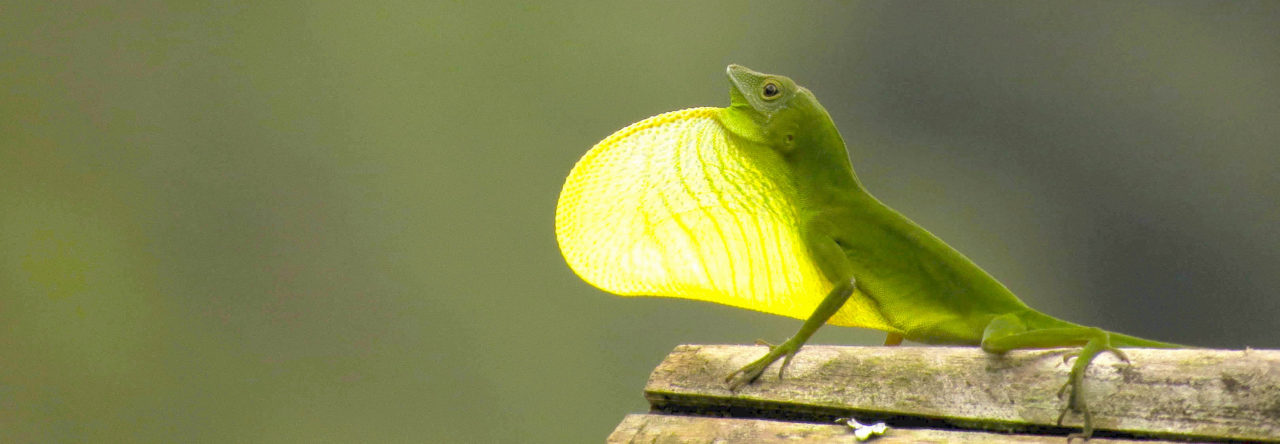

Anolis grahami aquarum (male)
As I do like reading about field trips or merely observations from vacations where anoles have been spotted, I thought I would share my observations made in Jamaica.
Following the disastrous effects of the Hurricane season in 2025, I’d like to raise some awareness for this beautiful island.
In Mach 2024 I was fortunate to travel to Port Antonio, Jamaica for a 7 day field trip with anoles being the main target.
I was accompanied by three friends who share the same enthusiasm for these lizards.
Our goal was to see all seven species described for Jamaica. The first species was soon off our check list as we had a small toilet break in the middle of our trip from the airport in Montego Bay to Port Antonio: Anolis sagrei was found at a gas station. This introduced species needs to introduction, but we were eager to find the remaining 6 species.
Our hotel was located in the hills above Port Antonio and is famous for watching birds so we thought it might be also good for watching anoles. The hotel can only host around 10 people and a larger garden is surrounding the bungalows. Old trees have been kept, most other plants were introduced and many flowering plants have been planted.

Part of the garden

Vegetation on the grounds of the hotel
Our initial plan was to explore the nearby area but we left the area of the hotel only once. We were able to walk the garden by day and night, which proved to be perfect for 5 of the 6 endemic anole species.
Here is a short summary for each species:
Anolis garmani
This crown giant was one of our main goals. We thought it might be difficult to spot them and finding a few individuals was not really considered to be realistic.
As it turned out, it was one of the most abundant species we found. In the mornings we found freshly hatched youngsters in the understory of the garden. Semi adult and adult individuals were found throughout the day on the larger trees in the garden. Throughout our week we spotted around 20 adults plus 20+ youngsters inside the hotel perimeter–we caught a number of them to confirm they weren’t the similarly colored A. grahami aquarum.

Anolis garmani juvenile
The area was certainly sustaining this quite larger population.
Although finding them during the day was easy, we never saw one sleeping.

Anolis garmani (male)
Anolis lineatopus ahenobarbus
During our stay in Jamaica we were only able to oberve one subspecies of Anolis lineatopus. In the garden of the hotel Anolis lineatopus ahenobarbus was the most abundant one – if you knew where to look.

Anolis lineatopus ahenobarbus
They were easy to spot during the night, especially the young ones sleeping on small leaves just above the ground.
The adults were most often observed during the morning hours and the afternoon – or in the heavily shaded parts of the garden. They hid in the underbrush during the hotter parts of the day.

Anolis lineatopus ahenobarbus
Anolis opalinus
Anolis opalinus was not rare in the area of the hotel, but it wasn’t as easy to produce on command like most other species. Males were found throughout the whole premises, mostly on larger trees with enough sunlight. Females, on the other hand, were quite rare and mostly found in small bushes. We never saw this species at night and no youngsters were found during the whole week.

Anolis opalinus (male)
While exploring the Blue Mountains, we encountered several Anolis opalinus which were significantly larger than the ones we saw in Port Antonio. The coloration also differed, some individuals showed more greenish colors. To my knowledge there are no subspecies of Anolis opalinus so this might be just something related to the altitude (? [editor’s note: see this previous post).

Anolis opalinus (Blue Mountains)
Anolis valencienni
Twig anoles are always a challenge during the day. But with Anolis valencienni we were confident to find some individuals as they are not considered rare in Jamaica.
We did succeed (by sheer luck) as two small females were found on the same tree two days apart. We suspected that this species “escaped” to the upper parts of the trees in this area because of the larger population of Anolis garmani – and the larger variety of birds.

Anolis valencienni
We did not spot more individuals despite having 8 eyes on every twig available!
Anolis grahami aquarum
The subspecies of Anolis grahami is the most striking one in coloration to me. I was happy to be able to observe several individuals on the tree right at our bungalow. We rarely saw this species more than a few meters away from the bungalows and hotel buildings. Watching two grown up males fighting over a female was one of the highlights of our trip.

Anolis grahami aquarum
Anolis reconditus
This enigma of an anole was more like a dream than a goal which could be accomplished. Although several individuals have been spotted throughout the years, it’s still something rare to find.
We hired a taxi to take us to the Blue Mountains via the road leading to Kingston eventually. Our driver did not ask many questions why the four of us wanted to stop every few miles just to stare at the vegetation, maybe take a picture and then hop in the car again to repeat this procedure for some hours.
On our way back again, passing by the famous Green Hills Field Station, we did one last stop at the road – and luckily I spotted a female just below the street. Several hundred pictures were made before it hopped away.

Anolis reconditus
As time was running out (we tried to avoid being on the street in a car in the dark) we headed back.

- The Anoles of (Eastern) Jamaica - July 30, 2026
Leave a Reply