Category: New Research Page 64 of 67

More microsatellite markers

Sequencing of the Anolis genome holds great promise for unlocking the genetic basis of anole phenotypic variation – such as dewlap coloration and limb length differences – and it also makes for a nifty way to discover new molecular markers, such as microsatellites.  Wordley et al. report in a recent article on mining A. carolinensis expressed sequence tags (ESTs) for repeats and then blasting the EST-derived sequences against the genome to obtain the genomic sequence and its location on assembled chromosomes.  From these sequences, they designed primers, tested them out in A. carolinensis, and, importantly, attempted to amplify them in multiple, phylogenetically diverse species.  They identified 8-25 new variable markers for apletophallus, carolinensis, distichus, porcatus, and sagrei, which can be added to the existing resources designed for carolinensis, cristatellus, distichus, luciae, roquet, oculatus, and sagrei, which also work for some related species.  Happy genotyping!

All About Sleeping Anoles

Anolis princeps sawing logs in Ecuador.

There have been a number of posts recently discussing various aspects of the sleeping biology of anoles (e.g., here, here, and here). Anoles spend 1/3 to 1/2 of their lives asleep, so it is not surprising that there is a small cottage industry of research papers describing where they sleep, in what position, and with whom. The most recent addition to this genre is a very nice paper on A. uniformis in Mexico, which reveals that this species is typical in sleeping on leaves with its body in line with the long axis of the leaf. The paper includes a brief, but thorough review of the literature on anole sleeping and thus is a good entrée to the literature.

A somewhat less brief review of the literature might go something like this

Visualizing Anole Convergence in Morphospace

Evolution of species in a two-dimensional morphospace. Axes are from a principal components analysis of morphology; symbols represent different ecomorph classes.

Over on the Phytools blog, anole biologist and comparative methods guru Liam Revell provides a program to visualize the evolution of traits in multivariate space, termed a “phylomorphospace.” This method plots species’ values and connects the points to portray their phylogenetic relationships. Most imporantly, the example he uses is none other than Greater Antillean anole ecomorphs, using a figure developed by Luke Mahler and pictured above. The diagram above illustrates convergence of the ecomorphs by showing that members of the same ecomorph class occur in the same parts of morphological space, even though many members of each ecomorph are not closely related to each other. Each large dot represents an extant ecomorph and the color indicates ecomorph class; small dots are internal nodes of the phylogeny. Admittedly, these spaghetti-grams can be hard to follow for large phylogenies, but they do give a sense of how traits have evolved and the extent to which convergence occurs.

Photo Caption Contest

We’ll all give a big hand to whomever provides the best caption for this photo. While you’re ruminating about something clever, notice that this adult male Anolis sagrei, collected from an introduced population in Taiwan and reported on here, is quite fat and sassy (or at least fat). Clearly, the extra appendage did it no harm. Who knows, maybe it even helped! Many anoles with three legs have been collected over the years (more examples always welcome). The existence of five-legged anoles means that it is now statistically possible to examine the relationship between limb number and sprint speed. Stay tuned.

Anoles Rule!

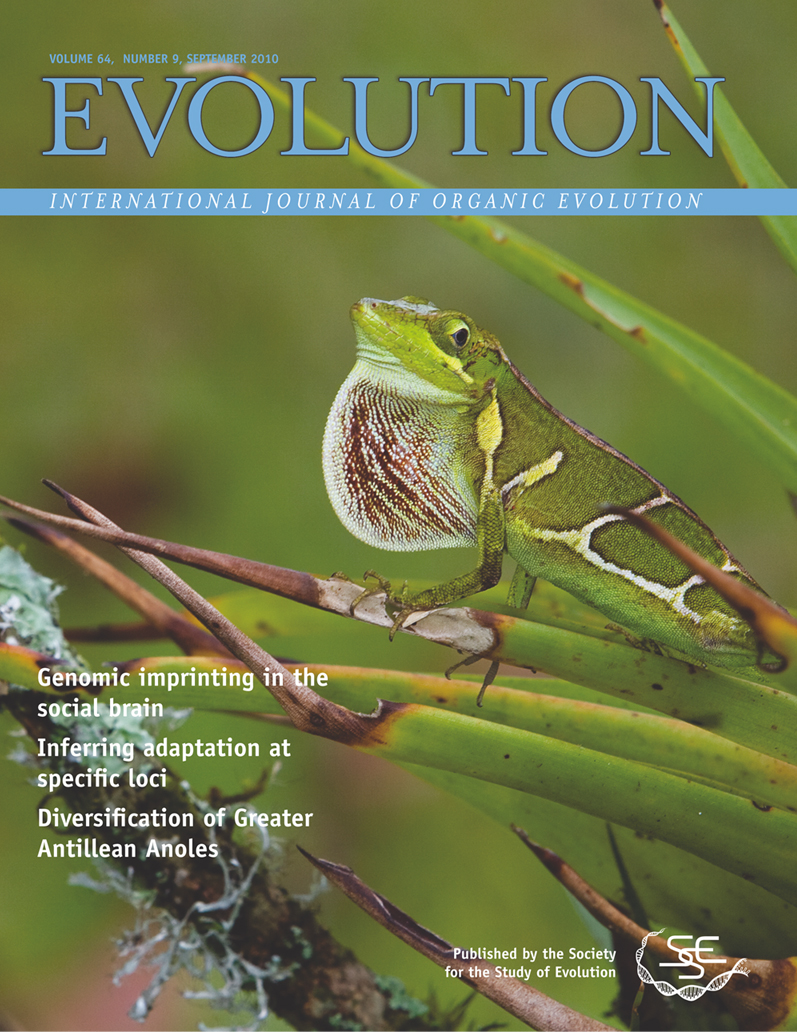
In an unprecedented display of organismal superiority, an anole graces the cover of a major scientific publication for the third time in six months (the others may be seen here and here [editor’s note: see comment]).  The photo advertises an article on environmental niche modelling and biogeographic boundaries in two Hispaniolan anole species, which will be the subject of a forthcoming post. Incidentally, not that anyone’s counting, this makes two cover shots for Richard Glor and one for Luke Mahler.

New Species of Anole Described Based on Differences in…Well, This Is A Family Website


Guess what these are

Anolis polylepis is a small and very abundant anole that occurs in southwestern Costa Rica. Recently, Köhler and colleagues divided A. polylepis into two species based on the structure of the hemipenis illustrated above. The vast majority of A. polylepis retains the name, but populations of the lizard on the Osa Peninsula, where the famous Corcovado National Park is located (and hence from where many people know A. polylepis) are now to be known as A. osa.

The species may be distinguished by their man parts.  Anolis polylepis, whose hemi-tallywacker is on the top row above, has a bilobed organ, whereas that of A. osa, on the bottom row, is unilobed.  What appears to be a narrow hybrid zone occurs at the base of the Osa Peninsula, where lizards exhibit an intermediate hemipenial morphology.  Köhler et al. examined a number of other morphological characters, including dewlap color, and found that in all other respects, the two taxa could not be distinguished.

Rapid Anole Adaptation to Human Habitat Disturbance

Anolis sagrei. Photo by Melissa Losos.

Anoles are renowned for their adaptation to different habitats. One particularly well-documented and ubiquitous axis of adaptation involves the length of the hindlimbs. Both among and within species, lizards that use broader surfaces have longer legs. The adaptive explanation for this correlation appears to revolve around a locomotion trade-off: on broad surfaces, longer limbs provide greater sprinting ability, whereas on narrow surfaces, shorter legs provide enhanced nimbleness. Anoles, and particularly A. sagrei, are also known for their ability to adapt rapidly to novel conditions (but see caveat below)—experimental populations introduced to different environments differentiate in hindlimb length in ten years.  For these reasons, anoles may be a particularly good organism to examine the extent to which human-caused habitat alterations lead to evolutionary change or, looked at another way, whether a species can adapt to changing conditions in a human-altered world.

In this vein, Erin Marnocha and colleagues studied populations of A. sagrei on four islands in the Bahamas. On each island, she compared two populations, one in natural, forested habitat, the other in disturbed habitats around houses. These habitats differ both because disturbed areas have fewer trees, but also because disturbed areas have more broad surfaces, such as big trees, walls, and fenceposts, as compared to natural forest, which has lots of narrow diameter vegetation. The prediction is straightforward: A. sagrei in disturbed areas should have relatively longer legs. And that is exactly what they found.

Monkey Business in Haiti

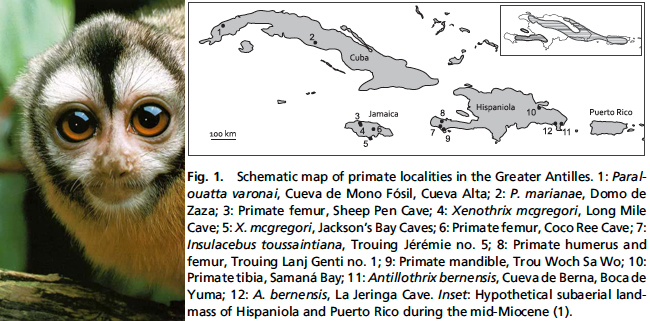
Owl monkeys in the genus Aotus may be the closest extant relatives of the Greater Antillean primate fauna. Fig. 1 is from Cooke et al.'s recent PNAS paper and summarizes known primate fossils from the Greater Antilles.

Imagine wandering around the Greater Antilles on an anole hunt with monkeys bouncing among the trees above.  As it turns out, your imagination wouldn’t need to take you back more than a few hundred years to make this vision a reality.  The Jamaican monkey (Xenothrix macgregori) – which was described in 1952 by Ernest Williams (a.k.a. the godfather of Anolis biology) and Karl Koopman (a.k.a. the namesake of the Haitian endemic Anolis koopmani) – may have even survived to see the first European explorers.

A recent PNAS article describes the fifth species of extinct monkey endemic to the Greater Antilles (two are from Cuba, two from Hispaniola, and one from Jamaica; see map above for more details).  A precise age for this fossil is unknown, but the available evidence is consistent with the Holocene.  In their description of Toussaint’s island monkey (Insulacebus toussaintiana), Cooke et al. contribute new data to the long-standing debate about the origins and evolutionary implications of the West Indian primate fauna.  Most students of Greater Antillean monkeys agree that they represented a relictual clade of primates that had long since disappeared from northern South America.  Although their precise phylogenetic affinities are still being debated,  the West Indian species seem to be most closely related to either the owl monkeys (Aotus) or the titi monkeys (Callicebus).  Cooke et al. further suggest that the large size of the Greater Antillean primates relative to mainland relatives may have resulted from the island effect.

Identifying Genes Involved in Anolis Dewlap Color and Pattern

Dewlap variation in Anolis apletophallus (formerly, A. limifrons). Photo courtesy Jessica Stapley.

Jessica Stapley writes:

I am a Marie Curie Postdoctoral fellow co-hosted by the University of Sheffield and the Smithsonian Tropical Research Institute (STRI) in Panama. I have just started a new project aimed at identifying loci underlying Anolis dewlap colour pattern.

Understanding the evolution and maintenance of phenotypic variation is a major goal in evolutionary biology. Addressing this goal ultimately requires linking molecular genetic variation to phenotypic variation, but identifying the genes responsible for important traits has been a major challenge in non-model organisms. Recent advances in DNA sequencing technology however, have revolutionized the development of genomic resources and paved the way for major advances in linking phenotype and genotype in non-model organisms.

Update on Anole Pests and How to Get Rid of Them

I’ve now read the book in which the Toda et al. paper (see previous post) is published. There are several other chapters that discuss the hypothesis that introduced A. carolinensis are responsible for the decline and even extinction of endemic insects on these islands. For example, one chapter notes that dragonflies have decreased greatly and that green anoles can eat two dragonflies a day. Also, note the green anole eating a cicada on the cover! There is also an article that suggests that green anoles may serve as pollinators.

Page 64 of 67

Powered by WordPress & Theme by Anders Norén