
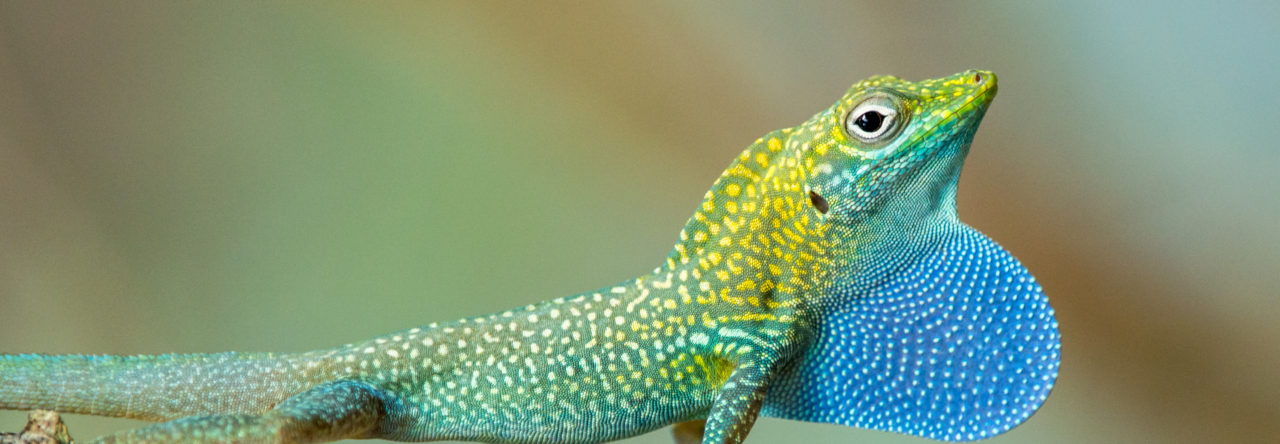
There are few topics more exciting than anole reproduction, but there’s still much we have to learn about the neuroendocrine mechanisms that allow these creatures to do the deed. We know that sex steroid hormones facilitate reproductive behaviors across a diversity of animals, and anoles are no exception. In particular, an enzyme called aromatase regulates both male and female sexual behaviors by synthesizing estradiol from testosterone. In a recent study using green anoles (Anolis carolinensis), Rachel Cohen and Juli Wade of Michigan State University examined whether lizard sex and season influenced the expression of aromatase in areas of the brain that are known to influence vertebrate reproductive behavior (the preoptic area (POA), the amygdala, and the ventromedial hypothalamus (VMH)).
Category: New Research Page 63 of 67
One day, years ago, I was collecting data on the behavior of the Jamaican twig anole, A. valencienni. As I was watching a female, to my surprise, she entered a hole in a tree trunk, and then emerged a little while later. To my amazement, I then saw another valencienni do the same thing! Overcome with curiosity, I approached the tree, peered into the hole, and spied to my astonishment a large number of what seemed to be anole eggs. I was not aware that communal nesting—in which multiple females lay their eggs in the same place—is known in a number of anole species, including A. angusticeps, A. bartschi, A. lucius and A. valencienni. The seminal work on the subject is still Rand’s 1967 Herpetologica paper.
A recent paper adds another species to the list of known communal nesters, the first from Central America of which I’m aware.
In the pantheon of anoles, Anolis maynardi has a special place as one of the funniest looking species around. To the casual observer it appears that someone has taken an A. carolinensis (to which A. maynardi is closely related), grabbed it by the tip of the snout, and pulled it forward. The purpose of this pincer-like proboscis, much more extreme in males than in females (which are smaller), is unknown. Indeed, until recently, just about everything about the species was unknown.
Anolis maynardi is endemic to the tiny island of Little Cayman. Remarkably, although visible in the distance, the nearby island of Cayman Brac does not harbor the species. At least naturally. In 1987, A. maynardi was reported at the Cayman Brac airport, most likely a beachhead resulting from a stowaway on an island-hopping airplane. Another survey in 1991 still found it only near the airport, and nothing further was known.
For about a decade now, several researchers have used remarkably realistic looking robotic lizards to study lizard behavior. A pioneer in this approach—especially with regard to studying anoles—is Terry Ord, now at the University of New South Wales. You can see videos of his robotic lizards, as well as clips of a variety of anole species displaying, on the Terry Ord Channel on YouTube (or read about his most recent work here). As you’ll see, these robots are very realistic, both in terms of appearance and motion pattern—they bob, pushup, and extend their dewlap just like a real anole. In fact, even when the rubber body of the lizard hasn’t been attached, the underlying struts move in a clearly anole-like fashion. Bottom line, at a distance, I think most humans would be fooled by a displaying robo-anole. And lizards seem to be fooled, too, because they clearly respond by displaying and approaching the robot—check out the videos and/or Ord’s papers. Or read the recent paper by Partan et al., which demonstrates that A. sagrei responds more to a robot giving the typical signature display than to one presening a different display occasionally given by a lizard in the population.
Just like audio playbacks which revolutionized the study of bird vocal communication, robotic lizards provide the opportunity to rigorously examine lizard behavior in a controlled and replicated manner. Many different questions could be examined, but one of particular interest concerns how anoles distinguish conspecifics from heterospecifics. By altering the display pattern—the timing and amplitude of headbobs, pushups, and dewlap extensions—and by altering the color and pattern of the dewlap, researchers have the ability to understand species-recognition. In turn, such an understanding may provide critical insight into how new species arise, because speciation is the result of changes that lead individuals to no longer recognize each other as conspecifics.
As the last 40 years of research attests, anoles present a great study system to investigate questions in evolutionary ecology, especially at the macroevolutionary, cross-species level. Indeed, the rich literature on a large variety of topics including sexual dimorphism, ecomorphology, size evolution, biomechanics and many other topics—reviewed in Lizards in an Evolutionary Tree—has made anoles a veritable model system for evolutionary study.
One area that has received surprisingly little attention is behavioral ecology. Anole behavior is remarkably easy to study in the field, at least for many species. And interesting patterns of divergence in behavior (e.g., territory, mating systems, foraging mode) among closely related species, combined with convergence at a deeper phylogenetic level, make anoles an attractive group for such studies.
Anoles are renowned for their displays in which they do pushups, bob their heads up and down, and unfurl their colorful dewlaps. Indeed, the internet is awash with videos of such behavior (here’s a good one of A. sagrei including some cool “slo-mo”; here’s a vicious fight with audience commentary; and for the pacifists out there, here’s a solitary brown anole displaying).
But what’s all the displaying about? And, more specifically, is there any significance to how much a particular male displays?
Many species of anoles exhibit sexual dimorphism in back patterning, often with the male being relatively uniform and the female festooned with stripes, diamonds, speckles or other geometries (in a few cases, the situation is reversed and the males are the dandies). Surprisingly, there are no reviews documenting the extent of this phenomenon, much less comparative studies explaining its significance (adaptive or otherwise).
Perhaps even more interesting, in some species females exhibit multiple pattern phenotypes within a single population. Most study to date has focused on A. sagrei in the Bahamas. The seminal paper on this topic was Schoener and Schoener’s 1976 study in Evolution, which suggested that pattern variation was related to crypsis, with different patterns being more cryptic in different parts of the structural habitat (e.g., stripes are cryptic on narrow branches). In support of this hypothesis, the Schoeners showed that within a locality, females with different patterns occurred in different parts of the habitat, and among sites, the relative frequency of the types varied in relation to inter-site variation in vegetation.
Everyone’s favorite anole, A. proboscis, is featured in an article in the most recent issue of Lacerta. The article is chockful of beautiful pictures, such as the one above, but does have one shortcoming, at least for most of AA’s readers: it’s in Dutch! However, thanks to Harvard undergrad Jelle Zijlstra, we can provide a translation of at least part of the text.
Jelle writes:

The Puerto Rican grass-bush anole, A. pulchellus, displaying. Recent research indicates that this and some other, but not all, anole species time their displays to occur when the wind isn't blowing. Photo @ Rich Glor.
Successful communication requires that a message be detected by the intended receiver. One trick animals have when they communicate is to use signals that stand out against the background, so that they are more easily detected, such as waving light colored structures against a dark background, or making high-pitched calls when surrounded by low-pitched sounds. But what happens when the background isn’t constant? Just as we tend to talk when conversation partners are quiet, animals would be expected to signal at those times when their signals contrast to the greatest extent with the background and thus are most detectable. Reasonable as this hypothesis is, it has only been tested once, in a study which showed that lab monkeys vocalized in silent periods between bursts of machine generated white noise.
Anoles signal primarily in two ways, by moving their head and body up-and-down and by extending their dewlaps. With regard to the former, research has shown that headbobs are effective at catching the attention of other lizards because the rapid and jerky movements contrast strongly with motion in the background. However, this is only true when, in fact, the background—that is, the vegetation and other stuff behind the lizard—isn’t moving very much. When the wind is blowing and leaves and branches are swaying back and forth, headbobs should be more difficult to detect. Consequently, on a windy day, a savvy anole should time its headbobs to occur when the wind is not blowing.
And that’s just what they do—at least some of them.

Anolis chlorocyanus (photo @ Rich Glor). Anolis chlorocyanus occurs north of Mertens' Line, A. coelestinus to the south. Map on right (from Glor and Warren, 2011) illustrates that suitable conditions for both species occur in the range of the other species (the warmer the color, the more suitable the area).
Many sets of closely related species exhibit a geographic distribution in which species only come into contact at their range border, with one species replacing another across the geographic landscape. Such a “parapatric” distribution could be explained in many ways, such as:
1. The species are adapted to different environments, and their distributions reflect geographic differences in environmental conditions;
2. The environment does not change geographically, but the species are so ecologically similar that neither is able to displace the other from its current range;
3. The species are not reproductively isolated; when they come into contact, they interbreed, thus preventing coexistence;
4. The species are newly-arisen, and have not yet expanded their ranges into sympatry, or one species has not yet displaced the other completely.
A case in point are the large green anoles of Hispaniola, Anolis chlorocyanus and A. coelestinus. Except for their dewlap, these two trunk-crown species are nearly identical in morphology, and they also occupy similar structural habitats. Yet, A. coelestinus occurs only in the southern peninsula, whereas A. chlorocyanus occurs throughout the rest of the island.


