
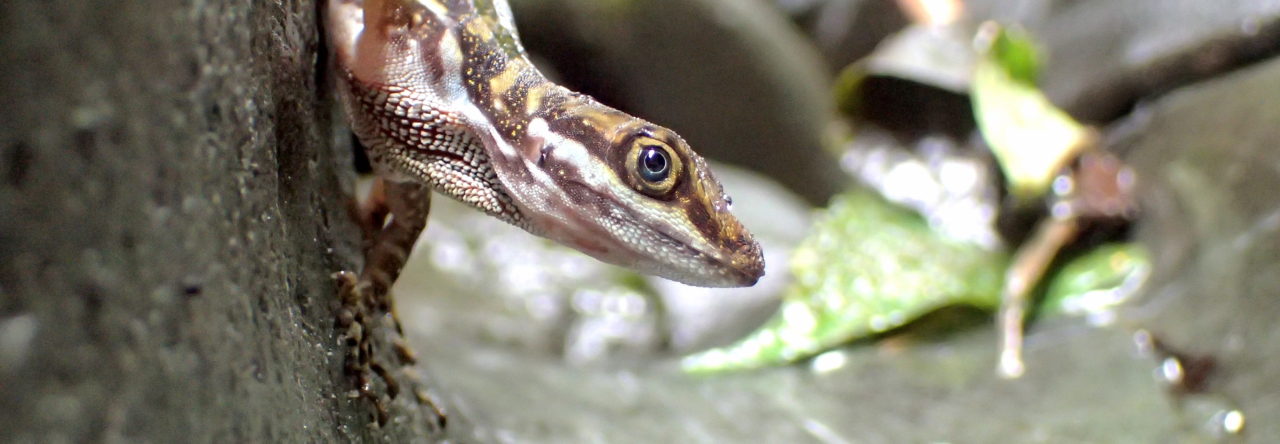
 This image is bouncing around the internet, and I can’t find any information on its origin, but it looks like an anole to me. Valiant last ditch effort, but I think we all know the outcome.
Category: Natural History Observations Page 28 of 34
 A few weeks back, we
 Need a dose of live lizard action? Why not check out the long-running series, Anole Alley, on lizardvideos.com? Now in its fourth season, with an all-star cast of green anoles (maybe browns, too–I haven’t watched all that many of them).
Episode 39, part 2, big game hunting, is linked above. It features a large male green anole snagging a dragonfly–well done! Other episodes show other anole hi-jinx and escapades. Store this one to put some sunshine into a cold, wintry day.

Blunt-headed treesnake eating an Anolis petersi.Photo by Elí García-Padilla from the March issue of Herp. Review.
The blunt-headed treesnake, Imantodes cenchoa, is renowned for its anolivory, but being a pencil thin snake, one might have thought that its carnage would be limited to the smaller members of anole nation. Not so, as two Natural History Notes in the March, 2011 issue of Herpetological Review report. García-Padilla and Luna-Alcántara report a treesnake eating a large A. petersi in the Los Tuxtlas region of Mexico (photo above), and Ray et al. provide the details of a 56 gram I. cenchoa that was found with a 19 gram A. frenatus and a 1.3. gram anole egg in its stomach. Justice was served in the latter case, as the snake died soon after capture, and an autopsy revealed a perforated stomach, attributed to the anole’s claw, presumably during post-ingestion attempts by the anole to pull a Gordon and escape.
New minor color variants appear every once in a while, but it’s always interesting to find something completely different. This, to the best of my knowledge, is something completely different. I’ve found a few of these guys running around, and most had very similar colors. Considering their size (and presumptive age) I wonder if they were from the same clutch, or if a single breeding pair yielded this Punnett square anomaly.

I think the concept of cryptic coloration isn't on his mind.
Both of the males I had time to annoy/photograph (and the one female that was slightly less photogenic) exhibited the usual traits of A. sagrei. From the heavier build and shorter snouts, as well as the bolder attitude than our native carolinensis (I think the dewlap display was more for me than anything else; even when I was three feet away with a rather bulky camera, both males stood their ground), they would definitely fit the profile. But they’re not structurally an exact match to sagrei’s either. I don’t have a great head-on shot, but they’re narrower. Considering the insect population in the area I can’t say it’s from undernourishment. They move and jump more like carolinensis as well. They just don’t seem to be a differently-colored sagrei. Maybe there’s a little A. cristatellus in there.

So what exactly is our bold little friend here?
I’m not the first one here to wonder what hybridization would yield and what cool little recessive traits could come from it, but I haven’t seen nearly enough specimens to suggest it’s a morph that may stick around- whatever it’s source.

Baby Anolis distichus playing dead. See comment by Hispanioland.
John Phillips and Kirsten Nicholson report in Herpetological Review (42:426-427) observations on A. laeviventris and A. cupreus. To wit: “Upon capture, the individuals struggled to escape the grasp of one of the authors (JGP), and then suddenly went limp without further pressure being applied. In this state, both individuals exhibited the same body position: jaw wide open, dewlap extended, hind legs out, forelegs bent in over the venter….but when the grip was loosened, the individuals immediately sprung to life and escaped.”
The authors note that similar behavior has been recorded in several other species. Any one else seen this? Is it a widespread, but under-reported, natural behavior of anoles?

Here's a photo of a Carolina Wren that's caught a brown anole. But this story is something different. Photo from http://www.flickr.com/photos/24073599@N05/4545405419/
Brian Langerhans, he of mosquitofish fame (but with some anole credentials, such as here and here), writes from Raleigh, NC:
A strange interaction was observed this morning and I’m wondering if you know what’s going on. There are a number of A. carolinensis that live around our house, and today something weird happened. It’s a pretty cool morning, but a big male was on a ledge on our porch. Two Carolina wrens flew over to the anole, the anole sat still while one pecked on it’s body and tail, and then extended it’s dewlap and opened it’s mouth for a while (but was otherwise still) as the other wren pecked around and in it’s mouth. Do you know what might have been happening here? You’d think the birds were harrassing the anole (and maybe it’s too cold for the lizard to fight back), but it didn’t seem like it. There’s no way they could have been cleaning it (like removing mites), right? Any thoughts?
 This sad photo comes to us courtesy of arachnologist extraordinaire Sarah Crews, who snapped the unfortunate little lizard (or fortunate spider, depending on your perspective) in Parque del Este in the Dominican Republic. The offending spider is a member of the genus Lactrodectus, the black widows. What a way to go.
Such spider on anole predation is far from unknown. I myself have observed a baby anole dangling in a spider web in a limestone pothole in the Bahamas, and there are a smattering of reports in the literature, including an A. carolinensis taken by a wolf spider, an A. chrysolepis ensnared by a whip spider, and an A. limifrons overpowered by a jumping spider (photo below). Indeed, I vaguely recall a fine example of scientific entrepreneurship, when a spider guy and a lizard guy teamed up to produce two papers from one such observation, publishing in a herp journal a paper with the theme “anole eaten by spider” and an arachnological journal entry with the tag line “spider eats anole.” Now, that’s maximizing research output! Alas, I could not put my finger on the publications. Anyone remember those?

Photo by Harry Greene, from Lizards in an Evolutionary Tree.

My first thawed hatchling, Mr. Freeze, moments after emerging with the desire to rule the world (as soon as he got a little extra warmth from my finger)
Two weeks ago our building decided to test its emergency power generators. They assured us there should be no problems (never the case) and that electronics plugged into emergency wall sockets shouldn’t have a disruption in power while others might experience small outages that evening.
We assumed our incubator was in the emergency socket and had little concern to think that any disruption to power would cause problems. Needless to say, that was not the case. There was a surge when the power came on and according to the repair tech it fried 2 boards… however when power was restored instead of returning to its preset temp, room temp, or even remaining off, it decided to turn on and drop the temp to freezing (or below) (we are unsure of the exact temp as the display board was one of the 2 that fried). Everything inside was covered in frost and ice including the few remaining eggs I decided to spare from embryo extractions and allow to hatch for breeding next year.
 Even Neil Losin’s cellphone photos turn out spectacular!